


























This article was first published on Deythere.
Whale positioning has pushed WLFI into focus. One newly created wallet withdrew 25,000,000 WLFI from an exchange. Another whale added $500,000 in USDC to extend a 42.47 million WLFI leveraged long, despite holding more than $1,000,000 in unrealized losses. That is conviction, not speculation.
Whale withdrawals and the supply story
WLFI price analysis begins with supply plumbing. Coins on exchanges are liquid, while coins moved off exchanges can reduce immediate sell pressure. It does not guarantee a rally, but it can thin liquidity so price reacts faster when demand arrives.
A range with clear lines in the sand
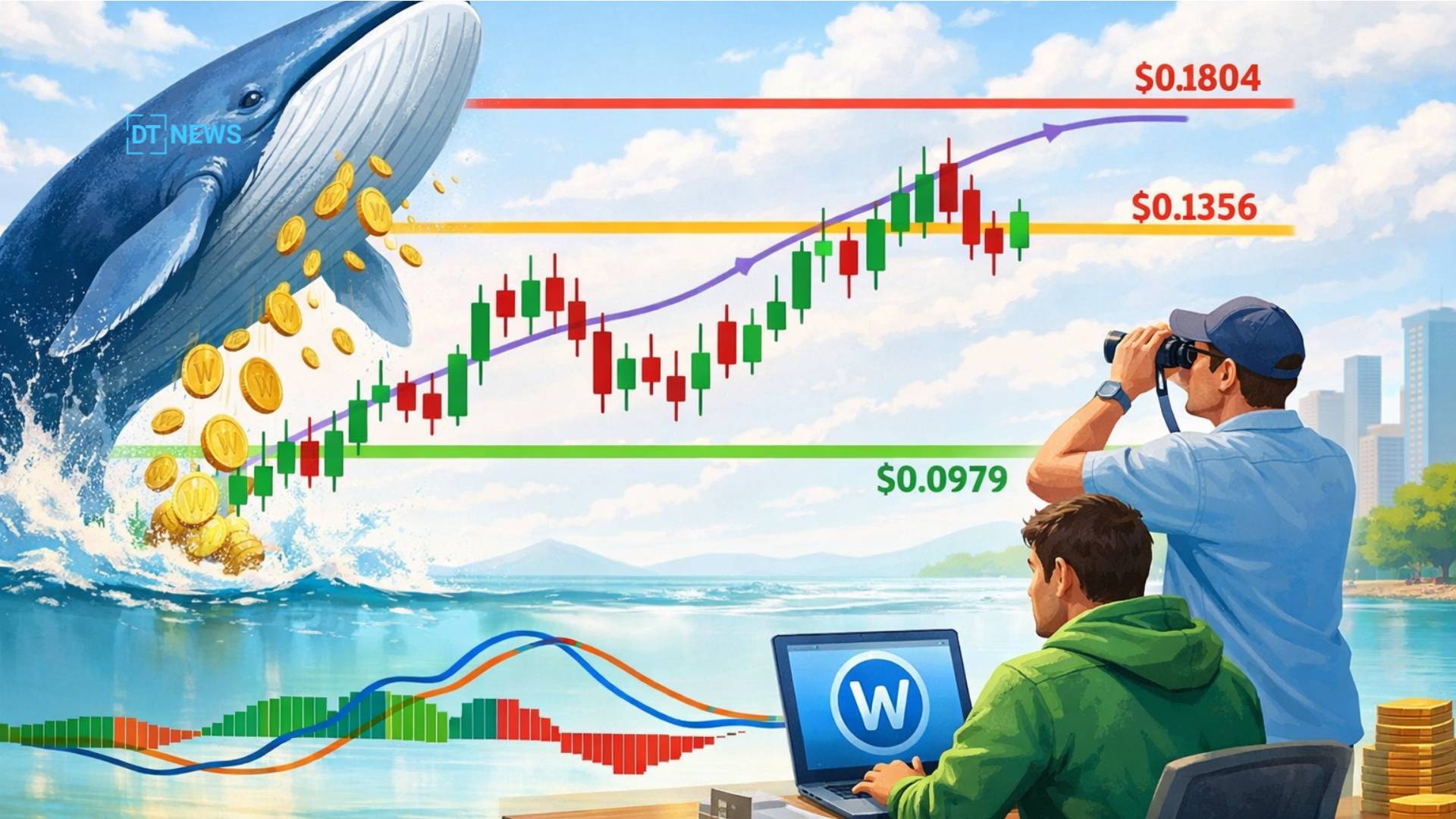
WLFI price analysis also has to respect the range. After falling from roughly $0.25, WLFI has been consolidating between a demand band near $0.0979 and a supply zone around $0.1804. In the middle, $0.1356 has acted as the pivot. Buyers have formed higher lows near demand, while sellers defend the upper zone. Volatility has compressed, and that is why whale activity feels heavier than usual.
Momentum signals and what MACD is saying
For indicator readers, WLFI price analysis is showing an early momentum shift on MACD. The histogram flipped positive near 0.0016, and the MACD line has been rising toward the signal line. That often appears when downside momentum fades, but confirmation still usually comes from price expanding above $0.1356.
WLFI price analysis: Leverage builds inside the range
The bigger risk factor is leverage. Reported derivatives volume surged 107.53% to about $596.30 million, while open interest climbed 42.10% to around $252.82 million. Fresh leveraged positions are building even though spot price remains boxed in. When leverage leads and price lags, breakouts can be sharp, and failures can be harsher.
WLFI price analysis treats support and resistance as crowd behavior, not magic. Support is where buyers defend value, resistance is where sellers tend to take control. Rising open interest during consolidation signals commitment, but it also stacks liquidation risk above and below price.
Liquidations show the stress points
Liquidations offer a clue about who has been leaning wrong. Recent data showed roughly $593.93K in short liquidations versus about $60.6K in long liquidations. Shorts have taken more pain near the lower area, suggesting sellers are being squeezed when demand holds. Resistance still gives bears a place to re-enter, which is why WLFI price analysis keeps circling the same levels.
What matters next
The roadmap is simple. A sustained reclaim of $0.1356 would reopen a fresh test of $0.1804, especially if exchange balances keep tightening and spot buying shows up without excessive leverage. Rejection near the pivot keeps the range intact and raises the odds of another test of $0.0979. Leverage can turn a normal move into a liquidation cascade.
Conclusion
WLFI price analysis is where conviction meets structure. Whale withdrawals and a stubborn long suggest accumulation, while surging derivatives activity adds fragility. WLFI price analysis remains range-first until price proves itself above $0.1356.
FAQs
In WLFI price analysis, what does an exchange withdrawal imply?
It can reduce near-term sell pressure.
Why is $0.1356 central?
It is the mid-range barrier that must flip to support.
What does rising open interest indicate?
It shows more leveraged positions are opening.
Is MACD a bottom signal by itself?
It is a hint that still needs price confirmation.
Glossary of key terms
Demand zone: an area where buyers historically step in.
Supply zone: an area where sellers push back.
Open interest: the value of outstanding derivatives positions.
Liquidation: forced closure of leveraged trades.
MACD: a momentum indicator built from moving averages.
Disclaimer: This content is informational only and is not investment advice. Crypto assets are volatile, and all decisions should be based on independent research and risk tolerance.