

This article was first published on Deythere.
- The 2017 Position and Today’s Reversal
- Why did Buterin’s View Change: Technology and Reality
- What Is Different With Ethereum’s Architecture
- The ‘Mountain Cabin’ Idea: Not a Lifestyle, but a Safety Net
- Conclusion
- Glossary
- Frequently Asked Questions About Ethereum Design
- What does the Ethereum design shift mean?
- Why did Buterin change his mind from his 2017 argument?
- What does a “mountain cabin” mean here?
- How exactly do zero-knowledge proofs benefit Ethereum?
- Does this development affect average users of Ethereum today?
- References
Ethereum co-founder Vitalik Buterin has publicly admitted that he now considers his biggest design regret since 2017. Buterin reversed his long-held stance regarding user verification of the Ethereum blockchain..
His updated stance included technologies such as zero-knowledge proofs (ZK-SNARKs) and light clients, in order to allow self-verification to be practical and mandatory for the longer-term decentralization of the protocol and security.
The 2017 Position and Today’s Reversal
Way back in 2017, Buterin famously called the concept of average users fully verifying Ethereum’s history a “weird mountain man fantasy,” meaning that it would be impractical due to the computational burden of re-executing every single transaction.
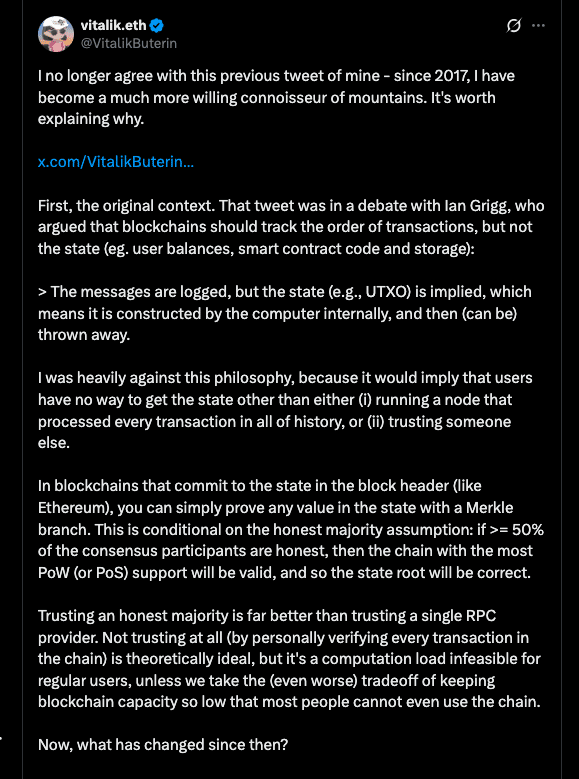
At that time, Ethereum’s design bound the entire state (balances, contracts, and storage) to every block header with Merkle-style proofs, letting users check certain values without having to replay history as long as they trusted consensus under an honest majority assumption.
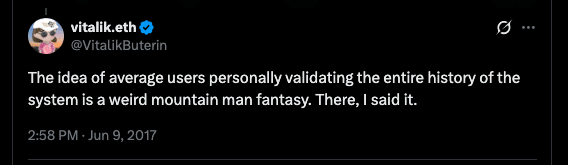
Fast forward to 2026, and Buterin has recanted that 2017 vision. He wrote on social platform X:
“I no longer agree with this previous tweet of mine… since 2017, I have become a much more willing connoisseur of mountains.”
He explained that while daily life inside the full verification mountain cabin isn’t required, maintaining it as a backup is part of supporting Ethereum.
Why did Buterin’s View Change: Technology and Reality
Two factors primarily drove this architectural change in Ethereum: improving cryptography and real-world fragility.
From the technology side, zero-knowledge proofs like ZK-SNARKs can now be used to prove correctness of a blockchain without having to replay each and every transaction, something that was believed impractical in the past.
These are proofs that one can efficiently verify, yet allow a complex computation to be easily and efficiently proven correct, thus achieving security at a much reduced computational expense.
Buterin compared the discovery to finding a “pill that cures all diseases” with regard to blockchain verification, still verifiable, but not at exorbitant cost.
The other aspect was practical fragility. Buterin cited potential failure modes in the real world such as inefficient peer-to-peer networking, long-lived services that shut down, validator centralization and informal governance pressure.
In these cases, giving users no options other than to trust intermediaries or centralized services could corner users into trusting a single source of truth.
He points to censorship problems Tornado Cash has run into as evidence that intermediaries can become a bottleneck for access and why the team is implementing designs where users get to interface directly with the chain when it makes sense.
What Is Different With Ethereum’s Architecture
The architecture of Ethereum is being actively improved to cater to this new focus on verification while remaining efficient. A big focus of growth is going to be around ZK-light clients and proof systems that lessen the computational cost of verification for everyday users.
Light client setups now rely on compact proofs and synchronized validator committees so devices can sync without having to store or process every transaction themselves.
For instance, Ethereum’s current Ev2 light-client model utilizes a rotating sync committee of 512 validators to generate the attestation data required for syncing, thus reducing local storage and bandwidth requirements.
There are also efforts to make statelessness easier, to lower the amount of state data that validators and nodes need to store. While full stateless clients are still an area of research, tools like Verkle trees hope to compress down proofs to make verification more practical without having to store massive amounts of state.
This development is consistent with a transition where verification is prioritized while storage and compute costs decrease.
Execution clients have already added partial history support expiry to delete hundreds of gigabytes of historical blockchain data and make running nodes easier on consumer hardware.
However, these changes do point to the compromise Ethereum faces: As storage and computational costs shift outward, decentralized verification becomes more reliant on trusted data retrieval and proof checks.
The ‘Mountain Cabin’ Idea: Not a Lifestyle, but a Safety Net
Buterin uses the “mountain cabin” analogy to describe the safe haven option he wants to protect. He adds that for the most part, even casual users won’t need to “live in the cabin” by cross-checking every detail of each blockchain on their own.
But it is important to keep available, meaning that no single middleman or service can have complete control over how users access Ethereum.
With this fallback as a backup, Ethereum can be used even if its conventional usage tends towards intermediaries; this pushes further decentralization and resilience.
According to Buterin, the fact that self-verification is a viable choice serves as a limitation on the centralization of control over protocol operation.
This simply recognizes that verification should follow architecture (rather than being stuck in assumptions made in 2017), and acknowledges that network failure modes and realistic censorship at the edges of the global Internet cannot be neglected when designing a truly decentralized system.
Conclusion
The Ethereum design shift by Vitalik Buterin’s 2026 U-turn is one of those rare, yet important switches in a protocol’s long term philosophy.
Through the adoption of technologies such as zero-knowledge proofs, and a push for improved user-friendly self-verification paths, Ethereum is saying that decentralization is not just architectural dogma, it’s an operational necessity for security, censorship resistance, and trust minimization.
Whether this new approach makes Ethereum more resilient in the face of the real world is yet to be proved out, but it clearly sets a new vector for how the network balances efficiency vs. usability vs. decentralization.
Glossary
Ethereum design reversal: the change of Ethereum’s architecture and philosophy regarding user self-vetting and decentralization, as demonstrated by Vitalik Buterin taking back his 2017 stance.
Zero-knowledge proofs (ZK-SNARKs): cryptographic devices that enable parties to personally validate the correctness of a computation that was performed on their data without revealing any information about said data, and without having to perform that computation themselves in total.
Light client: This kind of client can verify blockchain status by using short proofs and limited datasets, so verification is available on the low performance device.
Statelessness: in blockchain is defined as an approach where nodes do not need to hold the entire state of the chain, relying instead on proofs to verify transaction validity.
Verifier Committee: describes a rotating list of validators some light client schemes use to attest to and support each other’s data.
Frequently Asked Questions About Ethereum Design
What does the Ethereum design shift mean?
Vitalik Buterin has changed his view on relations of trust internally so that they prioritize self-verification via cryptographic proofs, accessible verification methods, and reducing intermediaries.
Why did Buterin change his mind from his 2017 argument?
Progress in zero-knowledge proofs and a realization of the real-world fragility of system fragilities like data outages, censorship pressure, made full or partial self-verification more practical and necessary.
What does a “mountain cabin” mean here?
It is Buterin’s metaphor for a secure fallback verification process that users can turn to when intermediaries fail, not a typical workflow but rather a safety net.
How exactly do zero-knowledge proofs benefit Ethereum?
They enable users to validate the blockchain without re-executing all transactions, delegating trust in third-party data providers.
Does this development affect average users of Ethereum today?
Not anytime soon; it’s a long-term design priority. New tools, such as light clients and ZK proof systems, are being developed that will improve the user verification level.