
This article was first published on Deythere.
- What is driving the Solana derivatives surge?
- Why is retail interest not following the Solana derivatives surge?
- How is the RWA ecosystem influencing Solana trading?
- What do market indicators reveal about current conditions?
- What should traders watch for next?
- Conclusion
- Glossary
- Frequently Asked Questions About Solana Derivatives Surge
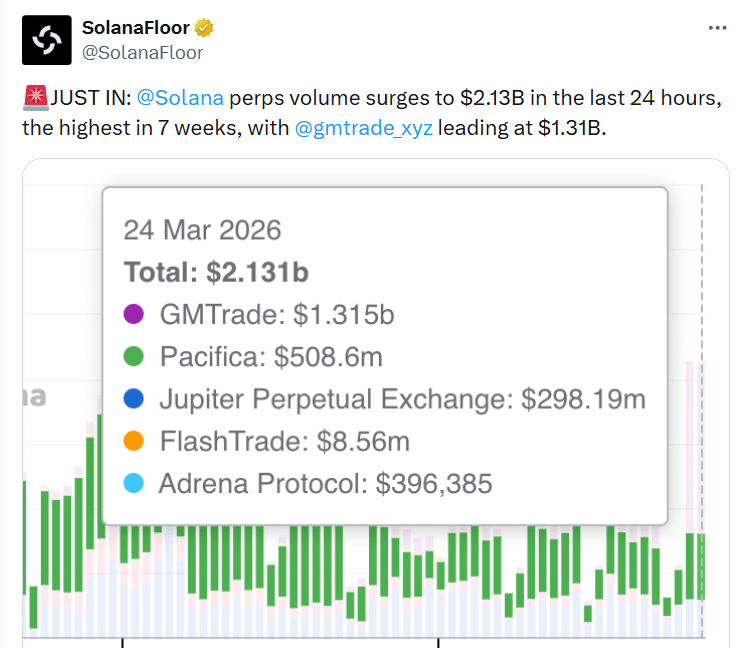
Solana derivatives surge has reached a seven-week high, with $2.13 billion in perpetual futures volume recorded over the period. GM Trade alone contributed $1.31 billion of this total, making up more than 60% of the overall trading activity.
Analysts explain that such a strong concentration of volume on a single platform often reflects expectations of short-term price volatility, even though retail participation remains limited. The trend clearly points to large institutional players driving the activity, while spot markets continue to show little connection to this momentum.
What is driving the Solana derivatives surge?
Solana derivatives’ surge is being driven by traders taking larger leveraged positions rather than broad participation across the market. Data shared in a post by SolanaFloor on X highlighted that total volume reached $2.13 billion, with GM Trade alone contributing $1.31 billion, accounting for over 60% of the activity.

Market observers note that when such a large share of trading is concentrated in derivatives. It often signals expectations of short-term price movement. However the lack of similar strength in spot volumes suggests this move is more calculated than widely supported.
Why is retail interest not following the Solana derivatives surge?
In the spot markets there are “only crickets in spot markets,” as retail participation has stayed largely neutral over the period. Trading frequency has continued to remain flat, and prices are still moving within the $90 to $100 range without any strong push in either direction.
Indicators further show little to no meaningful transition into the “many retail” or “too many retail” zones, highlighting a lack of strong interest from smaller investors. Analysts suggest that retail traders are choosing to stay cautious and are likely waiting for clearer confirmation from spot market activity before entering positions.
How is the RWA ecosystem influencing Solana trading?
Solana’s RWA ecosystem has grown by nearly 64%. Taking the total value of tokenized assets to $1.8 billion. At the same time active DeFi TVL has reached a record $465 million. This appears to be pulling liquidity away from traditional spot markets.
Analysts point out that this steady expansion is likely redirecting capital into DeFi platforms and tokenized assets instead of retail-driven spot trading. This trend reflects a broader market phase where institutional positioning and derivatives activity are playing a more dominant role.
What do market indicators reveal about current conditions?
Spot volume heatmaps have consistently reflected “cooling” conditions throughout the past week with no visible clusters pointing to any form of heating or overheating in the market, even as Solana trades near $92.76. This pattern makes it clear that the Solana derivatives surge is not being supported by strong or aggressive buying activity in the spot segment.
Analysts explain that without this kind of spot accumulation the current momentum may struggle to sustain itself over time. As a result, meaningful expansion in spot volumes is likely to be essential for any steady and lasting price movement.
What should traders watch for next?
Market watchers are now looking at retail participation and spot volume movement to understand where the market may head next. Right now, most of the activity is still coming from derivatives, while the spot side remains quiet without any strong pickup.

This gap shows that leveraged trades are continuing to lead overall market behaviour. A clear improvement in spot participation will be important to support stronger and more stable price movement going forward.
Conclusion
Solana derivatives surge demonstrates market phase led by leveraged trading, with $2.13 billion in perpetual futures volume and GM Trade accounting for more than 60%. Retail interest remains muted with trading frequency flat at $90-$100 and indicators showing minimal transition into active zones.
At the same time growth in Solana’s RWA and DeFi sectors seems to be pulling liquidity away from spot markets. This suggests that a meaningful rise in spot trading volumes will be important for achieving sustained momentum and wider market participation.
Glossary
Solana Derivatives Surge: Rapid rise in leveraged trading activity on Solana
Perpetual Futures: No-expiry contracts enabling continuous leveraged trading
Trading Volume: Total value of trades within a set timeframe
Leverage: Use of borrowed funds to amplify trading positions
Spot Market: Direct buying and selling of assets for immediate settlement
Frequently Asked Questions About Solana Derivatives Surge
How high did Solana derivatives volume reach?
Solana derivatives volume reached about $2.13 billion in the last 24 hours.
Why is derivatives trading increasing on Solana?
Derivatives trading is increasing as traders are taking larger leveraged positions to profit from price moves.
What role did GM Trade play in this surge?
GM Trade contributed around $1.31 billion. Which is more than 60% of the total volume.
How is the RWA ecosystem affecting Solana?
The RWA ecosystem is growing and attracting capital. Which may reduce activity in spot markets.
What is happening in Solana’s spot market?
The spot market is quiet with low trading activity and no strong buying or selling pressure.