
This article was first published on Deythere.
- Cardano CME Futures Launches Expanding Crypto Lineup
- Reaction: ADA Price Falls Instead of Moving Up
- Derivatives Activity and Market Behavior
- Conclusion
- Glossary
- Frequently Asked Questions About Cardano CME Futures Launch
- What is CME Group’s new Cardano futures launch?
- Why did ADA’s price fall after CME launched it?
- Are these futures contracts only for institutional investors?
- What impact did this launch have on the rest of the altcoins?
- Will this ensure more liquidity for ADA.
- References
The Chicago Mercantile Exchange (CME Group) launched Cardano (ADA) futures contracts on February 9, 2026, to further expand its regulated crypto derivatives product offering, alongside Chainlink (LINK), and Stellar (XLM). The new contracts were meant to help boost institutional trading and offer a regulated hedge tool for ADA traders, much like how futures already exist for Bitcoin and Ether.
However, rather than send the price of ADA into a rally, the Cardano CME futures launch came with a near 3% price drop in ADA that left investors and analysts perplexed.
Cardano CME Futures Launches Expanding Crypto Lineup
It was considered a welcome development in the world of institutionally regulated crypto when the CME Group launched ADA futures. These futures contracts are offered in standard and micro sizes; 100,000 ADA for a standard contract and 10,000 ADA for a micro contract, providing both major institutions and more modest-sized traders with regulated tools to get exposure or hedge positions.
This expanded CME’s crypto suite, which already consisted of Bitcoin, Ether, XRP and Solana futures.
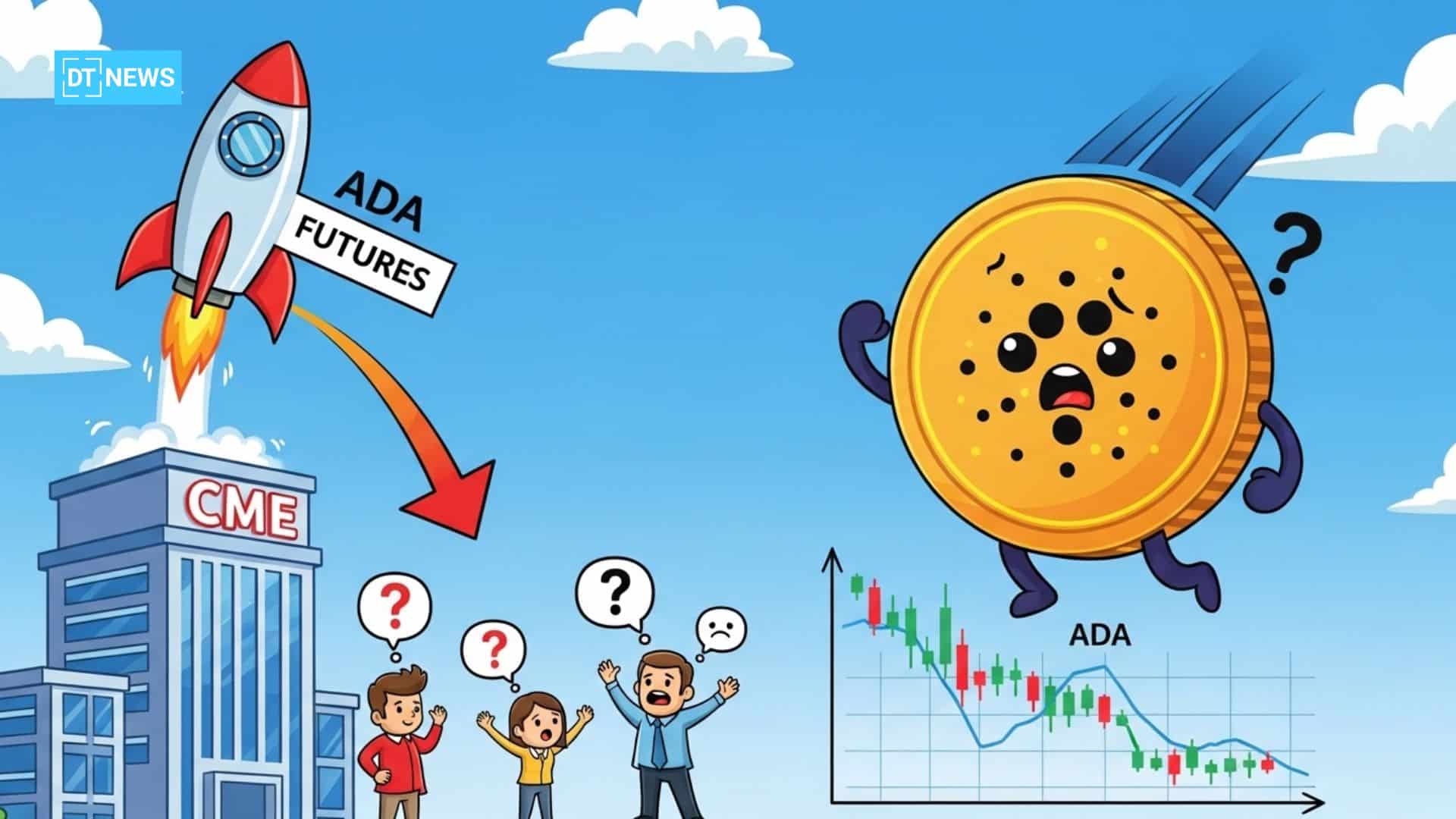
According to CME’s official filings this week, however, these products were launched alongside Chainlink (LINK) and Stellar (XLM) futures on the same platform, with all settling based on benchmarks that have been designed for strong pricing.
The addition of larger and micro contract sizes, as well as the expanded derivatives product suite, was designed to satisfy growing demand from hedge funds, institutions and professional traders for regulated exposure beyond Bitcoin and Ether.
This institutionalized growth is generally taken as a signal of increased legitimacy for Cardano, but the market reaction was really unexpected.
Reaction: ADA Price Falls Instead of Moving Up
While many were anticipating that the introduction of regulated Cardano CME futures would inject fresh buying or sentiment into markets, things appear to have gone in a different direction.
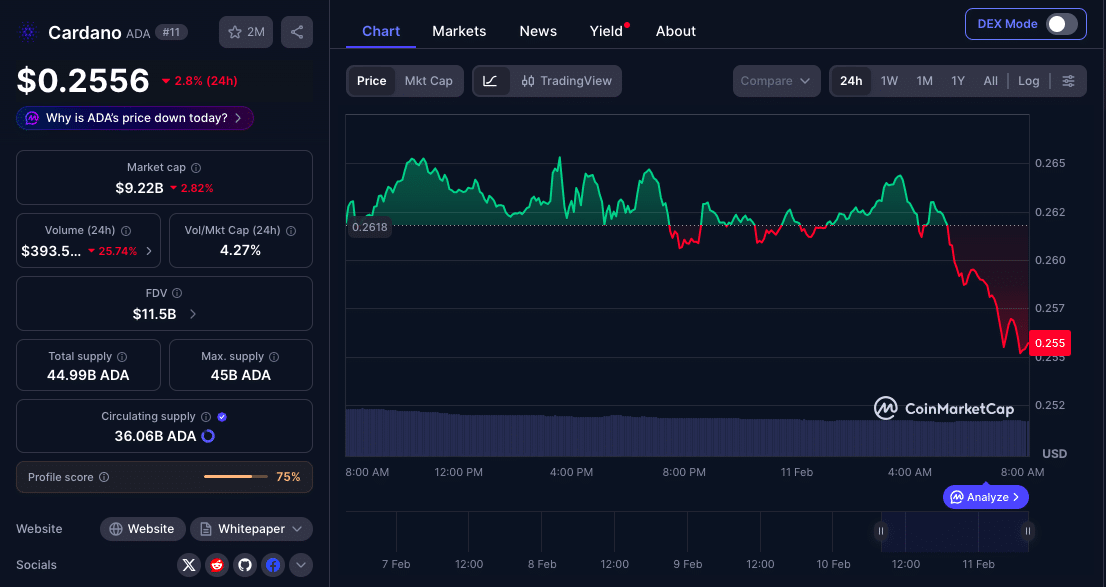
The day that the Cardano CME futures went live, ADA’s price dropped from roughly $0.2720 down to around $0.2608, a nearly 3% decline in value. The drop was not before or right after the market opened, but as the contracts went into trading. At press time, ADA sits around $0.2556
Additionally, the Open Interest also dropped. The failure of the OI to rise also confirmed that bulls did not step in. This unexpected reaction speaks of how derivative trading and spot price movements don’t always align, especially in conditions where the market is increasingly using futures more for short-term leverage as opposed to driven long positions.
In some instances, traders responded to the new CME tool by selling ADA spot in order to fund their futures positions: an action that can actually push the basic asset lower.
The absence of an immediate upward pressure on the market indicated that short-term speculators not long-term investors, were dominating trading around the Cardano CME launch.
Derivatives Activity and Market Behavior
In addition to the CME listing, information from derivatives exchanges indicated a surge in trade.
While the Cardano CME futures contracts brought regulated derivatives exposure, platforms such as BitMEX cited explosive growth in ADA futures volumes, sometimes exceeding tens of thousands of percentage point spikes, showing traders’ appetite for leverage rather than pure hedging.
Open interest in ADA derivatives also exhibited a mixed behavior around the Cardano CME launch as some reports showed declines as traders deleveraged, not adding to their positions. This means that bulls were not aggressively building positions in anticipation of an immediate price rise.
It is worth pointing out that market commentary and on-chain signs in the days surrounding the futures debut indicated spot demand for ADA was still weak with most trading activities being driven by news rather than natural adoption or usage growth.
The combination of speculative volume spikes and unconvincing participation contributed to the price drop instead of gains following a major regulated product launch.
Conclusion
The launch of Cardano CME futures had been anticipated by many as a step to institutional participation and market development. Rather than triggering a positive move, the Cardano CME futures launch coincided with nearly a 3% price drop for ADA based on derivatives speculation and soft spot demand.
Although the new futures contracts provide regulated means to hedge and gain exposure, the immediate impact on price only showed that trading volumes and short-term position taking can overwhelm fundamental anticipation.
The price dump aside, the addition of ADA to CME futures would be an important structural achievement in its market profile, as it opens Cardano up to greater access through regulated financial systems.
Glossary
CME Group: The Chicago Mercantile Exchange, one of the world’s leading and most diverse derivatives marketplaces with futures and options.
Futures Contract: A financial contract to purchase or sell an asset at a certain price on a future date.
Standard and Micro Contracts: Futures contracts in varying sizes, with micro terming it to have lesser nominal exposure.
Derivatives Volume: The amount of trading activities in futures and options markets.
Spot Price: The current price for an asset being traded in the exchanges.
Open Interest: The total number of outstanding positions (or open contracts) held by market participants.
Frequently Asked Questions About Cardano CME Futures Launch
What is CME Group’s new Cardano futures launch?
CME Group introduced listed futures in Cardano (ADA) to provide both standard and micro contracts based on the cryptocurrency to trade on a regulated derivatives exchange on February 9, 2026.
Why did ADA’s price fall after CME launched it?
Rather than staging a rally, ADA price fell by nearly 3% as speculative trading and weak spot demand dictated market movement, overshadowing the hopes for near-term constructive price effect.
Are these futures contracts only for institutional investors?
The futures contracts are meant to be regulated and cater to both institutions and active traders seeking the ability to manage risk or gain exposure in a compliant environment.
What impact did this launch have on the rest of the altcoins?
CME Group also debuted futures for Chainlink (LINK) and Stellar (XLM) the very same day, meaning a more widespread institutional derivatives expansion beyond ADA by itself.
Will this ensure more liquidity for ADA.
Not immediately. Even if regulated futures are successful in attracting institutional interest, there is no guarantee true liquidity will develop without market participation and order flow. The initial price response indicates that short-term trading dominated long-term liquidity improvements.