

This article was first published on Deythere.
Crypto ETF strategies are no longer built on patience alone as a shift is unfolding as investors begin to question whether simply holding digital assets can deliver reliable returns in an unpredictable market. The long-standing “HODL” approach once rewarded early adopters, but today’s environment demands more precision and smarter execution.
According to the source, Duncan Moir, president of 21Shares, believes the industry is moving toward active management. He described crypto as a “nascent and growing asset class” in a recent market insight, suggesting that passive models no longer capture its full potential.
Passive Models Are Losing Their Edge in Crypto ETFs
For years, crypto ETF strategies mirrored the habits of early investors. Funds accumulated assets like Bitcoin and waited for price appreciation over fixed periods. This approach worked in strong bull cycles but struggled when markets cooled or moved sideways.
Crypto ETFs that rely only on price growth often leave investors exposed to sharp swings without any form of income. That limitation has become more visible as institutional players demand steadier performance. As a result, passive strategies are slowly losing their appeal in a market that no longer moves in predictable cycles.
Why Crypto ETF Strategies Are Shifting Toward Yield
Crypto ETF strategies are now evolving to include yield generation as a core feature. This change reflects a broader shift in investor expectations, where income matters just as much as growth.
21Shares introduced an ETP linked to Strategy preferred stock, offering up to 11.5 percent annual yield paid monthly. This structure allows investors to earn consistent returns while maintaining exposure to Bitcoin-linked assets. In a market report, early demand for this product signaled strong appetite for income-focused solutions.
This development suggests that crypto ETFs are beginning to resemble traditional financial products, where yield plays a central role in portfolio decisions.

Global Demand Reveals a Two-Speed Market
Crypto ETF strategies also reflect clear regional contrasts. In the United States, investors continue to favor large-cap assets, with inflows reaching around 638 million dollars this year. This shows ongoing confidence in established digital assets.
Meanwhile, Germany and Switzerland recorded inflows of 377 million and 233 million dollars, respectively. European investors, however, are taking a different path. Many already hold Ethereum and Bitcoin, so they are now exploring newer sectors within blockchain.
This divergence reveals a two-speed market. One side focuses on stability through major assets, while the other seeks growth through innovation and diversification.
Staking and Hybrid Products Add a New Layer of Value
A major driver behind modern crypto ETF strategies is the integration of staking rewards. Firms like Grayscale and BlackRock are pushing to include staking in Ethereum ETFs, opening the door to consistent reward generation.
Staking allows investors to earn returns by supporting blockchain operations, creating a steady income stream that passive models lack. At the same time, hybrid products such as Bitcoin and gold ETPs are gaining traction. These products combine digital assets with traditional safe havens, offering a hedge against macroeconomic risks like inflation and rising debt.
Such innovations indicate that crypto ETFs are becoming more flexible and aligned with broader financial strategies.
Conclusion
Crypto ETF strategies are reaching a turning point where adaptability will define success. The decline in total assets under management, from nearly 240 billion dollars in 2025 to about 130 billion dollars today, reflects a market searching for stability.
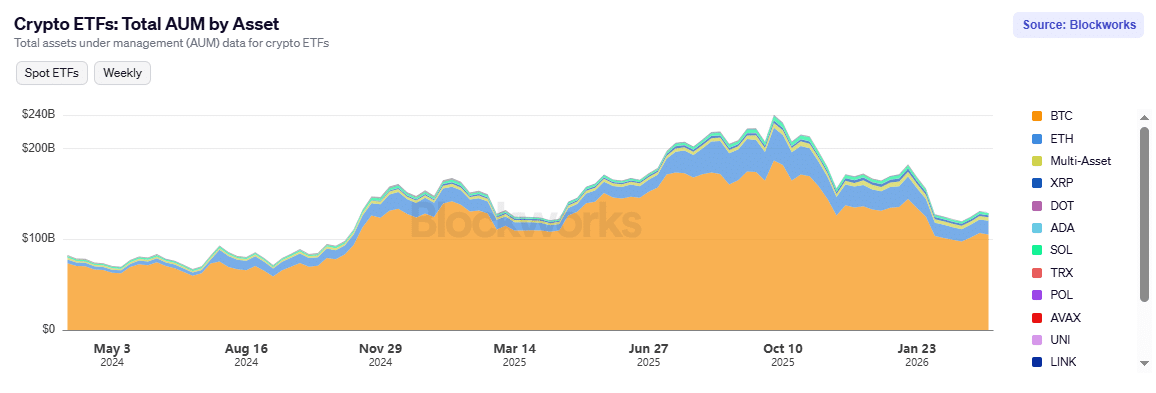
These as yield-based products, staking mechanisms and hybrid investment models look towards the future for a more mature phase of crypto ETFs. If these strategies indeed manage risk while delivering attractive, consistent returns they may change the way institutions and retail investors interact with digital assets.
The execution is where the real test happens. Active strategies promise to provide more control, but they have to prove themselves in a market that can change direction abruptly. If they are successful, crypto ETFs could transition from speculative instruments to familiar and dependable building blocks of modern portfolios.
Glossary of Key Terms
Crypto ETF: A fund that tracks digital assets and trades on stock exchanges.
Staking: Earning rewards by locking crypto to support blockchain networks.
ETP: A tradable product similar to ETFs with flexible structures.
Yield: Income generated from an investment over time.
AUM: Total value of assets managed by a fund.
FAQs About Crypto ETF Strategies
What are crypto ETF strategies?
They are methods used by funds to manage digital assets and generate returns.
Why are passive crypto ETFs declining?
They depend only on price growth, which is unreliable in volatile markets.
How do crypto ETFs generate income?
They use staking rewards, dividends, and structured financial products.
Are active crypto ETF strategies safer?
They aim to reduce risk, but crypto markets still remain volatile.