

























Bitcoin mining centralization is increasingly shaping the debate around crypto infrastructure, as new insights highlight a contrasting trajectory with artificial intelligence. As per statements from Galaxy Research head Alex Thorn, the evolution of mining and AI reflects a broader tension around “crypto’s core promise: decentralization.”
- How is Bitcoin mining centralization reshaping the network’s foundations?
- What did Thorn mean by AI taking an opposite path?
- Can edge AI growth realistically support decentralization?
- Is geographic redistribution offsetting mining concentration?
- How are costs and capital shifts influencing mining dynamics?
- What does this divergence reveal about decentralization models?
- Conclusion
- Glossary
- Frequently Asked Questions About Bitcoin Mining Centralization
While Bitcoin’s network has scaled through industrial consolidation, emerging AI models are gradually moving toward local and personal deployment. This divergence is now raising measured concerns about long-term resilience without dismissing parallel improvements in geographic distribution.
How is Bitcoin mining centralization reshaping the network’s foundations?
Bitcoin mining centralization has advanced alongside technological progress. Early mining relied on CPUs and GPUs, allowing individuals to participate from personal devices. That structure has shifted. Mining now depends on ASIC hardware and industrial-scale operations.
This has concentrated influence among fewer participants with access to capital and energy. Thorn emphasized that such consolidation directly intersects with crypto’s core promise: decentralization, and if the trend continues, it may influence the network’s long-term resilience, particularly as mining difficulty reaches new highs.
What did Thorn mean by AI taking an opposite path?
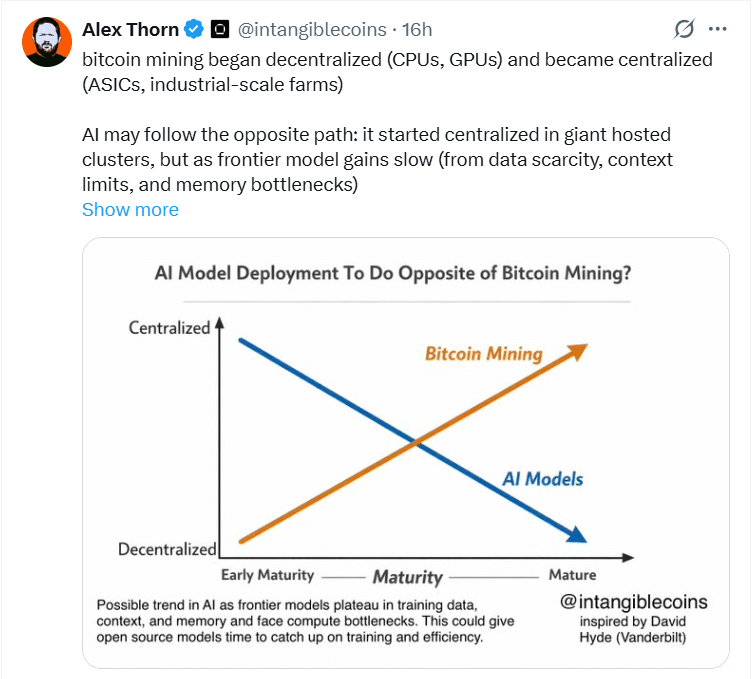
The contrast becomes clearer in artificial intelligence. Thorn stated that “AI may follow the opposite path,” pointing to a structural shift already underway. AI began in centralized environments, dominated by large data centers and hosted clusters.
However, progress in frontier models is slowing due to data scarcity, context limits, and memory bottlenecks. He explained that open-source models are narrowing the gap. As these systems become smaller and more efficient, AI could move toward on-device usage, making it more personal and less dependent on centralized infrastructure.
Can edge AI growth realistically support decentralization?
Edge AI lets AI work on your device instead of big servers. The sector is projected to expand significantly, with estimates showing growth from $25 billion in 2025 to $119 billion by 2033. This nearly 300% growth reflects rising demand for real-time processing, data privacy, and localized intelligence.
Still, this transition is not without limits. Hardware constraints and performance trade-offs remain challenges, suggesting that decentralization in AI may unfold unevenly rather than uniformly.
Is geographic redistribution offsetting mining concentration?
Bitcoin mining centralization reveals contrasting dynamics. Operational control increasingly consolidates among key players, while geographic distribution continues to broaden. Mining costs in the United States now exceed $100,000 per Bitcoin in certain regions.
This shift propels operations toward the Global South, notably Paraguay and Ethiopia, where abundant hydroelectric power remains more attainable. KuCoin notes, “This could help to decentralize mining, at least from a geographical perspective.”
Such continental diversification cuts reliance on single jurisdictions while easing political and environmental risks. In effect, geographic spread may offset some operational centralization, strengthening resilience even as ASIC-driven consolidation continues.
How are costs and capital shifts influencing mining dynamics?
Economic pressure is playing a decisive role in Bitcoin mining centralization. Production costs are estimated near $90,000 per Bitcoin, while market prices hover around $67,000. Some operators continue due to prior investments, but others are reallocating capital toward AI infrastructure and high-performance computing.
Network data reveals a 4% hash rate decline this year now near 1 zettahash per second. This first first-quarter drop in six years underscores mounting economic pressures. Such changes indicate that mining growth is becoming more sensitive to price movements and funding conditions while capital diversification into AI introduces new strategic priorities for operators.
What does this divergence reveal about decentralization models?
Bitcoin and AI trace divergent decentralization paths. Bitcoin mining centralization reflects efficiency-driven consolidation, while AI is experimenting with distributed, device-level deployment. Decentralization defies binary outcomes.

Bitcoin’s geographic expansion proves resilience strengthens even as operational control narrows. Similarly, AI’s decentralization depends on technological feasibility, not just intent. Both systems are evolving under different constraints, producing mixed but meaningful outcomes.
Conclusion
Bitcoin mining centralization underscores a complex trade-off rather than a one-sided risk. The network is becoming more operationally concentrated, yet geographically diverse. This dual shift implies resilience transforms rather than declines.
Meanwhile AI’s movement toward edge computing presents a contrasting model, though one still facing practical limitations. Together, trends show decentralization evolving uniquely per technology, driven by cost, infrastructure, and innovation.
Glossary
ASIC Miners: Specialized hardware built for efficient Bitcoin mining
Hash Rate: Total computing power securing the Bitcoin network
On-Device AI: AI running directly on personal devices without cloud use
Open-Source Models: AI with code that is publicly available and modifiable
Edge AI: AI processed locally instead of relying on centralized servers
Frequently Asked Questions About Bitcoin Mining Centralization
What is Bitcoin mining centralization?
Bitcoin mining centralization means a small number of companies control most of the mining power.
Why is Bitcoin mining becoming centralized?
Bitcoin mining is becoming centralized because it needs expensive machines and high energy.
How is AI different from Bitcoin mining in this case?
AI is moving toward smaller and local systems, while Bitcoin mining is becoming more centralized.
How was Bitcoin mining done earlier?
Bitcoin mining was done on personal computers using CPUs and GPUs in the early days.
Can AI become more decentralized in the future?
Yes, AI can become more decentralized as models become smaller and easier to run on devices.