























The Solana blockchain has quickly become one of the fastest and most scalable networks in the crypto world. Since its launch in 2020, it has attracted attention for its low fees, rapid transaction speeds, and a growing ecosystem of applications.
- What is Solana Blockchain and Why is it Important?
- How Does Solana Blockchain Operate?
- What Makes Solana Different from Other Blockchains
- What Are the Advantages and Challenges of Solana Blockchain?
- How is Solana Blockchain Used in Today’s Market?
- What is the Role of SOL in Solana Blockchain?
- Solana vs Ethereum Speed and Scalability Showdown
- What Does the Future Hold for Solana Blockchain?
- Conclusion
- Glossary
- Frequently Asked Questions About Solana Blockchain
Its native token, $SOL, ranks among the top ten cryptocurrencies by market capitalization, reflecting strong investor confidence and market influence. Developers are increasingly building decentralized apps on Solana, while traders use it for DeFi, NFTs, and meme coins thanks to its speed and affordability.
Although Solana has faced occasional network outages and concerns over centralization, experts believe its innovative technology positions it well for long-term growth and reliability.
What is Solana Blockchain and Why is it Important?
Solana blockchain is a public, open-source platform designed to carry out transactions very quickly for decentralized applications. Unlike many older networks, it uses a unique Proof-of-History (PoH) mechanism together with Proof-of-Stake (PoS) to confirm transactions efficiently and securely.
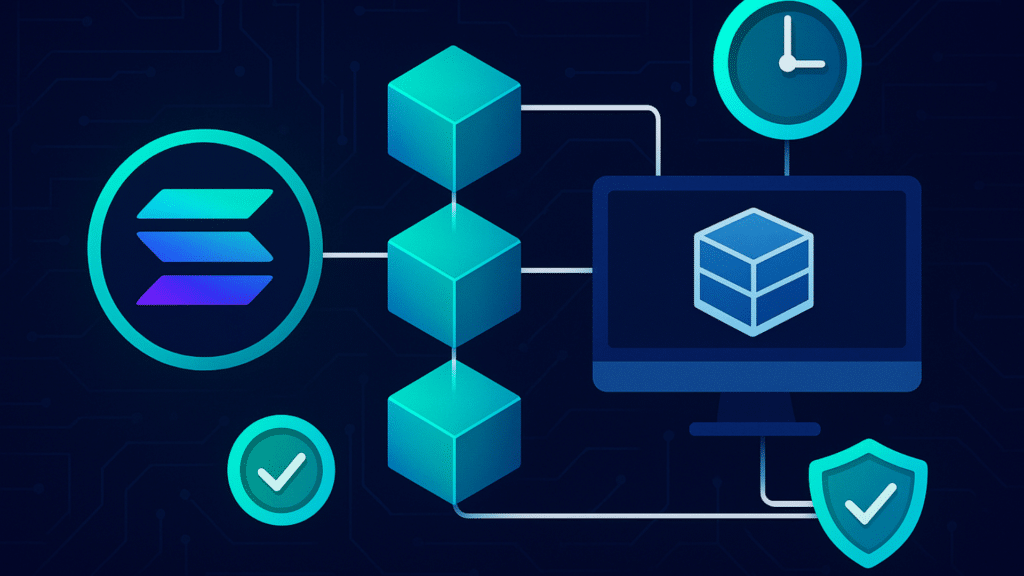
By establishing a clear, verifiable order of events, the network reduces the time validators need to reach agreement, making the blockchain faster and more effective. James Holloway, a blockchain analyst, points out that Solana mixes Proof-of-History with Proof-of-Stake to process thousands of transactions per second for way less money than most other chains.
Developers love it for building apps that need to handle tons of activity. That speed and low cost have turned Solana into a top pick for all kinds of projects, from DeFi and DEXs to NFTs, games, and Web3 stuff.
How Does Solana Blockchain Operate?
At the heart of Solana blockchain is its Proof-of-History system, which adds timestamps to each transaction to create a secure and verifiable record. This approach allows validators to confirm and process transactions much faster than on traditional blockchains, cutting down delays significantly.
Solana also uses Tower BFT, a version of Proof-of-Stake, to keep block times short and ensure transactions are finalized quickly. Other supporting technologies like Turbine, Gulf Stream, Sealevel, Pipeline, Cloudbreak, and Archivers work together to speed up transaction flow, run smart contracts efficiently, manage data, and handle block propagation smoothly.
Solana cranks through tens of thousands of transactions every second without jacking up fees. Other chains lag behind and cost more, so projects that need speed and volume flock to it.
What Makes Solana Different from Other Blockchains
Solana stands out because it processes transactions incredibly fast while keeping fees extremely low, making it a top choice for projects that need real speed. Compared to Ethereum, Solana can handle more activity at a lower cost, which has attracted a growing community of developers.
Its unique combination of Proof of History (PoH) and Proof of Stake (PoS) sets it apart from most blockchains. PoS allows users to stake $SOL coins to help secure the network, while PoH timestamps every transaction so the system reaches consensus quickly and efficiently.
Blockchain developer Maria Chen notes that Solana’s design easily handles real-time apps and high-volume trades that would slow down other networks. This speed opens doors for DeFi trading, NFT launches, and blockchain gaming. While often compared to Ethereum, Solana continues to impress with its scalability, low fees, and strong performance even under heavy demand.
What Are the Advantages and Challenges of Solana Blockchain?
Solana blockchain delivers high transaction speeds and very low fees, making it a strong choice for decentralized finance, NFTs, and other applications that require fast, efficient processing. Its growing ecosystem of dApps and developer tools adds to its appeal as a versatile and flexible network.
The platform does face some challenges. The relatively small number of validators on the Solana blockchain raises concerns about centralization. Running a validator also requires higher-end hardware, which may limit participation. Supporters argue that these measures help maintain network efficiency, but some remain cautious about long-term stability.
How is Solana Blockchain Used in Today’s Market?
Solana blockchain supports many different kinds of projects. On decentralized exchanges, it lets users trade tokens fast and cheaply. Lending and borrowing platforms in DeFi also take advantage of its speed, moving funds quickly and efficiently.
Solana serves as a leading platform for NFTs and gaming applications, where rapid transaction speeds and immediate finality prove essential. Meme coin launches frequently generate abrupt surges in trading volume, yet Solana reliably manages these demands without disruption, outperforming slower networks prone to congestion.
Experts point out that these real-world applications demonstrate the practical utility of Solana blockchain, highlighting its potential for supporting future innovations in payments, asset tokenization, and Web3 development.
What is the Role of SOL in Solana Blockchain?
$SOL is native token of Solana blockchain. It plays several key roles in the network. It covers transaction fees, can be staked to help validate the blockchain, and allows holders to take part in governance decisions that shape how the network develops.
$SOL does not have a fixed supply. Network uses a combination of inflation scheduling and token burning to keep supply and demand balanced. Dr. Emily Tran, a blockchain economist, explains that $SOL does more than secure the network through staking.
It also allows users to have a voice in how Solana develops, making the token a cornerstone of the network’s economic framework and future growth. By handling these roles, $SOL keeps Solana running reliably, staying secure while supporting a sustainable ecosystem for both developers and users.
Solana vs Ethereum Speed and Scalability Showdown
Solana often gets compared to Ethereum since both handle smart contracts and dApps. Ethereum boasts a bigger, more established dev crowd, but Solana pulls ahead with faster speeds, better scalability, and way cheaper fees.
Solana’s blend of Proof-of-History and Proof-of-Stake really sets it apart for apps that can’t afford delays or glitches. Ethereum got there first and built a huge lead, but Solana’s pulling in crowds now with that buzzing ecosystem and a setup built for raw speed.
Julia Reynolds, a blockchain analyst, says that while Ethereum continues to be a major platform, Solana blockchain’s design makes it an appealing choice for developers focused on building fast, reliable projects.
What Does the Future Hold for Solana Blockchain?
The platform’s future depends on how well it can tackle concerns around reliability and decentralization. Its technological strengths and expanding ecosystem give it a solid base for growth and wider adoption.
Industry watchers say Solana looks primed for breakthroughs in tokenizing real-world assets. Cranking through high-volume trades, and rolling out fresh blockchain finance tools. With smart partnerships and steady upgrades, it’s set to dig deeper into DeFi, NFTs, and all things Web3.
Conclusion
Solana blockchain has earned a strong place. Its fast transactions, scalability, and low fees make it best. More to this its unique consensus mechanisms, growing ecosystem, and wide-ranging applications continue to attract developers, investors, and traders.
Even with concerns about centralization and past network outages, blockchain’s strong performance and range of potential applications make it an important platform for next-generation decentralized technologies. $SOL and Solana blockchain are expected to remain key topics in conversations about the future of fast, low-cost blockchain networks.
Glossary
Proof-of-History: A timing system that quickly orders transactions.
Gulf Stream: Sends transactions early so they confirm faster.
Tower BFT: Solana’s method for fast and secure transaction approval.
Turbine: Breaks data into tiny parts to move it quickly across the network.
Finality: The point where a transaction is fully confirmed and locked in.
Frequently Asked Questions About Solana Blockchain
What makes Solana different from other blockchains?
Solana is different. It uses Proof-of-History and Proof-of-Stake to process transactions much faster than most blockchains.
What is the SOL token used for?
SOL is used to pay transaction fees, help secure network through staking, and participate in decisions about how blockchain runs.
How is Solana used in today’s crypto market?
Solana is used for decentralized finance, NFTs, gaming, trading, and launching new blockchain projects.
Why do people say Solana is scalable?
People say Solana is scalable as it can handle more users and transactions without slowing down or increasing costs.
Why do developers like Solana?
Developers like Solana because it is fast, low-cost, and ideal for building apps that handle lots of users and transactions.
Sources