
























This article was first published on Deythere.
- What exactly is being proposed in this filing?
- How would investor protections be maintained?
- Why is this filing significant for the ETF market?
- How would this structure bridge traditional and token-aware systems?
- Does the proposal change how TBIL trades or invests?
- What does this indicate about regulated tokenization?
- Conclusion
- Glossary
- Frequently Asked Questions About Tokenized T-Bill ETF
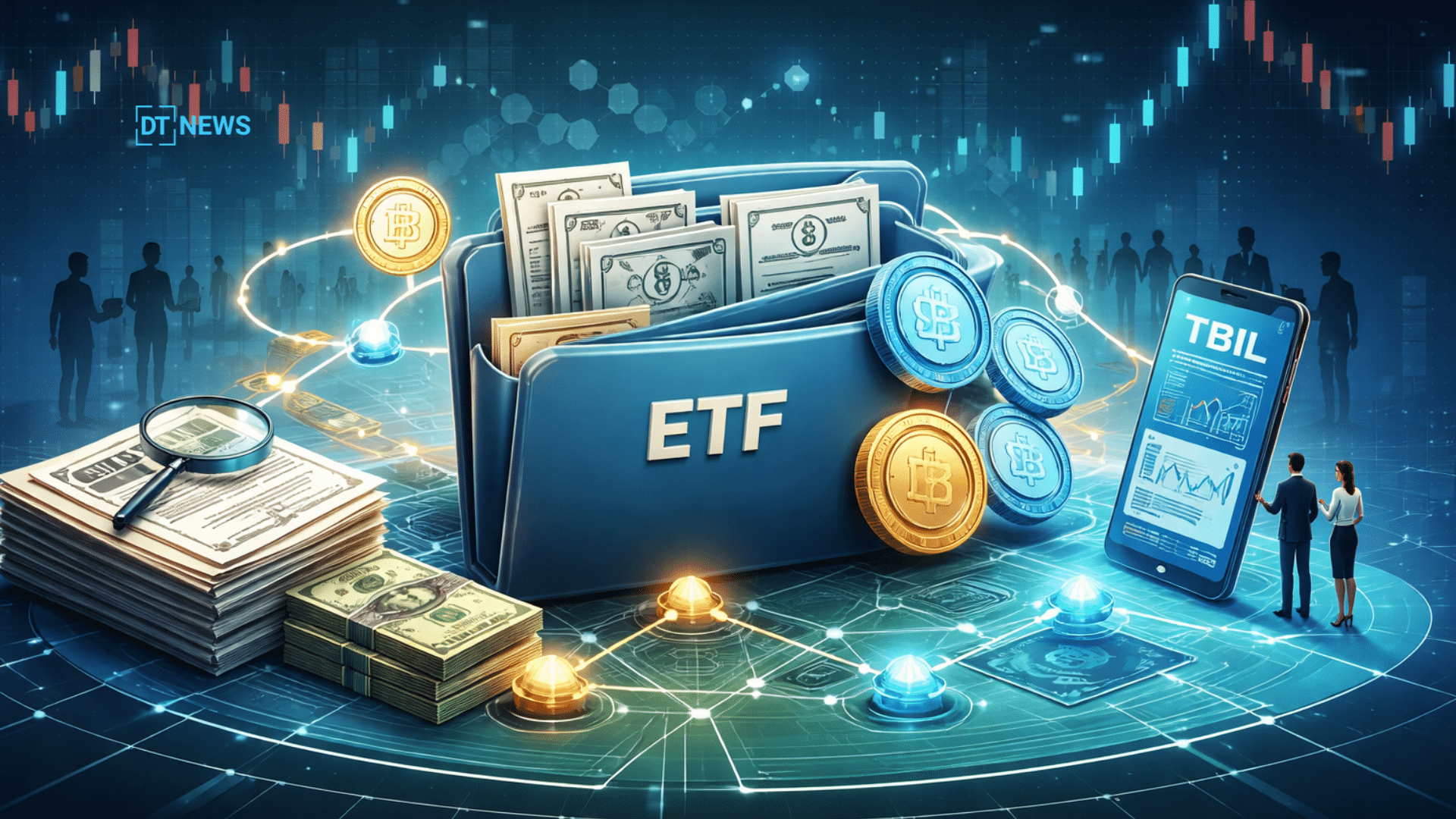
The tokenized T-bill ETF, the exemptive application filed with the U.S. Securities and Exchange Commission on January 21 places F/m Investments at the center of a regulatory discussion on how blockchain technology could be integrated into existing ETF infrastructure. The filing seeks approval to record ownership of shares in the firm’s F/m US Treasury 3 Month Bill ETF (TBIL) on a permissioned blockchain.
At the same time, the proposal makes clear that the fund’s structure, trading behavior, and investor protections would remain unchanged. The application is focused on improving how ownership records are maintained rather than altering the ETF itself. This approach positions short-term U.S. Treasuries as a test case for introducing blockchain technology within regulated financial markets.
What exactly is being proposed in this filing?
It is a change in recordkeeping, not a change in the ETF. F/m Investments has requested permission from the SEC to tokenize ownership records of TBIL, a $6.3 billion Treasury ETF, without altering its investment strategy or day-to-day market operations.

If the request is approved, tokenized and traditional shares would exist together under the same ticker, CUSIP, fee structure, investor rights, and disclosures. The ETF’s portfolio, exchange listing, and trading process would remain unchanged. The proposal focuses solely on how ownership is documented, forming the technical basis of the tokenized T-bill ETF framework.
How would investor protections be maintained?
All existing regulatory safeguards would stay in place. The filing makes clear that the blockchain-based ownership ledger would fully comply with the Investment Company Act of 1940 and Rule 6c-11. Oversight by the fund’s board, daily portfolio transparency, third-party custody, and regular audits would continue without any changes.
Alexander Morris, CEO of F/m Investments, said the firm considers regulatory alignment a priority. “Tokenization is coming to securities markets whether we file this application or not,” Morris said. “The question is whether it happens inside the regulatory framework investors have relied on for 85 years, or without that set of protections.” This perspective explains how the tokenized T-bill ETF is designed to operate within established securities laws.
Why is this filing significant for the ETF market?
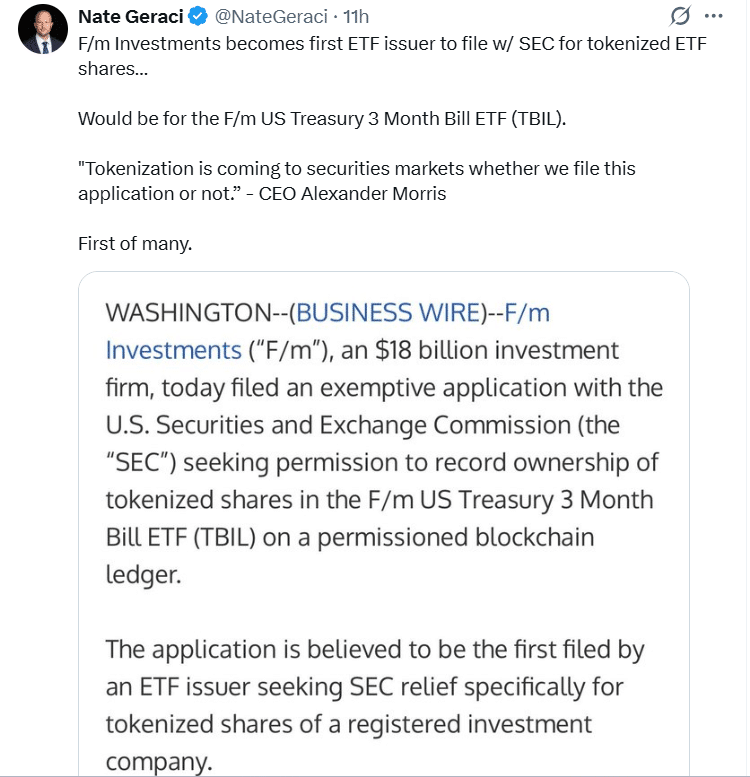
Because it could mark a first for registered ETFs. The application is widely viewed as the first time an ETF issuer has formally sought SEC approval to introduce tokenized shares within a registered investment company.
Market analysts see the filing as a possible benchmark for how blockchain-based settlement systems could function under regulatory oversight. ETF analyst Nate Geraci wrote on X that F/m Investments appears to be “the first ETF issuer to file with the SEC for tokenized ETF shares,” and suggested that it may be “the first of many.”
How would this structure bridge traditional and token-aware systems?
Through a single share class that works across both systems. David Littleton, Co-Founder and President of F/m Investments, said the goal is to allow TBIL to continue operating as a standard Treasury ETF while also enabling regulated movement between traditional brokerage platforms and blockchain-aware settlement systems.
The filing was submitted in collaboration with The RBB Fund, Inc., F/m’s multi-series trust. If approved, the tokenized T-bill ETF would be able to support both conventional brokerage rails and newer digital settlement workflows without splitting liquidity or governance.
Does the proposal change how TBIL trades or invests?
No, the ETF’s market behavior would remain the same. The filing does not change TBIL’s investment objective, portfolio composition, index exposure, or exchange-traded mechanics. Investors would continue to buy and sell shares in the usual way.
The only adjustment being proposed relates to how ownership is recorded in the background. This difference explains why the tokenized T-bill ETF filing is seen as an infrastructure update rather than a redesign of the product itself.
What does this indicate about regulated tokenization?
It reflects a move toward bringing blockchain technology into existing regulatory frameworks. Instead of creating unregistered digital instruments, F/m Investments is aiming to apply blockchain within the ETF structure that investors already recognize and trust.

This approach views tokenization as a regulated operational improvement rather than a break from established market standards. That thinking forms the basis of the tokenized T-bill ETF request now being reviewed by the SEC.
Conclusion
Tokenized T-bill ETF discussions remain active as the SEC has not yet ruled on F/m Investments’ application, though the filing itself marks a meaningful development in how asset managers engage with regulators on blockchain adoption. The proposal keeps tokenized ownership records firmly within existing securities law, testing whether new technology can be introduced without reducing investor protections.
By working inside established rules, the approach highlights a measured path for innovation rather than a disruptive shift. The outcome could influence how future ETFs explore tokenization as a regulated evolution of market infrastructure instead of a separate system.
Glossary
F/m Investments: The firm filing the first SEC request to tokenize ETF shares.
Tokenization: Turning ownership of an asset into a digital record on blockchain.
CUSIP: A unique code that identifies and tracks ETF or security shares.
Rule 6c-11: SEC rule that simplifies ETF registration while keeping compliance.
TBIL ETF: F/m’s 3-Month U.S. Treasury Bill ETF worth $6.3 billion.
Frequently Asked Questions About Tokenized T-Bill ETF
What did F/m Investments file with the SEC?
F/m Investments filed a request to allow its T-Bill ETF shares to be tokenized on a blockchain.
Why is this filing important?
It is the first time an ETF issuer has filed with the SEC to tokenize ETF shares.
How will tokenized and regular shares work together?
They would coexist under the same ticker, fees, rights, and disclosures without splitting the ETF.
How does this filing bridge traditional and blockchain systems?
It allows the ETF to work with both normal brokerage platforms and blockchain-based settlement systems.
What does this mean for the future of ETFs?
It shows that blockchain can be added inside regulated ETFs, which may influence future tokenized financial products.