
This article was first published on Deythere.
- How NFTs Work: Blockchain, Standards, and Smart Contracts
- NFTs: Use Cases Beyond Just Art and Collectibles
- NFT Market Trends and Stats (2024-2025)
- Where Do Experts Think NFTs are Going?
- Benefits and Challenges of NFTs
- The Legal Scope for NFTs
- Conclusion: NFT in Reality Today
- Glossary
- Frequently Asked Questions About Non-Fungible Tokens
- What are NFTs for?
- Are NFTs a good investment?
- Which blockchain is NFT stored on?
- Are NFTs okay for the environment?
- References
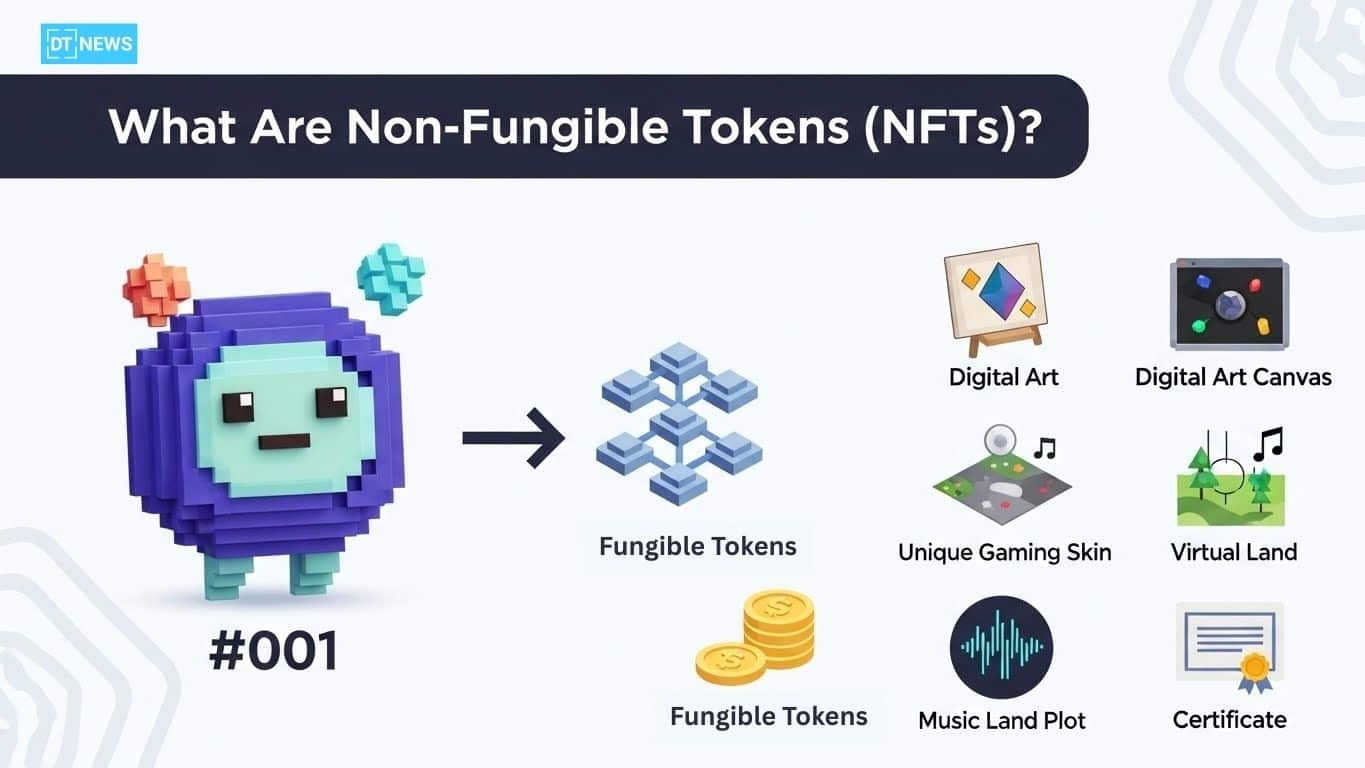
NFTs, short for non-fungible tokens, are unique digital assets on a blockchain that provide irrefutable proof of ownership over something, be it an object or even just a piece of content like art, music or video.
They’re also quite unlike fungible cryptocurrencies such as Bitcoin or Ethereum, which may be substituted for the next unit of the same type. Each NFT is a one-of-a-kind, which can’t be swapped out for something else one-for-one.
Think of an NFT as the digital equivalent of a certificate of authenticity or title deed for things like art, music videos, virtual land, event tickets or tweets.
Every NFT comes packed with metadata and rules set by a smart contract all stored on the blockchain. The process of creating or “minting” an NFT is as simple as uploading a digital file to a blockchain platform (usually Ethereum), and then it creates its very own token linked to that file.
Because the blockchain is involved, NFTs keep a super-safe record of ownership and everything that’s happened to the item, making forgery extremely hard to pull off.
NFTs burst into the scene with massive digital art sales, making headlines in 2021-2022 with big-name celebrity endorsements.
NFTs are still being discussed today, but the conversation has moved on from getting everyone hyper excited to exploring practical use cases.
How NFTs Work: Blockchain, Standards, and Smart Contracts
NFTs exist on a blockchain. When someone creates (or mints) a new NFT, it comes with a smart contract that, on the blockchain, generates a special token ID and links it up to the digital asset’s details (like where it came from and what it is).
Most of the time, NFTs use Ethereum’s ERC-721 or ERC-1155 token standards, which are like set rules that define how these tokens are created and transferred.
These standards are good because they mean that if one marketplace or wallet supports ERC-721, they can verify an NFT’s authenticity and allow it to be traded. The entry on the blockchain then lists who owns the NFT, when it was made, and any other times it was moved on.
Because each and every NFT is unique, they can’t be swapped one for another like dollars or Bitcoin.
Taking the example of CryptoPunks, one of these NFTs is not interchangeable for another – each has its own different image data and rarity. The blockchain and smart contract work together to make sure this is the case.
Also, owning an NFT does not give holders the rights to any copyright on the actual content. What an NFT does is to prove one holds the token that points to a piece of digital content (such as a picture or video).
On the user end, NFTs are bought and sold on places called marketplaces. Buyers pay for it with cryptocurrency (like Ether) and the smart contract takes care of the exchange of money, tokens and updating the ownership.
Platforms like OpenSea, Magic Eden on Solana, or NBA Top Shot on Flow are the kinds of platforms that make these trades possible.
Once one is bought, it can be shown off or given away; buyers are free to do what they want with it. Many NFTs also include royalties so that the original creator gets some money each time their NFT is resold.
NFTs: Use Cases Beyond Just Art and Collectibles
The most popular NFTs are in digital art and rare collectibles, particularly some of the best-known ones, like Beeple’s Everydays: The First 5000 Days, which sold for $69 million at Christie’s; and CryptoPunks, one of the first big NFT collections to really take off. But whereas those attention-grabbing sales might have attracted the most attention, there are other uses for NFTs:
Digital Art and Collectibles: Artists turn their work into NFTs and sell it to a worldwide audience without needing a gallery or auction house. Platforms like OpenSea, Nifty Gateway and SuperRare focus on art NFTs and collectibles. People buy NFTs because they’re one-of-a-kind and have a proof of ownership that’s verifiable, akin to a certificate of authenticity.
Gaming: NFTs allow buyers to own in-game items (such as virtual land, guns or characters) and sell them to someone else outside the game. Games such as Axie Infinity exist on the blockchain and rely on NFTs to capture, representations of characters and items. Immutable X is one of a number of platforms for buying and selling gaming NFTs. Gaming accounts for nearly 40% of all sales in NFTs today, by some reports.
Sports and Entertainment: Companies sell NFTs of highlight videos or collectibles. NBA Top Shot is a flow blockchain platform that is selling classic basketball moments in the form of limited-edition video clips. Musicians and other celebrities have gotten in on the game as well. Kings of Leon released an entire album through NFTs, for example, while even individuals have turned their tweets or memes into NFTs.
Virtual Property and the Metaverse: All over the NFT space, there are virtual worlds such as Decentraland and The Sandbox that utilize NFTs to offer digital land, or a piece of virtual property. Which means that people can buy and sell virtual land, as well as build on it or rent it out. This NFT is essentially a digital deed to property in a virtual world.
Identity and Access: There are NFTs that are tokens for membership or tickets to events. For instance, there may be no other way to gain entry into a concert or exclusive club without holding an NFT. Fan clubs, exclusive event operators and ticket sellers are among the types of businesses that are leveraging NFTs to provide fans with a secure, frictionless way to attend things they care about.
NFT Market Trends and Stats (2024-2025)
The NFT market has had its ups and downs. Sales skyrocketed in 2021, but sales crashed in 2022 and 2023. Volumes are much lower than the 2021 peak by 2024-2025.
According to industry reports, total NFT sales in 2022 came out to around 24 billion, but by 2025, it’s in the hundreds of millions (around 600-700 million).
User adoption seems to be growing again, based on reports; sources put the figure at around 11-12 million unique wallets that have bought an NFT (a slight increase from 8.7 million in 2022).
And in 2025, OpenSea remains the king of the hill; managing more than 80 percent of all NFT trading volume. It’s a marketplace that lists millions of NFTs across multiple blockchains; though others like Magic Eden (Solana NFTs) and Axie Infinity (gaming NFTs) are definitely worth a look.
Here’s a rundown of the top NFT marketplaces by trading volume:
| Marketplace | Blockchain(s) | Notable Highlights |
| OpenSea | Ethereum & Layer-2 networks | Largest NFT exchange (art, collectibles). |
| Magic Eden | Solana | Leading platform for Solana-based NFTs (art, gaming). |
| Axie Infinity Marketplace | Ronin (Ethereum sidechain) | Famous for Axie NFT creatures and items. |
| NBA Top Shot | Flow | Sports highlight NFTs (NBA moments). |
| Other Platforms | Multiple | Domain names (e.g. ENS), music (Audius), virtual items. |
Despite lower dollar volumes, NFTs are a rightly significant market. The steady stream of activity in art, gaming, sports and brand projects shows sustained interest.
Data actually suggests that about half of all NFT sales are for very low prices (under $200) – because small transactions are common. This implies that most NFTs trade at modest prices, while just a handful fetch huge sums.
In 2025, the average revenue per active NFT user is estimated around $59, according to predictions.
Where Do Experts Think NFTs are Going?
Industry experts think NFTs are moving from being seen as speculative collectibles to actually being useful digital assets. As an example, analysts point out that big companies like Nike, Disney and Coca-Cola are starting to integrate NFTs into their real products and marketing.
This corporate adoption is what’s driving NFTs towards mainstream consumer use. As one crypto expert summed it up, the NFT space is expected to shift “beyond the initial hype” to actually focus on “real-world applications like fractional ownership of assets and hybrid physical-digital items”.
Many people predict growth in gaming and entertainment. NFTs can give players genuine ownership of game assets and open up new revenue streams. They can also be used to tokenize music albums, films, or merchandise, which creates some new fan experiences.
Energy consumption, a major criticism of NFTs in the past, has also dropped dramatically. For instance, Ethereum’s 2022 switch to proof-of-stake cut its energy use by nearly 99.95%, making NFTs a lot greener than they used to be.
Some are even talking about how NFTs might eventually blend with augmented and virtual reality. Investor Mike Novogratz has suggested that “one-of-a-kind” NFT art could be shown off as virtual jewellery or objects in AR glasses.
So, a unique NFT could suddenly appear in the real world, via AR. Novogratz believes NFTs are going to be a lot bigger than people currently think because digital and physical realities are going to start to blur together.
That being said, experts are warning that for NFTs to really succeed, the market needs to learn from its past mistakes.
Quality and usefulness need to start driving the value of NFTs, rather than just hype and marketing.
According to one analysis, the coming years are likely to see NFTs characterized by more practical applications, more cross-chain interoperability, and a lot more focus on sustainability and social responsibility.
All in all; while it’s impossible to predict exactly what’s going to happen, there’s a clear consensus that NFTs are here to stay as a form of digital ownership. They’re likely to get more and more integrated into gaming, art, music and commerce.
Benefits and Challenges of NFTs
NFTs have a lot of advantages. They give artists and musicians a chance to make money from their digital work without having to go through all the hassle of intermediaries. They can sell their stuff to anyone in the world, and even get a cut of the action when someone sells their work on again.
Collectors get the reassurance of knowing they own something unique, an NFT is like having a rare piece of digital art on one’s hands. NFTs can also make it easier to get in on high-value investments.
However, there are some major challenges and risks. The NFT market is like a rollercoaster as prices can go all over the place in an instant.
Some people lost a lot of money in 2022 when the market crashed. Experts are saying that most of the NFTs are pretty much worthless with estimates suggesting that over 90% of them have little to no resale value.
On top of that, there are some complex intellectual property issues. Buying an NFT does not give holders the rights to the actual asset. There is also the risk of scams like making fake NFTs or running off with all the investors’ cash.
Even though some of the blockchains are now being run on greener tech, some are still saying that NFTs are a waste of energy. Though they have come a long way on the energy front, there is still a long way to go.
Pros and Cons of NFTs
| Pros (Benefits) | Cons (Challenges/Risks) |
| Verifiable digital ownership via blockchain | Highly speculative; price bubbles possible |
| New revenue stream/royalties for creators | Intellectual property rights are often unclear |
| Enables new business models (e.g., gaming economies, fractional assets) | NFTs can be lost (e.g., if wallet keys are lost) |
| Immutable record of provenance and authenticity | Scams, fraud and smart-contract bugs occur |
| Reduced energy consumption on PoS chains | Market and regulatory uncertainty |
The Legal Scope for NFTs
The world of NFTs is rapidly evolving within a vague and constantly shifting legal framework. No global NFT law has yet been established and regulations differ from country to country, and even jurisdiction to jurisdiction.
In the US, some regulators choose to treat NFTs more like commodities or collectibles rather than securities. A 2025 court case which threw out an “insider trading” conviction against the NFT marketplace OpenSea clearly shows that regulators are still trying to get their heads around where NFTs fit into existing laws.
In many countries , digital assets (which, of course, include NFTs) are starting to be brought under the same rules as securities and investments.
It would be wise to be careful when investing in NFTs. As the regulators are pointing out, the law on NFTs is still unsettled. US courts are still arguing over whether they should be treated as property under the law.
Across the globe, anti-money-laundering and tax authorities are taking a close look at NFT transactions.
As a buyer, there needs to be awareness of the fact that NFT transactions can have tax implications (capital gains, etc.), and buyers may soon need to verify their identity if they want to buy NFTs through certain platforms.
On the plus side, clearer regulation should help build trust. The U.S. and E.U have drafted proposals for regulating digital assets, like the SEC’s proposals and MiCA in Europe, which could bring NFT marketplaces into the regulated mainstream.
For now, Kris is advised to treat NFTs with the same caution given to other high-risk investments.
Conclusion: NFT in Reality Today
NFTs (non-fungible tokens) have blossomed into a truly versatile digital asset class that’s much more than the JPEG rush of 2021. NFTs today can be used to prove ownership of one-of-a-kind digital items or physical world objects, such as art, music, a rare collectible, virtual property and even tickets.
All of this is possible through blockchain technology and smart contracts, which means each token is unique and can be tracked securely. Although the market may not be as high as it was at its peak, it remains and is settling into a steady industry.
Glossary
Blockchain: a digital ledger in which transactions made in Bitcoin or another cryptocurrency are recorded chronologically and publicly. Blockchains are the technology that allow NFTs to function by recording who owns them.
Smart Contract: it’s a program code, a set of rules that resides in the blockchain and takes effect when pre-defined conditions are met. NFTs depend on smart contracts to manage the transfers and things like royalties for original creators.
Fungible vs Non-Fungible: Fungible things can be exchanged for each other (e.g., one dollar for another one dollar), while non-fungible are unique. You can’t simply swap out one NFT for another.
Minting: the process of producing a new NFT. What that typically involves is uploading a file to a site, which then writes the details of the NFT to the blockchain.
ERC-721/ERC-1155: These are the standards for NFTs on Ethereum, where ERC-721 is a non-fungible one-off token, and ERC-1155 can be used for batches of tokens or items that are semi-exchangeable.
Wallet: a virtual wallet in which cryptocurrencies and NFTs are stored. Every wallet is assigned an address on the blockchain.
Royalties: a cut of the profit when an NFT is resold that goes to the person who created the original.
The Metaverse: a 3D virtual world, usually in game form. In these worlds, NFTs are minted to represent virtual land, characters or other pieces of digital gear.
Frequently Asked Questions About Non-Fungible Tokens
What are NFTs for?
NFTs can be used to claim ownership of just about any kind of digital or physical asset, including art, music videos, avatars or objects inside video games, virtual real estate and concert tickets, the list goes on. They’re being deployed to sell digital art, in gamers’ economies, as collectibles and even as loyalty cards.
Are NFTs a good investment?
NFTs are highly speculative. Some have sold for millions, but mostly they don’t trade for much. The market is as volatile as one would expect and a lot of NFTs may decrease in value. Experts recommend doing thorough research.
Which blockchain is NFT stored on?
Lots of NFTs live on the Ethereum blockchain but there are other home blockchains, too, including Solana and Flow. Every blockchain has its own small ecosystem and marketplaces. Ethereum is the largest of the lot.
Are NFTs okay for the environment?
This is a common criticism as early NFTs used a lot of power but Ethereum blockchain changed to a more efficient system in 2022, which has made a huge difference. The energy use went from 99.95% down to just 0.05%. Lots of NFT platforms now use more eco-friendly blockchain technology too. Some even try to offset their carbon footprint by buying carbon credits.