
























This article was first published on Deythere.
- An AI-Powered Ethereum: Privacy and Trust First
- Ethereum as an Economic Layer for AI
- On-Chain Proofs for Checking Verifiable AI Outputs
- AI as a Gateway to Better Blockchain Interaction
- AI to Improve Governance and Market Systems
- Conclusion
- Glossary
- Frequently Asked Questions About Ethereum AI Integration
- What is Vitalik Buterin’s Take on Ethereum AI integration?
- Is Ethereum already using AI tools?
- What is the significance of privacy when it comes to AI integration?
- References
Ethereum (ETH) co-founder Vitalik Buterin has laid out a blueprint for how Ethereum could operate in particular with the development of AI. Buterin said the intention is not to replace people with AI, but instead use AI to improve privacy, trust and efficiency in blockchain systems while still maintaining a commitment to decentralization.
His post on X describes several plausible ways in which Ethereum AI integration might be woven into the near future.
An AI-Powered Ethereum: Privacy and Trust First
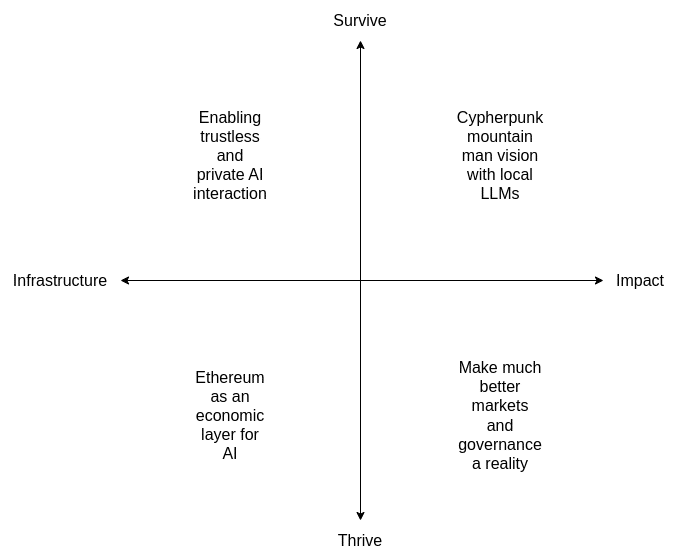
In his recent statements, Buterin has outlined certain possibilities of intersecting AI and blockchain technology in the next few years. First, he sees a use case for Ethereum in facilitating trustless and private transactions with AI systems so that users can interact with AI without divulging personal data.
This response follows increasing fears over large language models (LLMs) potentially unintentionally revealing sensitive information. According to Buterin, new tooling will be required to make local language models and blockchain interactions private and secure.
Techniques like zero-knowledge proofs are becoming more widely discussed in blockchain circles as a way to make AI calls and transactions more private.
The idea is to protect users from data leakage while still making AI decisions auditable.
Ethereum as an Economic Layer for AI
While privacy is a primary goal, Buterin sees Ethereum as an economic layer that will support AI-to-AI interactions. This means autonomous AIs could interact with one another on Ethereum, for example and at a very simplistic level to pay for services, accept API calls or place security deposits.
“Bots could be deployed to hire each other, handle API calls and make security deposits,” Buterin said in his public comments.
He says this is not an economy of profit but an economy that allows for more decentralized, distributed authorship in network interactions.
This economic consideration would leave AI agents with a basis to interact economically outside centralized infrastructure. Smart contracts, which are programmable contracts that run on the Ethereum network could also enable AI agents to automatically broker deals and hire labor or coordinate tasks without intermediaries.
On-Chain Proofs for Checking Verifiable AI Outputs
Another aspect of Buterin’s Ethereum AI integration vision is upgrading verification systems for AI outputs through blockchain. One of the big stumbling blocks to AI adoption, in his view, is verifying that a model’s output can be trusted.
Buterin said it is impractical for humans to verify every piece of code or model output, but AI can assist with verification by taking care of the heavy lifting.
“Take the vision that cypherpunk radicals have always dreamed of (don’t trust; verify everything)… Now, we can finally make that vision happen, with LLMs doing the hard part,” he said.
This might mean Ethereum recording verifiable on-chain proofs for AI actions, such that users can verify the authenticity of results or recommendations provided by an AI system. Such evidence could be important in decentralized apps, in which trust and responsibility are of utmost importance.
This aligns with Ethereum’s recent technical developments, as well. Some standards, like ERC-8004, which allows reputation/identity registries for AI agents on Ethereum have been deployed on mainnet, giving developers more tools that make decentralized interactions with AI/data more reliable and trusted.
AI as a Gateway to Better Blockchain Interaction
Buterin also expects AI to develop into a middleware connecting the users with blockchain. Many forms of interaction with decentralized apps today, require some knowledge. One possible friendly interface is AI, which could assist people with complex tasks safely, according to Buterin.
AI agents could be helpful in verifying transactions, interacting with decentralized apps and even suggesting users take more optimal actions, he added. That could help users who have no coding or trading experience gain access to blockchain on a much larger scale.
For example, newer advancements such as Ethereum zero-knowledge tech and node simplification features are focusing on making privacy-preserving computation and user participation more frictionless. One day, these improvements might even partner with AI to make blockchain easier for users.

AI to Improve Governance and Market Systems
Finally, Buterin also suggests the potential for AI to participate in governance and market dynamics over Ethereum by scaling human decision-making capabilities. Decentralized governance, the traditional form of decentralized prediction markets is often limited by how much information humans can process as a group.
AI could help eliminate those barriers, allowing more people to take part with stronger supervision, Buterin said.
The application of AI for the evaluation of proposals, or to predict outcomes when humans remain in ultimate control, might make governance structures more efficient without compromising on decentralization or accountability.
Conclusion
Vitalik Buterin speaks about a future of Ethereum AI integration to improve privacy, trust, proof of verification and transaction accessibility in blockchain networks.
He doesn’t imagine AI as being the replacement for human oversight, but as a means to make those decentralized interactions safe, transparent and consistent with Ethereum’s original ethics.
With recent developments like privacy tooling, AI agent standards on mainnet, and economic models for autonomous agents, Ethereum is acting as a substrate-level technology that can contribute to the next wave of decentralized computing and AI.
Glossary
Decentralized Interaction: A system in which one does not need to trust a central authority who can verify.
Zero-Knowledge Proof: A cryptographic approach to proving data without exposing the data.
AI Agent: A self-operating software that executes tasks or starts a transaction.
Smart Contract: It’s a code that sits on blockchain and runs when set of conditions are met, automatically.
On-Chain Verification: Verifying the genuineness of actions or outputs using blocks records.
Frequently Asked Questions About Ethereum AI Integration
What is Vitalik Buterin’s Take on Ethereum AI integration?
Vitalik suggested that Ethereum can offer privacy, trust and economic systems to aid decentralized AI in serving users rather than replacing them.
Is Ethereum already using AI tools?
Standards for AI agent identity and reputation (e.g. ERC-8004) are deployed on Ethereum already, that can support trustable AI interactions.
What is the significance of privacy when it comes to AI integration?
Since large language models have the potential to leak user data, Buterin said privacy tools such as zero-knowledge proofs are required for safe AI interactions.