

US stablecoin regulation is moving from theory to action, and markets are paying close attention. The latest proposal signals a shift that could reshape how digital dollars interact with traditional finance.
According to the source, the Federal Deposit Insurance Corporation board approved a plan to regulate stablecoin issuers under its supervision. This move aligns with the GENIUS Act, signed into law in July about nine months ago, with a planned effective date of January 18, 2027, unless implemented earlier.
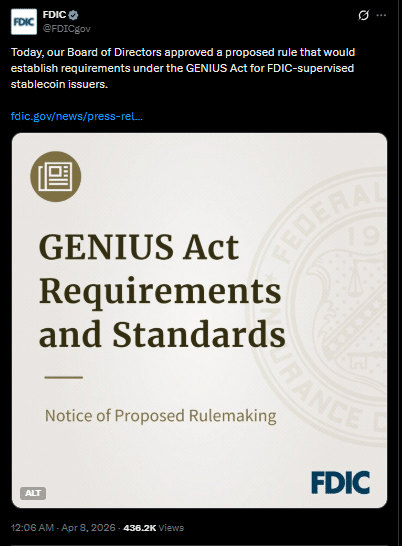
US stablecoin regulation expands under tighter banking control
The latest step in US stablecoin regulation brings stablecoins closer to the core banking system. The FDIC, which insures deposits across more than 4,000 institutions and supervises over 2,700 banks and savings associations, is now extending its oversight into this growing sector.
The proposal sets clear standards for reserves, redemption, capital, custody, and risk management. These elements are critical during periods of market stress. A recent update shows regulators want stablecoins to meet similar expectations as traditional financial products.
This approach strengthens US stablecoin regulation by reducing uncertainty and aligning digital assets with established safeguards.
GENIUS Act defines limits and unlocks oversight power
The GENIUS Act sits at the center of this framework and shapes every part of US stablecoin regulation. It grants the FDIC authority to oversee stablecoin activity within banks and related institutions.
However, the GENIUS Act also draws a firm legal boundary. Stablecoins cannot be treated as insured deposits. This rule explains why US stablecoin regulation cannot extend FDIC insurance directly to token holders.
A parallel effort by the Office of the Comptroller of the Currency, noted in a policy brief, shows that multiple regulators are working together under the GENIUS Act. This coordination expands oversight beyond banks to include broader stablecoin activity.
Why stablecoin holders remain outside direct protection
A key feature of US stablecoin regulation is what it does not include. Stablecoin holders will not receive FDIC insurance. The FDIC stated that treating holders as insured depositors would conflict with the GENIUS Act, which prohibits such classification.
Instead, insurance applies only to reserves held within regulated banks. This layered model protects the system but not the individual token. Still, regulators argue that US stablecoin regulation improves safety through stronger reserve backing, tighter supervision, and better risk controls.
In simple terms, the system becomes more stable, even if it is not risk-free.
Second proposal signals deeper change and market urgency
This proposal marks the second major step under the GENIUS Act. In December, the FDIC introduced a framework allowing insured depository institutions to apply for stablecoin issuance through subsidiaries.
Now, regulators have opened 144 detailed questions for public feedback over 60 days. This shows that US stablecoin regulation is still evolving and invites industry participation in shaping the final framework.
Market trends add urgency. Stablecoins have already surpassed automated clearing house volumes, showing strong real-world adoption. This rapid growth explains why US stablecoin regulation is accelerating.
For analysts, the implications are clear. Banks may enter stablecoin issuance more actively under this framework. At the same time, existing models like USDC and USDT may face stricter compliance expectations under the GENIUS Act.

Conclusion
US stablecoin regulation is entering a structured phase, guided by the GENIUS Act and enforced through FDIC oversight. The system aims to build trust without removing all risk from users.
For developers, investors and analysts, the way forward is becoming clearer. Stablecoins are a step closer to traditional finance, but they differ in important respects. The balance between safety and innovation in the years to come will determine success of US stablecoin regulation.
Glossary of Key Terms
Stablecoin: A digital asset designed to maintain a stable value, often linked to fiat currencies.
FDIC: A US regulator that insures deposits and supervises financial institutions.
GENIUS Act: A law that defines how stablecoins are regulated in the United States.
Reserves: Assets held to back the value of stablecoins.
Custody: Secure storage and management of financial assets.
FAQs About US Stablecoin Regulation
What is US stablecoin regulation?
It refers to rules governing how stablecoins are issued, backed, and supervised in the United States.
Does the GENIUS Act allow FDIC insurance for users?
No, the GENIUS Act prevents stablecoins from being treated as insured deposits.
Why are stablecoin holders not insured?
Because current law separates digital tokens from traditional bank deposits.
What changes for banks under this framework?
Banks may issue stablecoins under strict rules and regulatory approval.