
This article was first published on Deythere.
The long running Uniswap lawsuit has recently been dismissed by a federal judge in Manhattan The ruling stated that Uniswap Labs and its founder, Hayden Adams, are not responsible for losses incurred by traders who bought scams tokens on the decentralized exchange.
The judge’s reasoning pointed out that designing software in and of itself does not make Uniswap responsible for third-party misbehavior.
This outcome follows years of litigation filed by a group of plaintiffs who accused Uniswap of failing to stop fraudulent trades, or “rug pulls,” on the platform. The judge’s ruling emphasizes that it is virtually impossible to know the identity of scam token issuers, and that Uniswap’s technology cannot be equated with helping or facilitating those frauds.
What the Lawsuit Claimed
The original lawsuit for this case was filed in 2022 by a group led by plaintiff Nessa Risley, who alleged that multiple so-called scam tokens traded on Uniswap had cost investors money.
The plaintiffs contended that Uniswap and its venture investors, which included top firms, were to be held responsible because they supplied the marketplace infrastructure that enabled these tokens to be traded.
They portrayed these actions as violations of state consumer protection laws and U.S. securities laws, arguing that Uniswap’s software enabled what they described as unregistered trades and rug pull scams.
The judge, Katherine Polk Failla; who heard the case in the U.S. District Court for the Southern District of New York, dismissed those assertions in a written opinion.
According to the court; the Uniswap lawsuit didn’t show that Uniswap was aware of nor contributed to the fraudulent activity that took place. Just making a platform that law-abiding and non-law-abiding users could access wouldn’t necessarily be in itself aiding and abetting wrongdoing.
The judge compared it to a ride-sharing app being blamed for the way a user behaves, emphasizing that liability doesn’t reach developers of open-source software for actions taken by nameless third parties.
The court instead focused on the fact that Uniswap Labs neither issued scam tokens nor controlled them, nor was involved in creating or promoting them.
What the Ruling Means for Uniswap and Crypto Platforms
The victory for DeFi community from Uniswap lawsuit dismissal reaffirms that protocol creators are not automatically responsible when someone misuses their tools. The ruling offers clearer legal boundaries for projects built on open-source platforms.
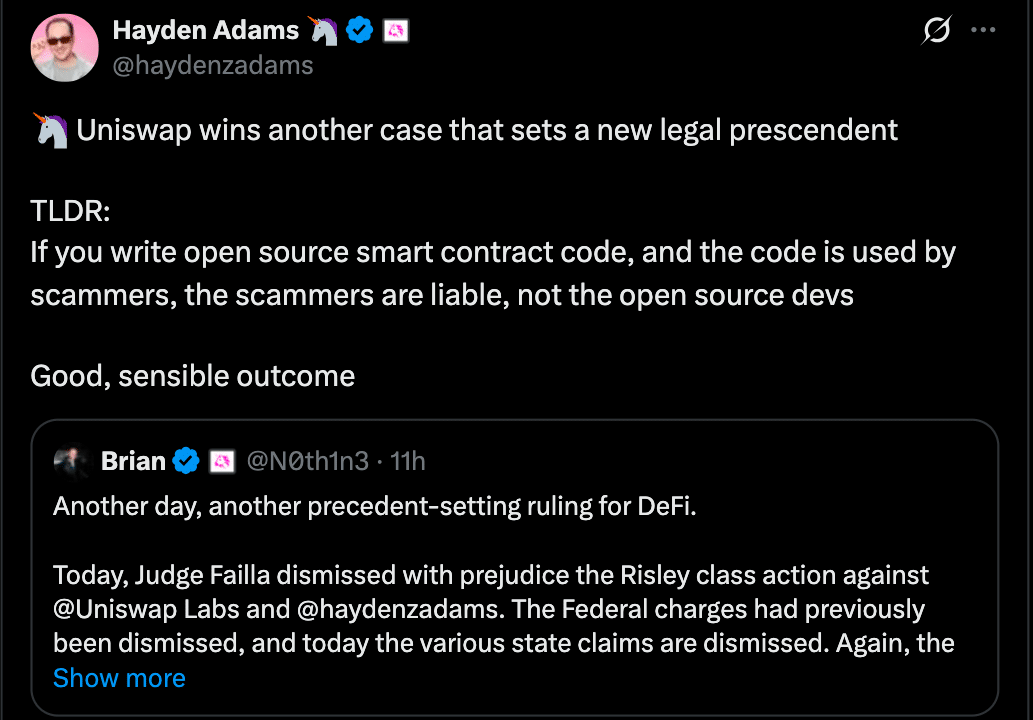
The founder of Uniswap, Hayden Adams, made the remark that: “If you write open source smart contract code, and the code is used by scammers, the scammers are liable, not the open source devs.”
What has been a blurred line between decentralized protocols and centralized financial intermediaries in past court cases becomes clearer with this ruling for the time being at least.
What is left unanswered on a regulatory level is what happens to securities laws going forward, especially in terms of DeFi, and whether new legislation or judicial opinions may in the future reassess how decentralized platforms fit into existing financial structures.
As critics of the ruling emphasize the need for consumer protection, legal experts say that without identifiable defendants who can be held liable, courts have limited ability to apply traditional statutes to decentralized systems.
This is, of course, part of an ongoing discussion in the crypto industry about the need for regulatory certainty and new legal standards that really cater to the realities of blockchain innovation.
How the Crypto Industry Responded
Industry reaction to the court’s decision of the Uniswap lawsuit was mainly positive among developers and protocol advocates, who viewed the dismissal of the Uniswap lawsuit as validation that decentralized technology could walk hand in hand with legal accountability for bad actors individually.
The case has drawn attention to the challenges that courts encounter when trying to apply existing laws to decentralized systems operating without traditional intermediaries.
Long-term Uniswap supporters say that the ruling may discourage other attempts at litigation blaming infrastructure builders for third-party bad behavior.

They say this helps innovation because it means developers don’t have to fear being held responsible for things that are completely out of their control.
Meanwhile, other consumer advocacy voices argue that the ruling exposes deficiencies in protections for traders operating within decentralized markets.
That means without clear legal solutions against DeFi platforms should fraud occur, investors may require new types of self-regulatory tools to prevent risks that are inherent in open-access ecosystems.
Conclusion
The dismissal of the Uniswap lawsuit by the federal court has raised mixed views in the industry especially about user protection.
However, by ruling that a decentralized exchange’s developers do not bear legal responsibility for how unknown third parties may have used their technology to defraud investors, the decision also provides legal stability for blockchain projects seeking to conduct themselves in accordance with open-source principles.
This ruling not only liberates Uniswap Labs and its founder from liability; it also affirms that creators of code are separate from fraudsters who pervert permissionless systems.
Glossary
DeFi (Decentralized Finance): A blockchain-based financial system that operates without centralized intermediaries.
Class Action: A lawsuit filed by a group of individuals who share common claims against the same defendant.
Open-Source Software: Software that is publicly available for anyone to use; study, and modify.
Scam Tokens: A blockchain currency that has been created with malicious intent and becomes ghost after launching.
Smart Contract: A blockchain program that automatically carries out the terms of an agreement.
Frequently Asked Questions About Uniswap Lawsuit
What was the Uniswap lawsuit about?
The lawsuit alleged that Uniswap Labs and its founder; were responsible for the losses suffered by investors from scam tokens traded on its protocol. The court found that there was no sufficient basis to hold them responsible.
Who dismissed the Uniswap case?
U.S. District Judge Katherine Polk Failla dismissed the case with prejudice; which means it can not be refiled.
Does this ruling shield other DeFi platforms?
While the decision provides precedent, it technically pertains to this case and similar legal principles, future decisions could vary based on context.
Does that make Uniswap responsible for token scams?
No. At all events, the court confirmed that Uniswap is not legally liable for the misconduct of third-party token issuers.
Does this change securities law?
It doesn’t change the law but clarifies how existing laws apply to decentralized protocols, and it reinforces that regulatory gaps must be filled by lawmakers, not courts.