

This article was first published on Deythere.
Zcash (ZEC), a privacy-focused cryptocurrency, has arrived on wallets distributed to U.S. government employees.
The United States has, according to analytics by the blockchain-investigating company Arkham Intelligence, seized about $1.5M in Zcash from when it took down dark-web market AlphaBay in 2017.
Meanwhile, Arkham has stated that it has tagged over 53% of all Zcash transactions, whether transparent or shielded, part of a $420 billion worth of transaction volume attributed to real-world entities.
U.S. Government Holding Zcash: What is Known
Arkham’s analysis points to a modest, yet symbolically potent, stash of ZEC in federal custody. The holdings are rumored to come from assets that were confiscated from AlphaBay, which was alleged to be a platform for darknet transactions using Zcash.
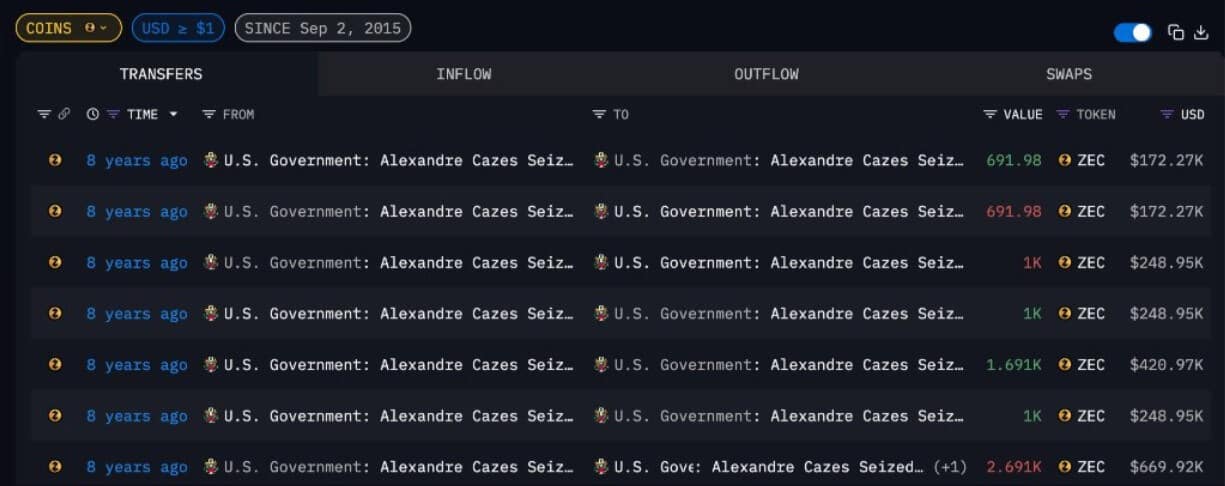
This is small compared to overall federal crypto holdings, but it puts Zcash alongside digital assets being stored by regulators such as significantly larger and more transparent networks like Bitcoin (BTC) and Ethereum (ETH).
Arkham Traceability Claim: Extent and Controversy
Just recently, Arkham reported that its intelligence platform has tagged over half of all Zcash transactions, covering both shielded and transparent such usage.
This includes about $420 billion of transaction volume, 48% of inputs and outputs and around $2.5 billion in total balances identifiable by a wallet now.
This has triggered a response among privacy advocates and developers.
Critics say the announcement obscures a crucial point. On privacy chains such as Zcash, an overlarge percentage of traceable activity stems from transparent addresses and well-known entities, not shielded pools.
Zcash founder Zooko Wilcox responded by stating that Arkham did not actually deanonymize any ZEC in shielded pools. As he wrote on X:
“That would be impossible because the information just isn’t there. They’re just tracking wallets that opted into public transparency.”
So, while Arkham is tracking a big chunk of Zcash on-chain flow, the claim doesn’t mean that Zcash privacy core is doomed to fail.
Why It Matters: Privacy vs. Regulatory Pressure
Regulators around the globe but particularly in the United States are stepping up attention on so-called crypto assets that can mask transaction history.
In doing so, the fact that a coin launched to ensure privacy is held by the United States government raises new questions about how these coins should be regulated, stored or even liquidated.
As Arkham Data is exposed publicly and the regulators begin to consider enforcement tactics, privacy-focused protocols such as Zcash will likely face further pressure. While holdings might be small, it is hugely symbolic in terms of setting the tone of regulatory narratives.
The point that analytics firms can trace a significant chunk of Zcash volume out there could serve to influence exchanges, custodians and institutional investors, who may move conservatively or exactly in the opposite direction, insisting on transparency.
Market Reaction and Institutional Interest
In spite of the attention, Zcash has had a very strong price rally in 2025. According to available data, ZEC turned over 1,000% in the past months, peaking at more than $700 in November before retracting to around $434.
This spectacular increase in value has also rekindled institutional interest. Of particular interest, Grayscale Investments has submitted to the U.S. Securities and Exchange Commission (SEC) plans to transform its Zcash trust into a spot exchange-traded fund (ETF), according to reports, suggesting that there is demand for regulated access to ZEC.
The momentum of the market, combined with institutional maneuvers, indicates that Zcash remains attractive at present to those in search of privacy or perhaps just for exposure to 2025’s privacy-coin comeback.
Conclusion
The tale of Zcash hanging out in U.S. government wallets may be a small-dollar one, but it’s laden with symbolic weight, pointing up the uneasy collision between crypto privacy and public-sector oversight.
Alongside Arkham’s sweeping assertions about the linkability of ZEC transactions, 2025 has been a moment of notable change for privacy coins.
The price rally of Zcash and growing interest from institutional players suggest there is still demand, but what happens in the coming weeks, especially with recent regulatory talks and increasing scrutiny, could go a long way in determining if ZEC remains a viable mainstream privacy coin or will be compelled to play by the rules.
Glossary
Privacy coin – A type of cryptocurrency that is built to conceal the sender, recipient or amount in a transaction, providing more privacy than other types of blockchain-based coins.
Transparent address (Zcash) – A type of Zcash address for which the transaction record, including how much is being sent, from, and to whom, is public.
Shielded address(Zcash) – An address eschewing the transfer of metadata between senders and receivers via cryptography, which allows to remain anonymous.
Spot ETF – This is an exchange-traded fund that holds the asset (in this case ZEC) so investors can become exposed to it without owning the coin.
Frequently Asked Questions About Zcash Government Holdings
Does this mean Zcash’s privacy is shattered?
No. The analytics company is said to have monitored numerous transactions linked to public (clear) addresses. Zcash’s privacy shielded transactions, have not been compromised, its founder said.
How did the U.S. government get Zcash?
The tokens were confiscated from the darknet marketplace AlphaBay in 2017. Over time, they appreciated to a value of around $1.5 million at prevailing rates.
Does Arkham naming impact the entire Zcash network?
Arkham says it has labeled more than half of all ZEC transactions using its system, but it hasn’t divulged the details of its methodology. Many also point out that labeling typically originates from clearnet addresses and publicly known wallets.
What will happen to Zcash under regulations now?
Policy makers and regulators are already targeting illicit-finance risks associated with privacy coins. A crucial roundtable with the SEC is scheduled for December 2025 and whatever comes of it may play a role in Zcash’s future.
Why is there an increasing institutional interest in Zcash at this time?
ZEC’s price run-up, plus the filing by a major asset manager for a spot ETF, are indicative of increasing demand for exposure to privacy coins, particularly from those who want diversified crypto holdings with institutional structure.