























This article was first published on Deythere.
Trump tariffs shook global markets this week, raising alarms among analysts, crypto traders, and policymakers who now wonder how far the trade pressure will go. The decision tied economic force to a revived territorial debate that many believed belonged to history, yet it has returned with sharper global consequences.
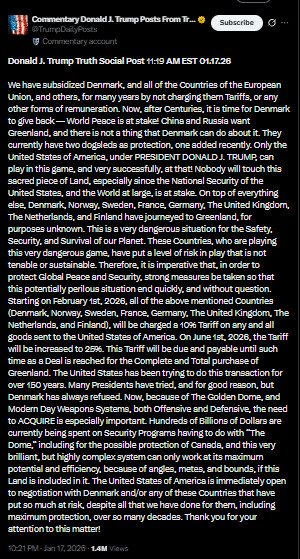
According to the source, the tensions reignited after negotiations involving the U.S. proposal to purchase Greenland stalled. President Trump stated that the United States has spent decades subsidizing European defense and now expects strategic concessions in return. This brought the Arctic region back into global focus, prompting experts to revisit its role in future defense planning.
A Sudden Trade Shock That Caught Markets Off Balance
The impact of Trump tariffs landed quickly. Starting in February, Denmark, Sweden, Norway, Finland, France, Germany, the Netherlands, and the United Kingdom will face a 10 percent import rate, which could rise to 25 percent by June if no progress is made. The tariff pressure is directly tied to Denmark’s refusal to sell Greenland to the United States.
A policy brief noted that Arctic influence has long shaped global diplomacy, adding weight to the ongoing conflict.
Equity markets in Europe saw cautious movement, while the crypto sector reacted in waves. Bitcoin held steady, suggesting that traders viewed it as a haven amid instability. Meanwhile, altcoins saw sharper reactions, reflecting the market’s fast-changing confidence levels.
According to data, political shocks often influence markets more than internal sector trends, especially during trade disruptions.
Why Analysts Believe the Greenland Dispute Runs Deeper Than Geography
Analysts argued that the renewed interest in Greenland goes beyond symbolism. A defense strategist quoted on a policy forum stated, “Arctic routes decide the future of global security,” hinting at the deeper layers behind the dispute.
Trump reinforced this idea by linking the conflict to the development of the “Golden Dome” missile defense system, which he claims requires Greenland’s geography to operate effectively. The island’s high-latitude location offers military advantages for missile tracking, energy corridors, and climate research. This context places Denmark in a problematic position as political and economic pressure intensifies.
Crypto Traders Watch the Market Ripple From a Distance
As the news spread, crypto traders monitored how Trump tariffs shaped risk appetite. Many shared charts on X showing Bitcoin’s resilience. Market analysts noted that Bitcoin often stays steady when geopolitical tensions spike. Altcoins, however, tend to swing faster.
The market response supported a long-standing view that crypto investors treat major political events as indicators for near-term volatility. The added focus on Greenland strengthened this trend as traders watched for signals that could influence global risk levels.
Global Politics, Economic Pressure, and Digital Markets Intertwine
The combination of the Arctic strategy and Trump tariffs tied political influence to global commerce. Public comments from policy researchers stressed that Arctic debates rarely remain isolated. The renewed push to acquire Greenland, combined with tariff escalation, resurfaced years of strategic tension, placing pressure on both sides to defend national interests.
Conclusion
The uncertainty created by Trump tariffs reminded markets how quickly global politics can influence financial behavior. The resurgence of Greenland as a strategic bargaining piece highlighted that territorial disputes can reshape far-reaching economic decisions, especially when linked to defense systems like the Golden Dome.
Readers following these developments may find that understanding geopolitical triggers offers practical insight, particularly in sectors where sentiment often moves faster than data.
Glossary
Tariffs: Taxes added to imported goods during cross-border trade.
Arctic Strategy: Planning based on northern routes that influence global security.
Market Sentiment: Investor emotions that guide financial decisions.
Volatility: Fast changes in asset prices driven by uncertainty.
FAQs About Trump Tariffs
Why were these countries targeted?
They were tied to political disagreements linked to Arctic strategic planning.
Why is Greenland important in this dispute?
Its location supports defense, navigation, and long-term resource routes.
How might this affect crypto traders?
Political tensions often shape short-term risk-taking in digital assets.
Could the tariffs rise to 25 percent?
Yes, if negotiations remain frozen in the coming months.