
This article was first published on Deythere.
- Core Frameworks and Environments
- Libraries and SDKs
- Testnets, Simulators, and Local Blockchains
- Security, Oracles, and Ancillary Tools
- Expert Analysis Deep: Trend and Prediction
- Table: Top Blockchain Developer Tools (2026)
- Conclusion
- Frequently Asked Questions About Blockchain Developer Tools
- How does Remix IDE benefit blockchain developers?
The progress of Blockchain development in 2026 is encouraged by a rich ecosystem of tools that make coding, testing ,and deployment of smart contracts easy. From Ethereum-specific heavyweights such as Hardhat and Foundry to browser-based web IDEs such as Remix, Blockchain developer tools offer solutions for every stage of development.
These are tools that focus on easy debugging, secure contract libraries, and simple integration with blockchains.
Core Frameworks and Environments
Hardhat and Foundry are at the core of Ethereum smart-contract development.
Hardhat is a Node. js-based environment known for its flexible, plugin-driven architecture and superior debugging.
It comes with a built-in Ethereum development network (Hardhat Network) for testing, and supports advanced features like mainnet forking. According to a recent survey, Hardhat is used by over 30% of Solidity developers. Its main standout feature is its detailed stack traces and even Solidity console.log(), making error diagnosis straightforward.
Foundry (built in Rust), is focused on raw speed. It comes complete with lightning-fast compilation and testing via its Forge framework and Anvil test node.
Foundry’s design allows writing tests in Solidity itself and excels at fuzz testing and gas optimization. The Solidity Developer Survey reported that Foundry’s adoption jumped to 51.1% among professionals in 2024.
Teams generally make the choice between Hardhat and Foundry based on familiarity (JavaScript vs. Rust) and requirements for performance.
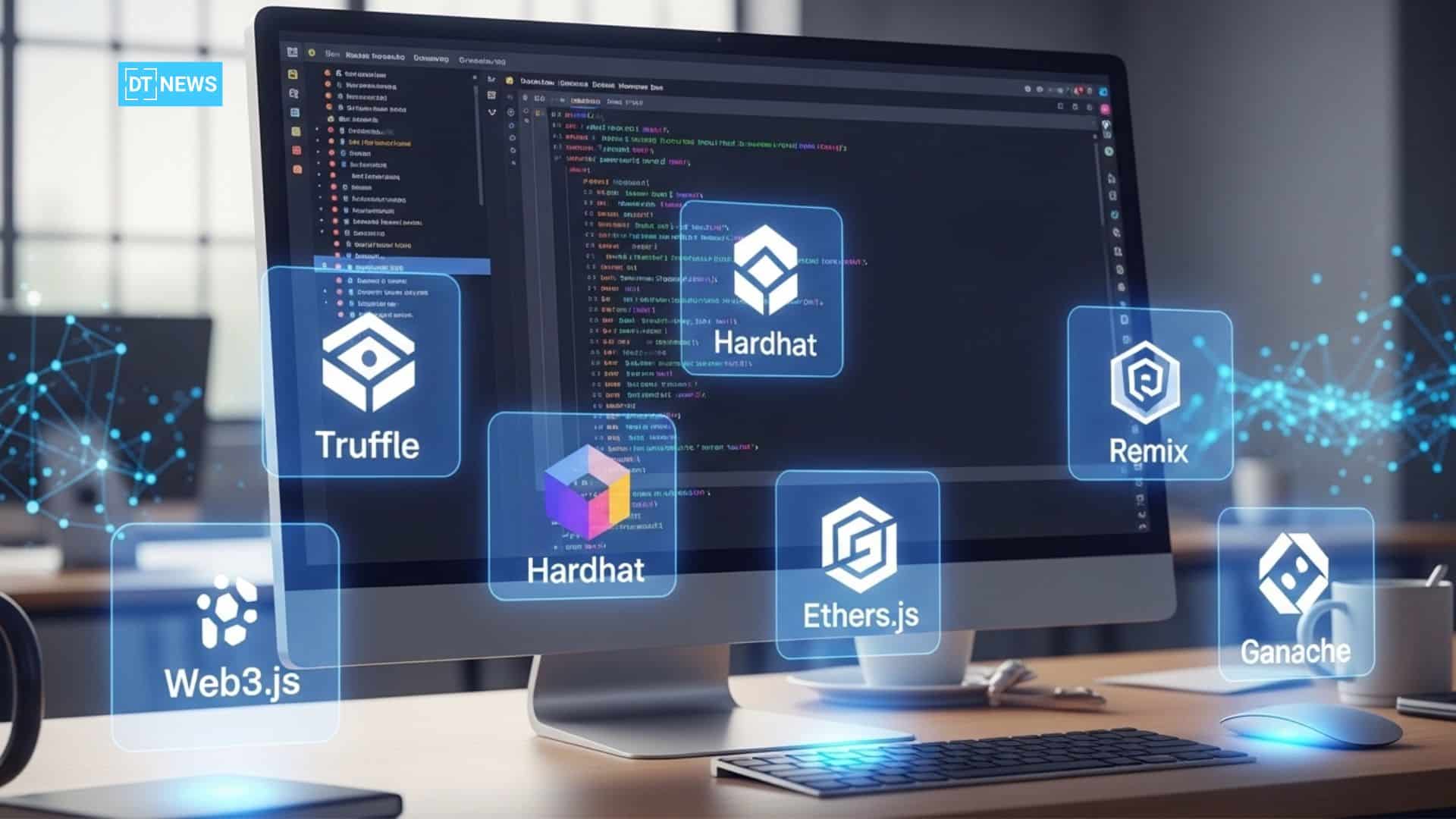
Developers are using new tools, including Hardhat or Foundry, to write and test blockchain applications faster.
Truffle Suite is a full-featured development stack for the Ethereum blockchain. Truffle offers easier way to compile and deploy contracts, and includes Ganache (a local blockchain simulator).
Smart contract migration is easy due to the suite’s strong CLI and a developer can easily prototype a smart contract before committing it on-chain.
According to industry guides, Truffle lets developers simulate an Ethereum blockchain for testing purposes without real Ether costs. Truffle is a staple in many development stacks due to its maturity and integration with tools like Ganache, Drizzle.
Remix IDE is the go-to in-browser Ethereum IDE. It doesn’t need any setup and provides a fast and efficient development experience with built-in compiler, debugger, and plugin ecosystem.
Since it operates in a browser or desktop app, Remix is easily used for rapid prototyping and learning. The official documents state that Remix is the tool used for the entire journey of smart contract development by users at every level of knowledge.
Novices and experts use Remix for writing code and debugging. It does have collaborative features and works well with MetaMask to deploy on networks.
Libraries and SDKs
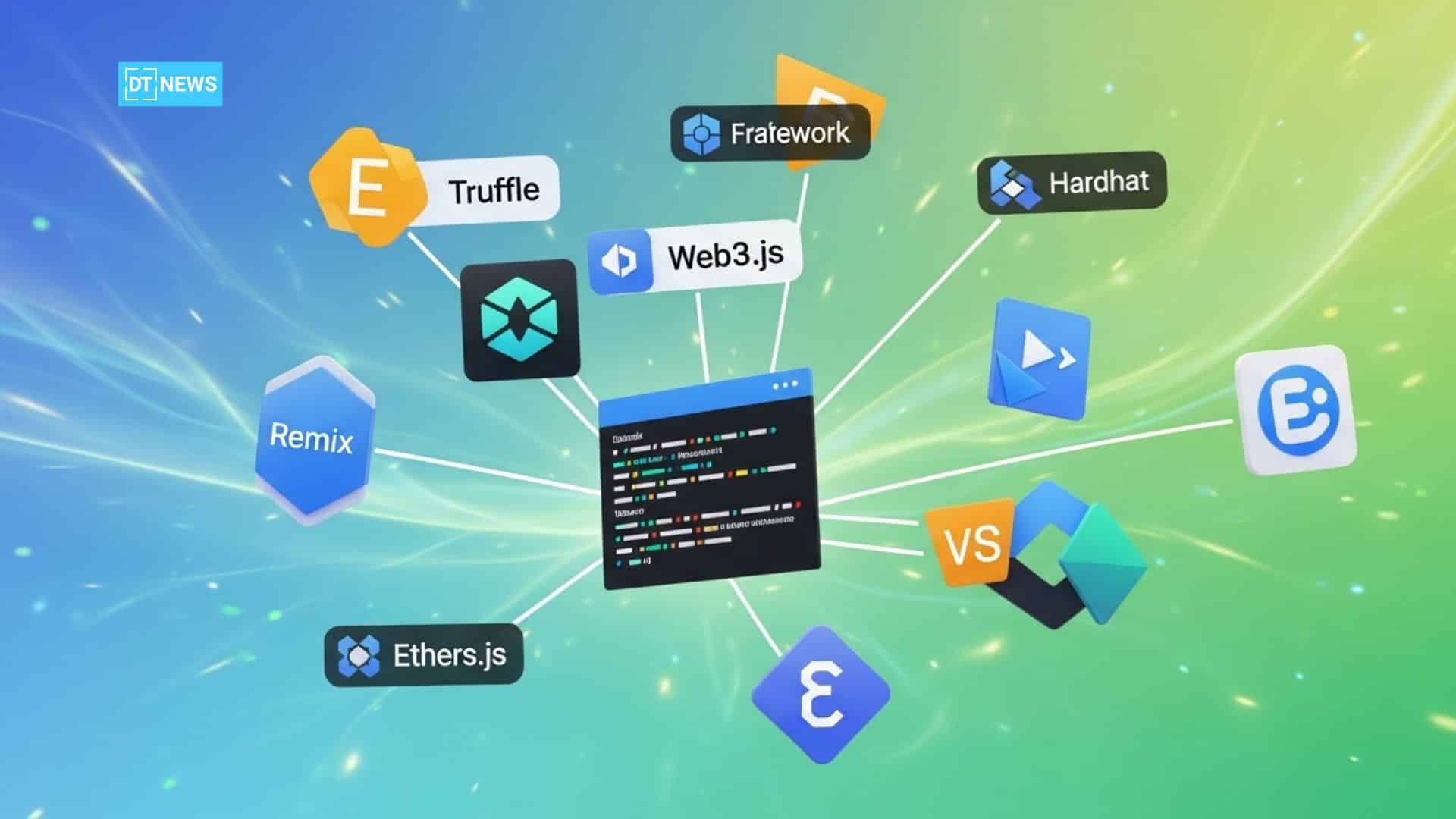
Developers rely on libraries such as Ethers.js and Web3.js to interact with blockchains in code. Ethers.js has won over developers with its clear API and incredibly deep documentation.
Newer revisions have more sophisticated wallet management capabilities and also support ENS, with built-in protections for private keys.
Notably, Ethers.js is great with new blockchain features, offering modular imports and wide Layer-2 (Optimism, Arbitrum) support. This makes Ethers.js a popular JavaScript library for Ethereum and associated networks.
Web3.js is the original JavaScript/TypeScript library for Ethereum JSON-RPC interaction. While older, it still enables basic connectivity and event handling.
Many new projects prefer Ethers.js for cleaner APIs, but Web3.js remains widely recognized and supported.
Both libraries allow applications to exchange data with nodes and wallets; eg Dapps import them to build UI contract calls.
Blockchain developer tools like this exist on other chains. For instance, Solana Web3.js (Solana’s official SDK) and Anchor (a Solana Rust framework) are also getting increasingly popular.
Ethereum-heavy tools may be popular today, but a full toolkit should support multiple chains and languages (such as Rust and Move for Solana/Aptos etc.) in order to remain relevant.
MetaMask (Dev Tools): beyond being a wallet, MetaMask’s developer SDK and extensions serve as a testing ground for dApps. It injects Web3 providers into browsers which further facilitates deployment and interaction with contracts directly from frontend code.
The widespread use of MetaMask by developers gives a convenient method to simulate user wallets during testing.
Testnets, Simulators, and Local Blockchains
It is very important to test on a safe network. Ganache (part of Truffle Suite) provides a personal Ethereum blockchain for development. It features an enhanced UI for transaction and block details, as well as power functionalities such as forking a mainnet or custom chain to simulate real conditions.
Developers can modify gas limits and network parameters on the go. New versions of Ganache now allow teams to copy entire mainnet state locally, enabling them to easily test upgrades or complex interactions.
Ganache’s comprehensive logging and account management simplify debugging in a controlled environment.
As an alternative to Ganache, there are testing runners available in blockchain frameworks (such as Hardhat Network or Anvil). The important point here is that these tools support fast, deterministic tests. For instance, Hardhat and Foundry can simulate transactions in seconds, and with Foundry’s Rust performance, tests run up to 20x faster than some older tools.
Along with local testnets, developers are also able to work with public test networks (Goerli, Mumbai, etc) and private blockchain nodes for integration tests.
Node providers such as Alchemy and Infura provide API endpoints, so that developers don’t need to run full nodes. Such facilities (or specialized RPCs like Helius for Solana) are indispensable tools for connecting applications with live networks in both the development and production phases.
Security, Oracles, and Ancillary Tools
Security and data integration are also important. OpenZeppelin is the industry-standard library of audited smart contracts. This includes both reusable ERC-20 and ERC-721 templates, access control modules, as well as tools such as the OpenZeppelin Defender for contract operations.
OpenZeppelin’s contracts and CLI support are popularly used to minimize. It even offers automated vulnerability scanning as well as governance templates for DAOs. In short, OpenZeppelin provides developers with battle-tested code, greatly accelerating safe contract development.
Chainlink is the most widely used decentralized oracle network, offering trustworthy off-chain data feeds, as well as a trusted source of on-chain randomness. It provides essential tools for linking smart contracts to external data sources, which can be price oracles, weather APIs and the like.
Its Verifiable Random Function (VRF) is arguably the standard for on-chain randomness within gaming and NFTs. Chainlink’s expanding ecosystem (Data Feeds, CCIP cross-chain messaging etc.) means developers can aggregate real-world inputs seamlessly. For any application that requires market facts, randomness or external events, Chainlink is an indispensable blockchain developer tools.
Additional specialized tools complement the developer’s kit. Tenderly is a platform for monitoring smart contracts that offers real-time debugging, transaction simulation and gas profilers. It alerts developers to issues on live contracts.
The Graph enables decentralized indexing which developers can use to query on-chain data with GraphQL instead of slow on-chain scans. These are the layers that dApps need and often cited in most guides from experts.
Expert Analysis Deep: Trend and Prediction
Experts share the belief that blockchain developer tools will continue to move toward more abstraction and speed. The recent rise in AI-assisted coding, for instance, means some teams use AI plugins to automatically write Solidity code or test cases.
Tools are, likewise, paying more attention to interoperability. Today, most frameworks can already accommodate several chains (both EVM-compatible and not) from the very beginning.
Integration is a theme seen across the leading platforms. Blockchain developer tools are working together more and more, as seen with Remix plugins for Hardhat/Foundry or OpenZeppelin contracts deployed from Truffle. Focus group feedback suggests that devs value having ecosystems where tools “play well together”.
Security still remains a major topic, so growth is expected in analysis tools such as MythX or Slither (static analyzers) alongside static type languages like Vyper or the new Move-based languages to help catch bugs earlier.
On the market side, blockchain investment globally is still growing, which creates demand for developer efficiency.
The next year or two may see established standards for interoperability of tools (e.g., universal contract metadata) as well as more automation of DevOps workflows (contracts deployed continuously).
For instance, the CI/CD integrations for tools like Foundry or Hardhat that are coming up, could automatically run and publish contracts on multi-chain environments.
Overall, in 2026 the chain of tools is as important as the blockchains themselves. Developers will rely on a stack composed of frameworks (Hardhat/Foundry), IDEs (RemiX/VsCode), libraries (Ethers/Web3) and also infrastructure/tool suites (Ganache, Alchemy) and securities suites (OpenZeppelin) to build strong dApps.
Each tool has its own value, but when brought together as one ecosystem, it enables teams to innovate more quickly with less risk.
Table: Top Blockchain Developer Tools (2026)
| Tool | Category | Key Use/Features |
| Hardhat | Ethereum framework | Flexible task runner, detailed debugging, plugin ecosystem |
| Foundry | Ethereum toolkit | High-speed testing (Rust-based), Solidity-based tests, built-in node |
| Remix IDE | Web IDE | Browser-based Solidity editor/debugger, no install required |
| Truffle Suite | Ethereum framework | Contract pipeline (compile, deploy), Ganache integration |
| Ganache | Local blockchain | Personal Ethereum blockchain, network forking for testing |
| Ethers.js | Library/SDK | Intuitive JS API for Ethereum, wallet & ENS support |
| Web3.js | Library/SDK | Ethereum JSON-RPC client (WebSocket/HTTP) |
| OpenZeppelin | Security Library | Audited contracts (ERCs, access control), upgrade tools |
| Chainlink | Oracle Protocol | Decentralized data feeds & randomness (VRF) |
| Tenderly | DevOps Monitoring | Real-time smart contract monitoring, simulation, gas analysis |
The blockchain developer tools listed above serve different purposes from coding, testing and data, to security etc. Together, they form a comprehensive toolkit for building modern dApps in 2026.
Conclusion
Blockchain developer tools in 2026 are marked by greater efficacy, compatibility and security. Developers now have a rich toolbox with frameworks like Hardhat and Foundry that make testing and debugging more efficient, while IDEs like Remix provide developers with the ability to develop without installing anything.
Libraries such as Ethers.js making blockchain interaction simpler, platforms such as OpenZeppelin and Chainlink that give battle-tested contracts and trustworthy data to a project.
The ability to utilize these top tools will enable blockchain engineers to create and deploy smart contracts more quickly, safely and with cross-chain compatibility.
Glossary
Blockchain: A digital ledger comprised of a chain of blocks, each one a list of transactions that is sealed with cryptography and maintained by a network of nodes.
Smart Contract: Code in a blockchain that executes automatically when certain conditions are met.
dApp (Decentralized Application): A software application that runs on a blockchain or peer-to-peer network and typically makes use of smart contracts for its backend logic.
Solidity: A widely used language to write smart contracts on Ethereum (statistically typed, inspired by JavaScript and C++).
Oracle: A provider (such as Chainlink) that imports and exports data from the real world, into smart contracts on-chain.
EVM (Ethereum Virtual Machine) : The virtual environment in which all smart contracts run on Ethereum and similar blockchains.
Frequently Asked Questions About Blockchain Developer Tools
What is Hardhat and why is it popular?
Hardhat is a JavaScript-based Ethereum development framework for compiling, deploying, testing and debugging smart contracts. It’s popular for its fast local testing network (Hardhat Network) and superior debugging tools (stack traces, Solidity console.log).
How does Remix IDE benefit blockchain developers?
Remix is a free browser-based IDE for Solidity. It is zero-installed, works in the browser and provides instant compilation and debugging, and supports a rich plugin environment. Remix is used from the creation of the smart contract up to it’s deployment.
Why use OpenZeppelin contracts?
OpenZeppelin offers security audited libraries of reusable smart contract libraries (e.g. ERC-20 tokens and access controls). Developers can save time on having to code patterns that are common, and also include security best practices so their contracts are less likely to have a vulnerability.
How does Chainlink fit into the development?
Chainlink provides decentralized oracle services, meaning what they do is provide verified real-world data (price feeds etc.) for smart contracts. Developers use Chainlink tools when contracts require data inputs from outside like market prices, or provable randomness for games/NFTs.
Can developers use these tools on other blockchains?
Many of the tools are blockchain-oriented (tools focused on Ethereum/EVM chains are typically based on Solidity). But the ecosystem is growing; Hardhat and OpenZeppelin now support more networks, and libraries like Ethers.js work with any EVM-compatible chain.