

























This article was first published on Deythere.
- QVAC Fabric Moves AI From the Cloud to the Device
- Billion-Scale AI Models Work on Smartphones Now
- More Access for Developers Due to Open Source Push
- Tether Leverages Growing AI Strategy in March 2026
- Conclusion
- Glossary
- Frequently Asked Questions About Tether QVAC AI
- What is Tether QVAC AI?
- Does QVAC require cloud computing?
- What devices support QVAC Fabric?
- Why is this important?
- Is QVAC open source?
- References
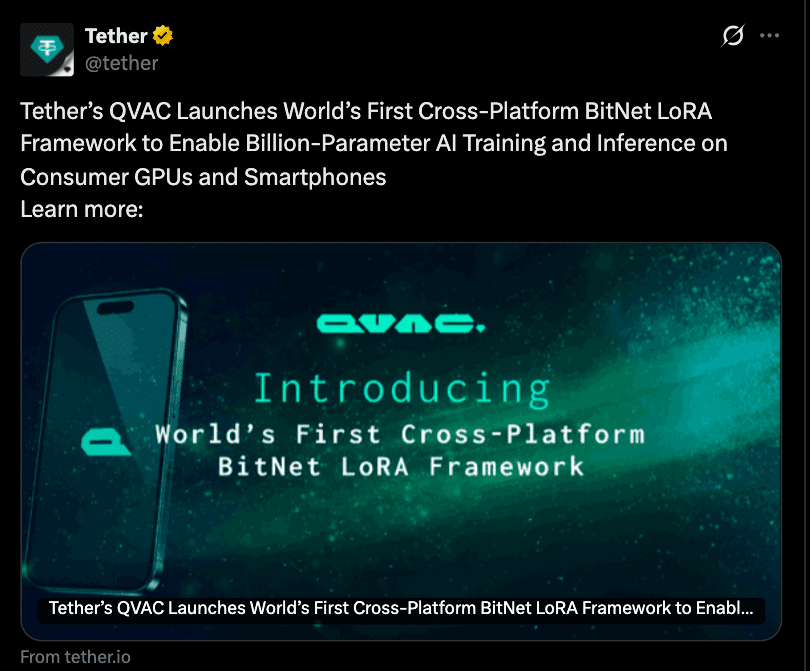
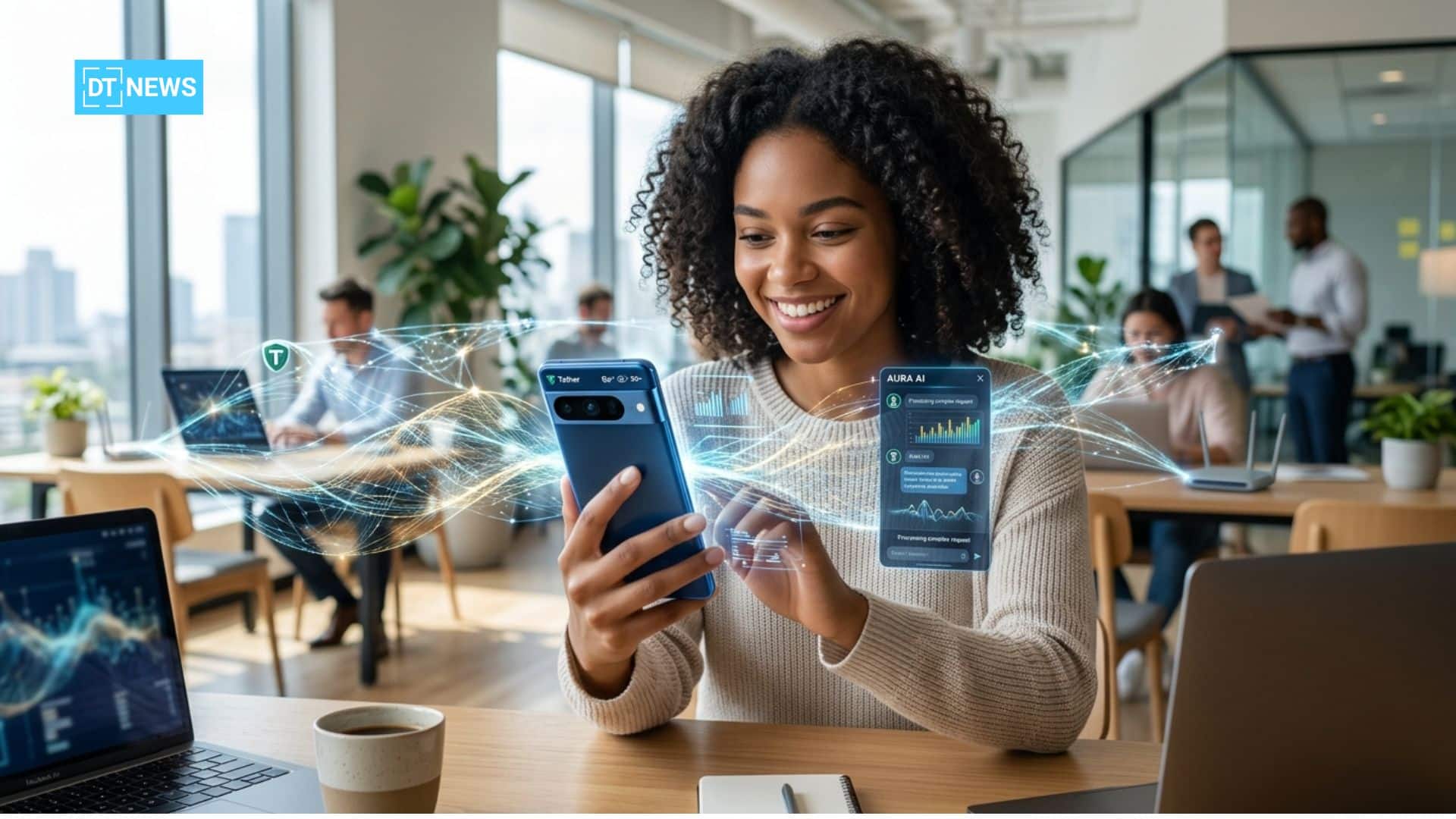
The latest Tether QVAC AI development brings artificial intelligence even closer to everyday users, as the company has introduced a system that permits large models to operate directly on smartphones and consumer hardware.
Introduced with Tether’s growing AI team, Tether QVAC AI also removes the need for cloud-based processing. Instead; it enables training and inference directly on the device, smartphone, laptop, regular GPU.
QVAC Fabric Moves AI From the Cloud to the Device
The main point of this rollout is QVAC Fabric, the engine behind Tether QVAC which integrates BitNet LoRA to fine‑tune and run multi‑billion‑parameter AI models on consumer GPUs and flagship phones. This system lets developers run and fine-tune large language models locally on consumer hardware, avoiding the need for costly cloud-based infrastructure.
This is different from how AI has always been managed. The training and deployment of advanced models had previously required specialized data centers or high-performance GPU clusters. Now with Tether QVAC AI; those requirements are getting much lower.
The framework is backed on diverse hardware, from AMD and Intel GPUs to Apple Silicon and mobile chipsets. It also is compatible with major operating systems, which opens it up for use by developers operating on different platforms.
Tether says the aim is straightforward: enable users and companies to create and execute AI on machines they already possess, without needing to transfer confidential information to third-party servers.
Billion-Scale AI Models Work on Smartphones Now
If there is something that catches people off guard about Tether QVAC AI, it is the fact that this can run very large models on devices that were never meant to be able to do so.
The system allows fine-tuning on mobile GPUs, the same kind of chips found in modern smartphones. That means AI models could train and adapt directly from phones, without having to rely on outside computing power.
Tether’s team says it has completed fine‑tuning of models up to 3.8 billion parameters on devices like the Pixel 9, Galaxy S25, and iPhone 16, and has pushed fine‑tuning to as large as 13 billion parameters on the iPhone 16 specifically.
This is different from current industry norms. Most of the mobile AI tools available today are either based on smaller models or are quite reliant on cloud processing for more complex tasks.
Tether QVAC AI on the other hand can support much larger local models. The implication is that rather than just being simple AI interfaces, smartphones are stepping into the role of the complete AI processing unit.
For users, this could translate to quicker responses, better personalization and improved privacy because data stays on the device.
More Access for Developers Due to Open Source Push
Open-source release is another aspect of the Tether QVAC debut. The framework also has been released under an Apache 2.0 license, so developers can use and modify the system as they see fit.
This choice is a distribution strategy. Tether is fostering development on its infrastructure, opening up access for developers, startups and research teams alike.
The company has also been expanding its AI ecosystem with earlier launches. These consist of massive training datasets and local AI tools targeted toward working without relying on the cloud.
These are systems meant to decrease the difficulty of creating AI. Tether QVAC allows teams of smaller size to play with advanced models without waiting for access to costly infrastructure.
Tether Leverages Growing AI Strategy in March 2026
Tether is actively expanding its investments in AI providing not only software tools but also additional support.
Earlier in the month; a $1.5 billion valuation-backed investment in Eight Sleep, a health technology company specializing in AI-powered sleep systems was recently made by the company. The collaboration is expected to use QVAC technology, enabling on-device processing of data for consumer health products using AI.
At the time, Tether CEO Paolo Ardoino had stated that AI should not fall under the control of centralized platforms, adding that users should be able to run and customize models “on their own terms, on their own hardware.”
This is completely in sync with the idea behind Tether QVAC AI integration. It is constructing an AI-powered system that can work locally, learn about the user and be free of central governance.
Conclusion
There is a clear direction in the rollout of Tether QVAC BitNet LoRA platform. This is that AI is no longer just running in big data centers; it is getting closer to the user.
Tether is defying the expectations that advanced AI must run on centralized infrastructure by running large models locally, in the browser and on consumer GPUs. The firm is going beyond stablecoins, into building the systems that support decentralized computing.
For now, the system will be tested by adoption. Not only that, if Tether QVAC AI finds its way into developers hands and becomes adopted by a majority, it will clean up the way AI tools are created and distributed.
Glossary
QVAC Fabric: Tether’s system for executing AI models on local devices.
Local AI: A type of artificial intelligence that operates natively on a user’s device.
GPU: Graphics Processing Unit-hardware used to accelerate computing tasks like AI processing.
LoRA: A method of efficiently fine-tuning AI models
Inference: When you use an AI model to generate outputs from it.
Frequently Asked Questions About Tether QVAC AI
What is Tether QVAC AI?
Tether QVAC AI is a framework that enables running and training large language models on local devices including smartphones and GPUs.
Does QVAC require cloud computing?
No. It is made in an effort to ensure that it works locally without any need of data being sent out to servers.
What devices support QVAC Fabric?
It works on smartphones, laptops and AMD, Intel, Apple and mobile chipset GPUs.
Why is this important?
This allows for less reliance on centralized AI infrastructure and enhances data privacy.
Is QVAC open source?
Yes. And it is made available to developers under an Apache 2.0 license, encouraging reuse and modification.