
This article was first published on Deythere.
- What Happens When Tether Burns USDT?
- How Large Is This Burn Compared to Previous Ones?
- Why Did Tether Mint 1 Billion USDT on Tron Recently?
- Why Do Large Burns Matter for Stablecoin Supply Balance?
- How Does Transparency Factor Into Tether’s Supply Management?
- How Is Tether Expanding Its Role Beyond Supply Operations?
- Conclusion
- Glossary
- Frequently Asked Questions About Tether USDT Burn
Tether USDT burn has permanently taken 3 billion USDT out of circulation, making it one of the largest supply reductions in the stablecoin’s history. The burn represents about 3–4% of Tether’s total supply and followed heavy redemption activity.
This reflects the company’s standard supply management process aimed at keeping USDT aligned with real market demand. Despite the scale of the transaction, USDT continues to trade close to its $1 peg, with the stablecoin around $0.9988, while liquidity in major trading pairs returned to normal shortly after.
What Happens When Tether Burns USDT?
The Tether USDT burn removes tokens by sending them to a blockchain address that cannot be accessed again, effectively taking them out of circulation. Blockchain records from Etherscan show the transaction was completed on Tuesday, January 20, 2026, at 14:56:35 UTC, and originated from the address 0xC6CD****a828. Whale Alert flagged the wallet as part of Tether’s verified Treasury operations.
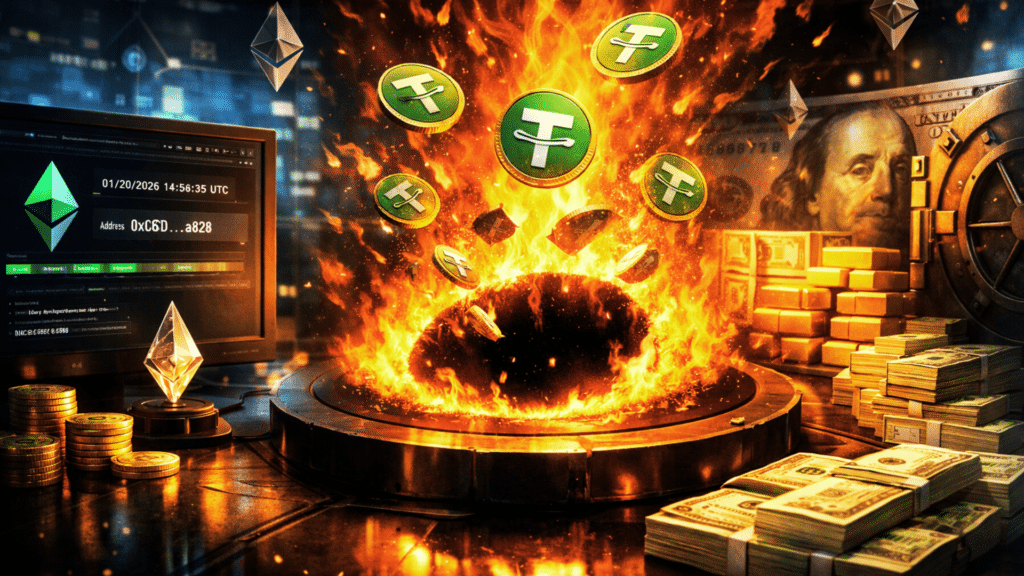
This type of action is standard for Tether when large amounts of USDT are redeemed for fiat currency. By reducing the number of tokens in circulation, the company avoids an excess supply in the market. While the tokens are permanently removed, the dollar reserves backing USDT remain untouched, allowing the stablecoin to maintain its 1:1 value against the US dollar.
How Large Is This Burn Compared to Previous Ones?
Tether has been adjusting the size of its USDT supply for years by adding tokens when demand rises and removing them when redemptions increase. In April 2021, the company burned 1.5 billion USDT, followed by another 2 billion USDT burn in July 2022.
The latest Tether USDT burn is larger than both of those events, making it the biggest one-time reduction the stablecoin has seen so far. Despite the scale of the move, trading remained calm. Liquidity in major pairs such as BTC/USDT and ETH/USDT fell briefly before recovering, indicating that the market absorbed the change without broader disruption.
Why Did Tether Mint 1 Billion USDT on Tron Recently?
The Tether USDT burn came days after Tether carried out its first major mint of 2026, creating 1 billion USDT on the Tron network on January 9. Those tokens were not released into the market and were kept aside in reserve.
Tether typically uses this setup so liquidity is available ahead of demand rather than being added later. Holding tokens in reserve allows exchanges, institutional users, and market makers to access USDT when trading activity increases, without waiting for new issuance or causing supply gaps.
Why Do Large Burns Matter for Stablecoin Supply Balance?
Large reductions in supply are meant to keep too many tokens from building up in the market. If redeemed USDT is not taken out of circulation, it can leave more tokens available than users actually need, which may put pressure on price stability. Burns like this are used to keep the issued supply closer to real usage.
Market participants generally see these moves as part of normal operations. They show that Tether can handle large redemptions without strain, and analysts treat them as routine liquidity management rather than signs of market stress.
How Does Transparency Factor Into Tether’s Supply Management?
Beyond what is visible on the blockchain, Tether also publishes reserve reports on a quarterly basis that outline the assets backing USDT. These reports offer added clarity on how the company’s minting and burning activity relates to the reserves it holds.
Public blockchain data shows what happens on-chain, while the reserve disclosures explain the financial side behind those movements. Together, this information allows traders, institutions, and regulators to assess whether Tether can meet redemptions and manage its supply responsibly.
How Is Tether Expanding Its Role Beyond Supply Operations?
Alongside the Tether USDT burn, the company also announced a Bitcoin and stablecoin education program in Laos planned for 2026. The initiative is being launched with licensed exchange Bitqik and is intended for students, young workers, and local businesses.

It will focus on helping participants understand how Bitcoin, stablecoins, and blockchain tools can be used safely in everyday situations. The program shows that Tether is working beyond infrastructure, with an added focus on access and practical use within the broader crypto economy.
Conclusion
Tether USDT burn activity at this scale shows how supply adjustments are used to support stability rather than send signals to the market. By removing 3 billion USDT following redemptions, Tether reduced excess circulation while keeping trading conditions steady and liquidity available across major platforms.
With publicly visible on-chain records, regular reserve disclosures, and a history of similar supply actions, the latest burn aligns with Tether’s established operating framework. For exchanges and institutions that rely on USDT, it reinforces confidence that large redemption events can be handled without causing broader market disruption.
Glossary
USDT Burn: When Tether removes USDT tokens permanently to reduce supply.
Minting: Creating new USDT tokens and adding them to the blockchain.
Blockchain Address: A digital location where USDT is stored or sent.
Reserve Reports: Quarterly updates showing the assets backing USDT.
Supply Management: How Tether controls USDT supply to keep demand and price stable.
Frequently Asked Questions About Tether USDT Burn
How many USDT were burned recently?
Tether burned 3 billion USDT, which is one of the largest reductions in its history.
How big is this burn compared to previous ones?
This 3B USDT burn is larger than previous burns, which were 1.5B in 2021 and 2B in 2022.
Why does Tether burn USDT tokens?
Tether burns tokens to match supply with real demand and to keep USDT’s $1 value stable.
What happens to the burned USDT tokens?
The burned tokens are sent to a blockchain address that cannot be used again, removing them permanently.
How do large burns help stablecoins?
Large burns prevent too many tokens from flooding the market, keeping the price stable and supply balanced.