

This article was first published on Deythere.
- What does the Takaichi Trade signal to markets?
- Why did Japan’s Nikkei 225 rally on Monday?
- How did Bitcoin and Gold respond during Asian trading hours?
- What was the reaction in U.S. markets?
- Did international political signals influence sentiment?
- Conclusion
- Glossary
- Frequently Asked Questions About Takaichi Trade
Takaichi Trade prompted a broad reaction across global markets after Japan’s election delivered a decisive outcome that investors had been waiting for. Prime Minister Sanae Takaichi’s supermajority win in Sunday’s general election brought short-term policy clarity, shaping market sentiment as trading got underway on Monday.
Japan’s Nikkei 225 advanced 3.4% during Monday’s session, crossing above the 57,000 mark for the first time on record. The rise reflected confidence in political stability and in the government’s capacity to move ahead with expansive fiscal initiatives.
What does the Takaichi Trade signal to markets?
The Takaichi Trade describes the broad market response tied to expectations of aggressive fiscal expansion under Prime Minister Takaichi’s strengthened mandate. Investors viewed the election outcome as a sign that upcoming economic plans are likely to move through parliament with limited opposition.

A key part of this outlook is a $135 billion stimulus program focused on infrastructure projects and tax relief. Market participants said clear direction on fiscal policy often lowers uncertainty, particularly for Japanese stocks that benefit from domestic growth.
Why did Japan’s Nikkei 225 rally on Monday?
The timing of events played an important role. Japan’s election concluded on Sunday, and markets responded as soon as trading opened on Monday. The Nikkei 225 rose 3.4%, moving above the 57,000 level for the first time.
Traders connected the advance to expectations that increased government spending would lift business performance and strengthen domestic demand. In this setting, the Takaichi Trade emerged as a common term for growing confidence in Japan’s economic direction.
How did Bitcoin and Gold respond during Asian trading hours?
The market reaction was not limited to stocks. Bitcoin climbed to a high of $72,000 before easing back above $70,000 during Asia morning trading hours. It is up by 2% in 24 hours. Gold also advanced, moving beyond $5,000 per ounce.
Market analysts said the rise in both higher-risk assets and traditional safe havens showed a balanced investor response. The Takaichi Trade reflected a strategy of seeking growth opportunities while remaining mindful of the longer-term effects of expansive fiscal policy.
What was the reaction in U.S. markets?
U.S. stock market futures moved higher as trading began, reflecting the upbeat sentiment carried over from Asian markets. The response indicated that investors saw Japan’s political outcome as reinforcing global growth expectations, not disrupting them.
This view fit with the positive mood already present in U.S. equities. Rather than changing the market story, the Takaichi Trade strengthened existing confidence.
Did international political signals influence sentiment?
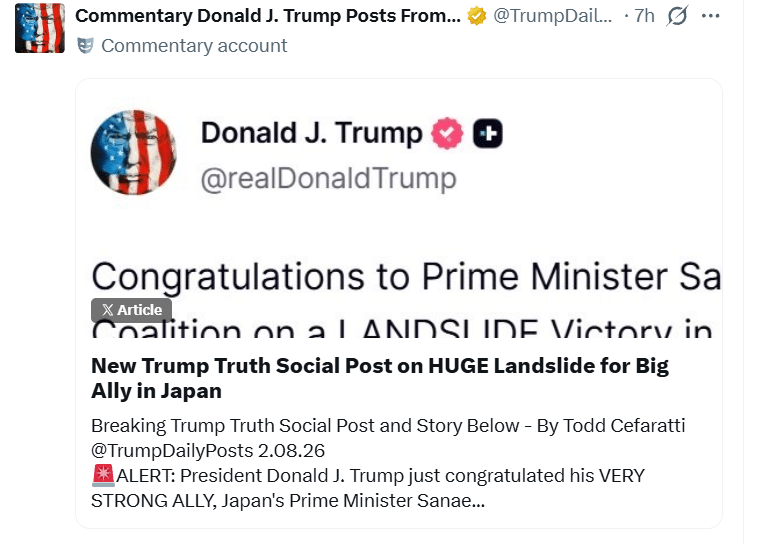
International responses reinforced market confidence. U.S. President Donald Trump and Treasury Secretary Scott Bessent publicly congratulated Prime Minister Takaichi, signaling diplomatic continuity.
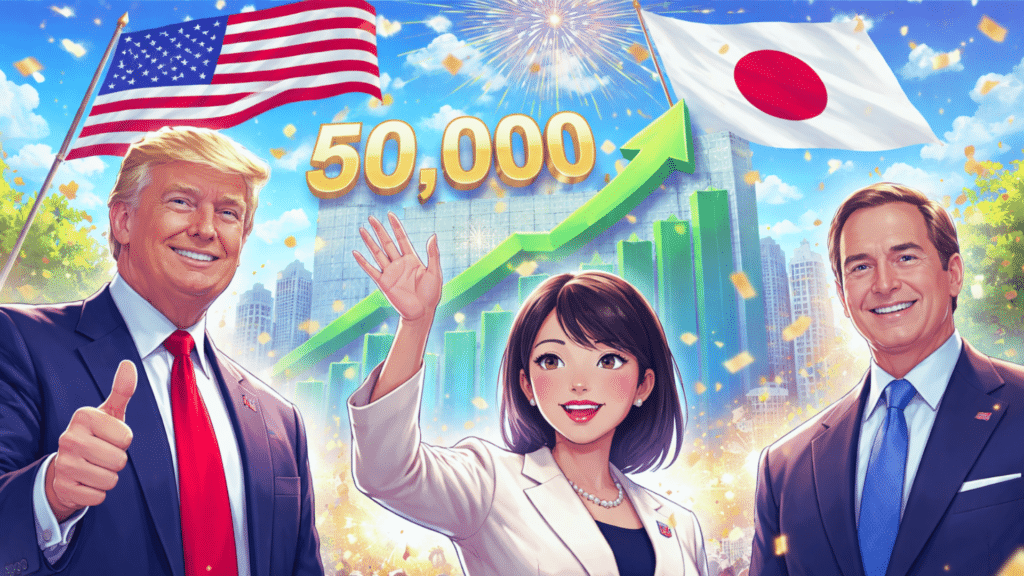
Trump has stated his aim for the Dow Jones Industrial Average to reach 100,000 by the end of his term. The $DJI moved past 50,000 for the first time on Friday, creating a supportive market backdrop as the Takaichi Trade took shape.
Conclusion
The Takaichi Trade shows how quickly markets can move when political direction becomes clear. New highs in the Nikkei, bitcoin reaching $72,000 before holding above $70,000 during Asia morning trading, and gold climbing past $5,000 demonstrate the scale of the reaction.
How long this strength lasts will depend on how effectively the announced fiscal plans are carried out. For now, investors are responding to confirmed results and clear policy signals, viewing Japan’s mandate as an event with global importance rather than a domestic development.
Disclaimer: This article is for informational purposes only and does not constitute financial or investment advice. Market prices mentioned are subject to change.
Glossary
Takaichi Trade: Markets rise as investors expect more government spending in Japan.
Nikkei 225: A stock index that tracks major Japanese companies.
Stimulus Package: Government money used to support the economy.
Risk Assets: Investments that can change value quickly.
Infrastructure Spending: Government spending on roads and public services.
Frequently Asked Questions About Takaichi Trade
Why did the Nikkei 225 reach a record high?
The Nikkei 225 rose because investors believe government spending will help Japanese companies grow.
How much did the Nikkei 225 rise?
The Nikkei 225 increased by 3.4 percent and crossed 57,000 for the first time.
Why did Bitcoin rise to $72,000?
Bitcoin rose as investors moved into risk assets during the global market rally.
Why did gold move above $5,000?
Gold increased because some investors still wanted safety while markets were volatile.
What is included in Japan’s stimulus plan?
Japan’s stimulus plan includes infrastructure spending and tax cuts worth $135 billion.
Sources