

Sui is trying to find its footing after a bruising pullback, and the timing is not accidental. As traders watch the chart for signs of exhaustion, a new onramp has arrived in the traditional market: TSUI, a spot-style fund tied to SUI, has begun trading on a major U.S. exchange. That combination, a pressured token and a fresh access route, is why the conversation has shifted from panic to whether a tradable base is forming, and what a realistic SUI price prediction should look like in the days ahead.
- A new access route lands while SUI searches for support
- SUI Price Prediction: Oversold signals meet a real-world catalyst
- What volume and derivatives data are really saying
- Levels that matter and what would count as “confirmation.”
- Why TSUI matters, and why it does not solve everything
- Conclusion
- Frequently Asked Questions (FAQs)
A new access route lands while SUI searches for support
TSUI launched on February 24, 2026, giving investors exposure through standard brokerage plumbing rather than direct token custody. The product carries a 0.30% management fee, and the launch coverage points to that fee being waived through October 2026, alongside roughly $9.2 million in assets at the start.
A Nasdaq notice also flagged that daily valuation information would begin dissemination on February 24, reinforcing that this is meant to trade like familiar exchange-listed products.
It is still a crypto-linked vehicle, not a magic shield as the issuer’s own disclosure states the product is not registered under the Investment Company Act of 1940, which matters because it is not subject to the same framework and protections investors often associate with mainstream ETF wrappers.
That nuance is easy to miss when headlines get loud, but it should sit right next to any SUI price prediction because structure affects expectations, risk tolerance, and how institutions may size exposure.
SUI Price Prediction: Oversold signals meet a real-world catalyst
SUI has been trading below the psychological $1.00 area in recent pricing snapshots, after a sharp month that the market has treated as a reset. The bounce talk comes from a familiar place: oversold indicators that tend to show up when selling pressure has already done its damage.
The Relative Strength Index, or RSI, is a momentum gauge that compares recent gains to recent losses on a 0–100 scale. When it sinks toward 30, traders often read it as “oversold,” meaning price has been pushed down quickly and may be due for a reflex move.
In this case, the market commentary highlighted RSI falling into the low-30s and then starting to curl upward, which is the first hint that sellers might be running out of clean follow-through. That does not guarantee a reversal, but it often marks the moment where a SUI price prediction stops being purely about downside risk and starts including the probability of a rebound.
Bollinger Bands add another layer as they wrap price with an upper and lower band based on volatility, like guardrails that widen during chaos and tighten when the market calms down. When price rides the lower band for days, it can signal persistent selling. When those bands begin to compress, it sometimes suggests volatility is cooling, which can set up a bigger move in either direction. The current setup has been framed as SUI leaning on the lower band while compression begins, basically the chart version of a spring being pressed down.
What volume and derivatives data are really saying
Indicators are useful, but they are not the whole movie. Volume is the “crowd size” behind the move. When price tries to bounce on thin volume, it can fizzle because there is no conviction behind it. The coverage referenced softer spot and derivatives activity during the drop, alongside open interest that did not scream aggressive re-leveraging.
That suggests traders were not piling into fresh risk at the lows, which can be healthy if the market is trying to reset, but it also means a bounce needs confirmation. A responsible SUI price prediction should treat a low-volume uptick as a possibility, not proof.

Levels that matter and what would count as “confirmation.”
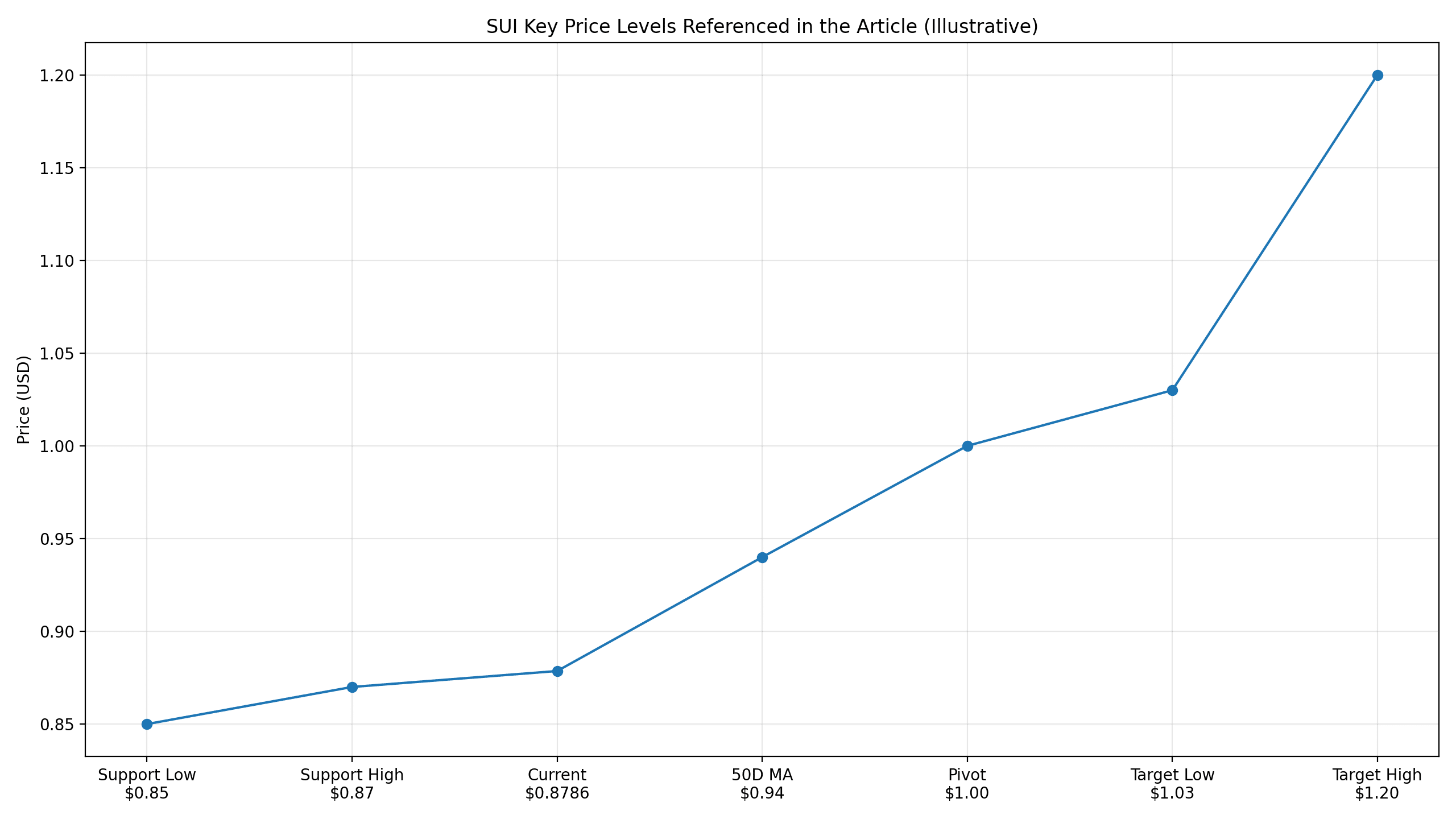
Markets tend to respect levels because people remember them. When enough participants view a zone as “cheap” or “expensive,” it becomes self-reinforcing until it breaks. The near-term support area has been discussed around $0.85–$0.87, a region where buyers have a chance to show they are willing to defend price rather than just hope for relief.
On the upside, reclaiming a commonly watched moving average, such as the 50-day, often acts like a trend checkpoint. A move back above that line, paired with improving RSI and better volume, tends to be the kind of “three-signal” confirmation traders look for. If that happens, the story shifts from a dead-cat bounce to a more credible base-building narrative, and the SUI price prediction conversation naturally broadens beyond a quick snapback.
Why TSUI matters, and why it does not solve everything
A U.S.-listed product can make participation easier, and sometimes that convenience changes the flow over time. It can also bring new types of holders who are less interested in leverage and more interested in allocation. Still, the wrapper does not remove crypto volatility, and it does not force the underlying token to recover.
TSUI is best understood as a distribution channel, not a guarantee. That is why the cleanest read is balanced: oversold conditions can fuel a rebound, TSUI can help broaden access, but price still has to earn the turn with structure, momentum, and follow-through. That is the most defensible SUI price prediction framing right now.
Conclusion
SUI is in the part of the cycle where charts start whispering “exhaustion” after weeks of selling, and TSUI’s launch gives the market a timely narrative hook. The practical takeaway is simple: an oversold bounce is plausible, but the market will want proof in the form of stronger momentum, improving volume, and a reclaim of key technical levels. Until then, the smartest SUI price prediction is one that respects both sides of the tape, because crypto has a habit of punishing certainty.
Frequently Asked Questions (FAQs)
What is TSUI and why does it matter for SUI?
TSUI is an exchange-listed product designed to give investors exposure to SUI through brokerage accounts. It matters because it can broaden access, particularly for participants who prefer regulated market infrastructure.
Does an oversold RSI mean SUI must rebound?
No. RSI near 30 often signals selling has been intense, and rebounds can happen, but RSI is a probability tool, not a guarantee. Confirmation usually comes from price structure and volume, not RSI alone.
Why do Bollinger Bands matter during selloffs?
They help visualize volatility and extremes. Price pressing the lower band can show persistent weakness, while tightening bands can hint that volatility is cooling and a larger move may be building.
Glossary of Key Terms
RSI (Relative Strength Index): A momentum indicator on a 0–100 scale used to spot potential overbought or oversold conditions.
Bollinger Bands: Volatility bands around price that expand during turbulence and tighten when volatility cools.
Moving Average (MA): A smoothed price line used to gauge trend direction and potential support or resistance.
Support: A price area where buying interest has historically appeared, sometimes slowing or stopping declines.
Open Interest: The total number of outstanding derivatives positions, often used to gauge leverage and participation.
Disclaimer: This article is for informational purposes only and does not constitute investment advice.
Sources