

This article was first published on Deythere.
Stablecoins growth is quietly reshaping the architecture of global payments, raising a question that banks and fintech firms can no longer ignore. What began as a simple crypto trading tool has evolved into a digital settlement layer that now commands serious attention from financial institutions worldwide.
According to the source, the stablecoin market has reached approximately $226 billion in total value, while traditional systems such as the Automated Clearing House continue to process nearly $93 trillion annually.
That contrast highlights both the rapid expansion of stablecoins growth and the immense scale gap that still separates blockchain-based payments from legacy financial infrastructure.
From Exchange Liquidity to Global Payment Infrastructure
The stablecoin market has evolved rapidly over the past several years, transitioning from a niche trading utility to a multi-layered financial instrument supporting decentralized finance, remittances, payroll solutions, and business settlements across borders.
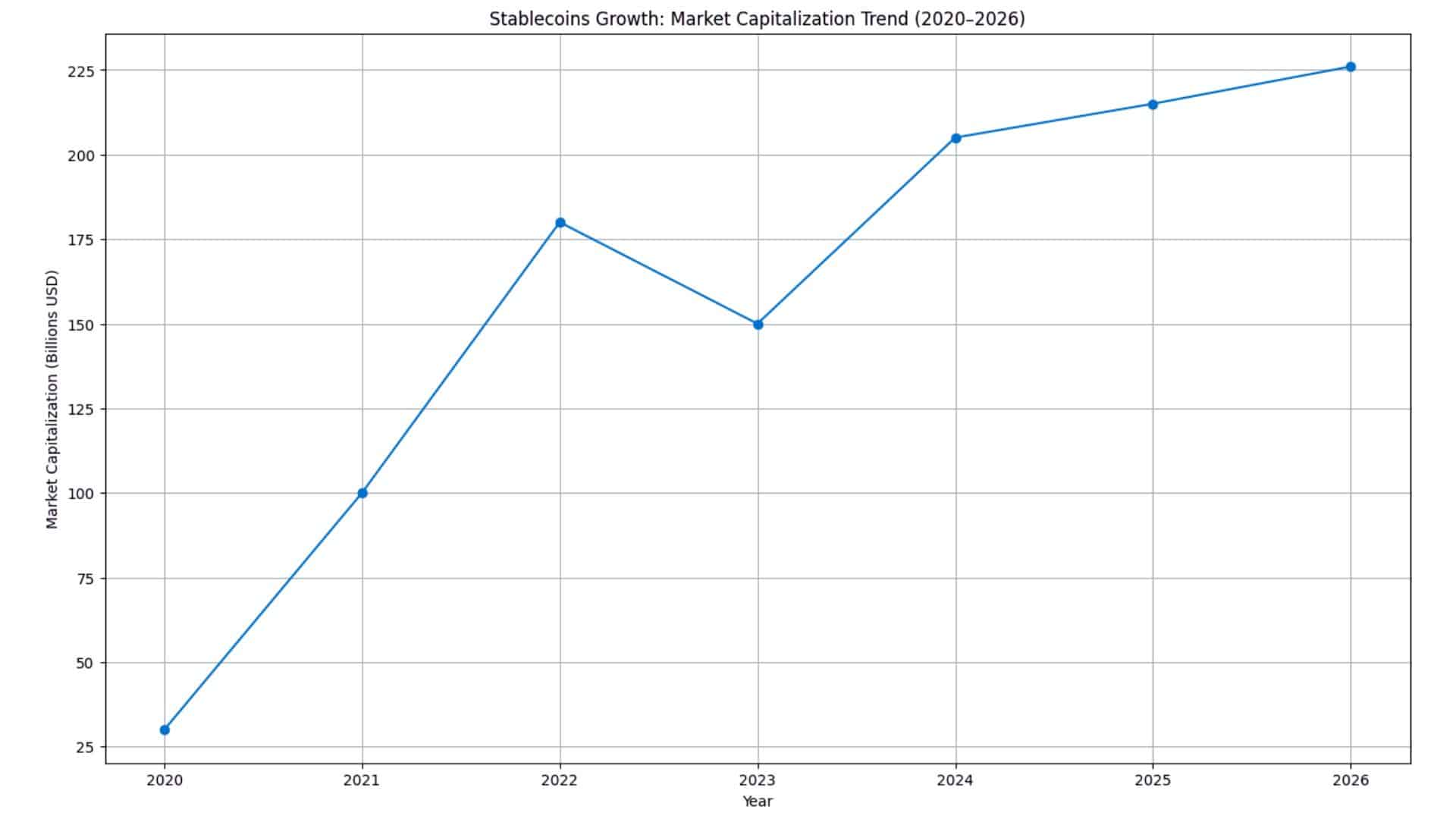
Aggregated industry data from recognized market tracking platforms shows that total capitalization expanded from below $30 billion in early 2020 to roughly $226 billion in 2026, illustrating how stablecoins growth has outpaced many traditional fintech innovations during the same period.
This expansion reflects demand for digital dollars that operate outside conventional banking hours while maintaining price stability relative to fiat currency. In emerging economies facing inflationary pressure or limited access to U.S. dollar banking channels, stablecoins increasingly function as an accessible store of value and transfer medium, reinforcing the relevance of the stablecoin market in global liquidity flows.
Why Stablecoins Growth Continues to Accelerate
Stablecoins growth is driven by clear operational advantages that address long-standing inefficiencies in global payments. Traditional bank transfers often require multiple intermediaries and several business days to settle, while blockchain-based transfers can finalize within minutes depending on network conditions.
Accessibility also strengthens adoption, since blockchain networks operate continuously without banking hour restrictions, allowing businesses and remote workforces to transact at any time across borders. This uninterrupted availability aligns with the demands of global e-commerce and decentralized finance.
Cost efficiency further supports stablecoins growth, as cross-border wires typically involve layered fees that reduce transaction value, especially for small and medium-sized enterprises in emerging markets. By reducing intermediary dependence and enabling programmable transfers, stablecoins offer a more transparent alternative.
Institutional pilots add credibility to this expansion, with payment processors and fintech firms testing blockchain settlement rails to streamline treasury management and lower counterparty risk. While these initiatives do not replace legacy systems, they position the stablecoin market as complementary infrastructure rather than speculative experimentation.
Competition, Modernization, and the Digital Currency Race
While stablecoins growth gains attention, traditional payment networks are not remaining static in the face of innovation. The ACH system has implemented same-day processing capabilities to enhance efficiency, and major card networks have explored tokenization frameworks and blockchain integrations to modernize backend settlement processes.
Simultaneously, central bank digital currencies are advancing from theoretical frameworks to pilot programs in multiple jurisdictions, reflecting governmental interest in digital sovereign money. Although CBDCs differ from privately issued stablecoins in governance and monetary control, both developments illustrate a broader shift toward programmable digital settlement layers.
This competitive landscape suggests convergence rather than abrupt disruption, as legacy systems evolve alongside blockchain-native alternatives. The stablecoin market therefore operates within a modernization race where innovation emerges from multiple directions rather than a single disruptive force.

Data Trends Reveal Structural Momentum
Historical data strengthens the case for stablecoins growth as a structural shift rather than a temporary trend. Between 2020 and 2022, total stablecoin capitalization expanded several times over before stabilizing during broader crypto corrections, yet it has remained resilient above the $200 billion level despite market volatility.
Analysts often describe stablecoins as core infrastructure for digital assets because they provide liquidity, reduce volatility exposure, and connect traditional finance with decentralized systems. This durability suggests that the stablecoin market reflects long-term integration into global payments rather than short-lived speculation.
Conclusion
Stablecoins growth signals meaningful progress, but not immediate dominance over established payment networks. A $226 billion valuation demonstrates clear demand, while the $93 trillion ACH system highlights the scale gap that still exists.
The stablecoin market is building parallel infrastructure within a financial system that is itself modernizing. If stablecoins growth continues alongside institutional adoption and regulatory clarity, digital settlement rails could gradually capture larger shares of cross-border and digital commerce activity, reshaping payments through steady evolution rather than sudden disruption.
Glossary of Key Terms
Stablecoin: A cryptocurrency designed to maintain a fixed value, typically pegged to a fiat currency such as the U.S. dollar.
Stablecoin Market: The total capitalization and transactional ecosystem surrounding all circulating stablecoins.
ACH Network: An electronic payment system in the United States that processes bank-to-bank transfers at large scale.
Blockchain Settlement: The confirmation and recording of transactions on a decentralized digital ledger.
Central Bank Digital Currency: A government-issued digital form of sovereign currency designed for electronic transactions.
FAQs About Stablecoins Growth
How large is the stablecoin market today?
The stablecoin market currently holds an estimated valuation of approximately $226 billion.
Why is stablecoins growth attracting institutions?
Institutions are exploring stablecoins for faster settlement, reduced friction, and programmable payment capabilities.
Are stablecoins replacing traditional payment systems?
Stablecoins are building parallel infrastructure, but traditional systems still dominate transaction volume.
How do CBDCs differ from stablecoins?
CBDCs are issued and controlled by central banks, while stablecoins are privately issued digital assets pegged to fiat currency.