

Stablecoins domestic payments are gradually becoming an important part of today’s financial system as transaction data and market trends show that the way stablecoins are used is changing across the digital asset industry. The total adjusted volume of stablecoin transactions has now crossed $10 trillion worldwide.
- How are stablecoins’ domestic payments evolving in the digital economy?
- Why are low transaction costs accelerating adoption?
- How are blockchain upgrades supporting payment networks?
- What does the U.S. policy shift mean for digital assets?
- Why are tokenized stocks and real-world assets growing?
- How are institutional investors reacting to market conditions?
- Conclusion
- Glossary
- Frequently Asked Questions About Stablecoins Domestic Payments
At the same time, the overall raw transfer volume reached $33 trillion in 2025. These developments indicate a broader shift in crypto markets, where stablecoins are moving beyond their earlier role in cross-border settlements and are increasingly being used in everyday payment systems, while regulatory developments and institutional capital flows continue to shape the market structure.
How are stablecoins’ domestic payments evolving in the digital economy?
Stablecoins domestic payments are gradually expanding beyond their earlier function as tools mainly used for cross-border settlements. During the early phase of adoption, most stablecoin transactions were linked to remittances and international treasury movements between organizations. As time passed, transaction behavior started to shift as more retailers and merchants began exploring stablecoin usage.

Transfers of smaller amounts, especially those below $250, increased sharply throughout 2025, indicating that more everyday users and businesses were starting to participate. This pattern shows how stablecoins are slowly being incorporated into retail payments and merchant settlement processes.
The scale of this change is visible in overall network activity. Adjusted transaction volume has now surpassed $10 trillion, while total raw transfers reached $33 trillion in 2025, demonstrating that stablecoins are becoming a significant part of blockchain-based financial operations.
Why are low transaction costs accelerating adoption?
Lower transaction costs continue to play a major role in the expansion of digital payment networks. Blockchains such as Solana (SOL) and Base can process transactions at an average cost of around $0.00201. This is far cheaper than the usual 2.3% to 3.5% fees charged by traditional credit card networks.
Because of this difference in cost, many merchants are starting to look more closely at blockchain-based payment systems. Payment providers including Stripe, PayPal, and Visa have started adding stablecoin payment rails to support checkout payments and payout services. As more businesses adopt this technology, the importance of Stablecoins domestic payments continues to grow within everyday commercial transactions and settlement activities.
How are blockchain upgrades supporting payment networks?
Blockchain scalability is also playing an important role in shaping the future of digital payments. Developers working on Ethereum (ETH) are preparing major network improvements through the Pectra and Fusaka upgrades. These upgrades are designed to increase network throughput and support larger volumes of transactions across payment systems that run on blockchain infrastructure.
Higher network capacity helps blockchains process a large number of small transactions more efficiently. This improved scalability builds the technical base required for Stablecoins domestic payments to function across broader commercial use cases. As the ecosystem evolves, digital assets are also developing more defined roles. Bitcoin (BTC) is widely viewed as a store-of-value asset, while regulated stablecoins are increasingly used as a medium of exchange for programmable digital payments.
What does the U.S. policy shift mean for digital assets?
The regulatory approach in the United States is also evolving as policymakers and regulators reconsider how they oversee the digital asset sector. In a March interview, former CFTC Chair Chris Giancarlo spoke about a shift in policy toward innovation and more coordinated regulation. He explained that leaders from the SEC and CFTC now meet every two weeks, replacing earlier coordination gaps that previously lasted around six weeks.
Giancarlo noted that this change shows a move away from a mainly enforcement-driven strategy toward a more structured effort to develop the digital asset industry. He also pointed to stablecoins and tokenization as important building blocks for future financial infrastructure. At the same time, he cautioned that strict surveillance provisions under the GENIUS Act could weaken privacy protections if they are implemented without proper safeguards.
Why are tokenized stocks and real-world assets growing?
Tokenized asset markets are growing alongside improvements in digital payment infrastructure. Tokenized stocks now hold about $1.1 billion in total value. This marks a sharp increase of nearly 3,000% compared to roughly $32 million recorded in early 2025.

Growth is also visible in the broader real-world asset (RWA) sector. The RWA market has surpassed $26.5 billion and recorded an 8.3% increase over a 30-day period. Many market participants see these changes as part of a broader shift toward digital financial systems. As blockchain infrastructure continues to improve, Stablecoins domestic payments can help enable quicker settlements and more efficient transfers within tokenized asset markets.
How are institutional investors reacting to market conditions?
Institutional investment flows continue to influence overall market sentiment. Digital asset investment products recorded $619 million in net inflows during the week, showing renewed interest from institutional investors. Early sessions of the week showed stronger momentum as capital gradually moved into crypto investment funds.
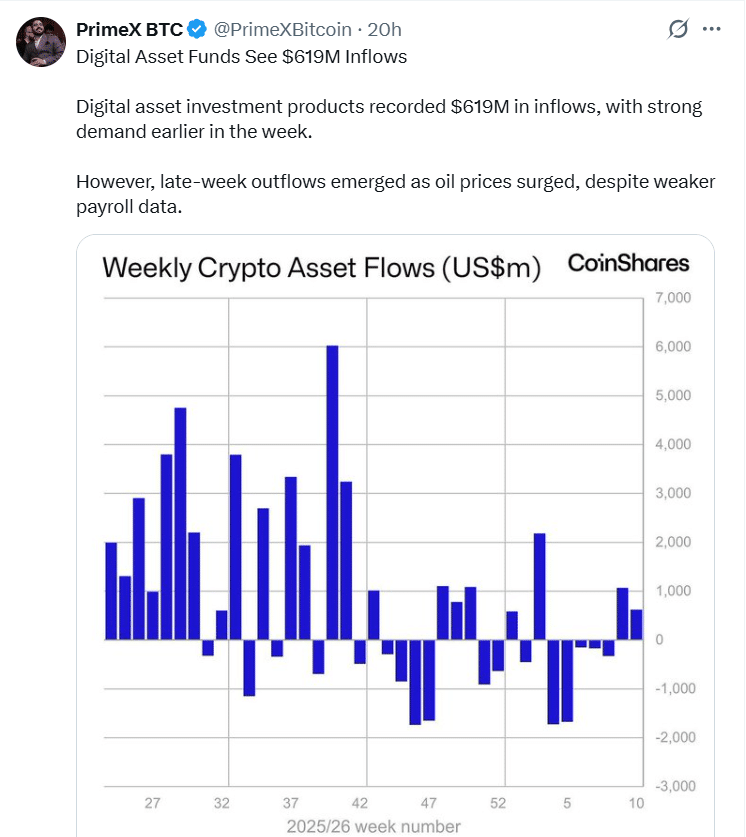
At several points during the week, inflows crossed $1 billion, suggesting improving confidence among professional investors. However, this momentum slowed toward the end of the week. Rising oil prices created macroeconomic uncertainty, which prompted some investors to take partial profits from digital asset products.
As a result, market activity shifted to modest outflows later in the week. Previous weeks have also shown notable volatility, with institutional flows ranging from about $6 billion in inflows to nearly $2 billion in outflows. Despite these fluctuations, the week still ended with positive net inflows, indicating that institutions remain engaged with digital assets while adjusting their allocations in response to broader economic signals.
Conclusion
Stablecoins domestic payments are steadily becoming a practical component of the digital financial system as transaction volumes grow and merchant adoption expands. Lower network fees, improvements in blockchain scalability, and expanding payment integrations are strengthening the role of stablecoins in everyday financial activity.
At the same time Bitcoin (BTC) continues to anchor the store-of-value narrative within the market. While stablecoins increasingly function as the medium of exchange for programmable digital transactions. Rising institutional participation and rapid growth in tokenized asset markets further highlight how crypto ecosystem is evolving toward real financial infrastructure supported by regulated digital assets.
Glossary
Stablecoins Domestic Payments: Stablecoins used for daily payments within a country.
Transaction Volume: Total value of transfers processed on a network.
Blockchain Payment Rails: Blockchain infrastructure that powers digital payments.
Merchant Settlement: Final payment received by a business after a transaction.
Cross-Border Payments: Transfers of money between different countries.
Frequently Asked Questions About Stablecoins Domestic Payments
How much stablecoin transaction volume exists today?
Stablecoin transaction volume has surpassed $10 trillion in adjusted global transfers.
What was the total stablecoin transfer volume in 2025?
The total raw stablecoin transfer volume reached about $33 trillion in 2025.
How do stablecoins help merchants receive payments?
Stablecoins allow merchants to receive payments quickly through blockchain networks.
Which companies are adding stablecoin payment support?
Companies like Stripe, PayPal, and Visa are starting to support stablecoin payment systems.
How does U.S. crypto policy affect stablecoins?
U.S. crypto policy can influence how stablecoins are regulated and used in financial systems.