


























Stablecoin transaction activity just crossed a line that once seemed untouchable. The shift may look quiet, but it hits at the core of global finance. A system built in less than 12 years has now moved ahead of a payment rail that has powered the US economy for decades.
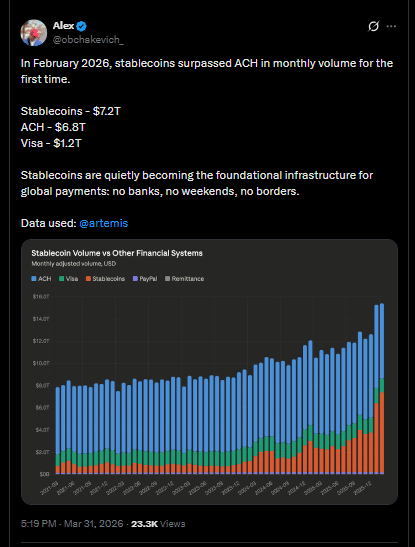
According to the source, stablecoin transaction volume surged to $7.2 trillion in February 2026, surpassing the $6.8 trillion processed by the Automated Clearing House. The figures rely on adjusted 30-day data that removes internal exchange flows and technical noise, offering a clear picture of real usage.
Stablecoin Transaction Momentum Collides With a Legacy System
The debate around stablecoins vs ACH has stepped out of theory and into hard numbers. The Automated Clearing House still processes nearly 93% of salary payments in the United States, making it one of the most trusted systems in finance.
Yet stablecoin transaction growth tells a different story. Blockchain networks operate without banking hours, delays, or borders.
As noted in an analyst’s remark, “Stablecoins are quietly becoming the foundation of global payments, with no banks and no delays.”
Another industry voice sharpens the warning. In a recent market analysis, a senior executive stressed that firms ignoring this shift risk becoming irrelevant. The tone is no longer cautious. It is urgent. This intensifies the stablecoins vs ACH narrative.
Stablecoins vs ACH Becomes a Consistent Trend, Not a One-Time Event
February was not a one-off moment. Stablecoin transaction volume climbed further to $7.5 trillion in March, matching ACH once again over a 30-day period. The pattern now looks steady, not accidental.
Comparisons with global payment giants deepen the story. Stablecoin transaction flows now rival networks like Visa and PayPal in scale. This strengthens the broader stablecoins vs ACH argument and shows blockchain payments stepping into the mainstream.
Data charts across analytics platforms reveal a clear upward curve. Each month adds weight to the case that stablecoin transaction usage is becoming a structural shift in finance.
Stablecoin Transaction Growth Anchors the Crypto Economy
Beyond payments, stablecoin transaction activity is reshaping the crypto market itself. Total stablecoin supply reached $315 billion in Q1 2026, marking an $8 billion increase from the previous year.
At the same time, stablecoins accounted for 75% of total crypto trading volume, the highest share on record. This dominance shows how stablecoin transaction flows now serve as the backbone of digital asset markets.
Insights from recent market research suggest that users favor stablecoins for speed and price stability. As a result, the stablecoins vs ACH discussion now extends beyond payments into liquidity and trading infrastructure.
Regulation, Forecasts, and a Clear Warning to Banks
Regulatory clarity in the United States has added fuel to this growth. The GENIUS Act has created a more supportive environment for institutions exploring stablecoin integration.
Forecasts from major financial institutions point to a $2 trillion stablecoin market by 2028, implying growth of over 530%. Such projections show strong institutional confidence.
The warning from industry leaders is now direct. One executive stated that banks and fintech firms are “toast” if they overlook this trend, pointing to the rise from under $30 billion in 2020 to over $300 billion today. This reinforces how serious the stablecoins vs ACH shift has become.

Conclusion
Stablecoin transaction growth signals more than innovation. It marks a structural change in how value moves across borders and systems. The comparison of stablecoins vs ACH shows a shift toward faster, always-on financial rails.
Traditional systems like ACH still hold deep roots in the economy. Yet stablecoin transaction momentum keeps building, month after month. The gap is narrowing, and pressure is rising.
The future of payments will not arrive overnight, but the direction is clear. Stablecoins are no longer testing the waters. They are shaping the current.
Glossary of Key Terms
Stablecoin Transaction: A digital payment using stablecoins that maintain a fixed value, often tied to fiat currencies.
ACH (Automated Clearing House): A US payment network used for bank transfers, payroll, and bill payments.
Stablecoin Supply: The total circulating value of stablecoins in the market.
Institutional Adoption: The involvement of banks and financial firms in emerging financial technologies.
FAQs About Stablecoin Transaction
What is a stablecoin transaction?
It is a transfer of value using stablecoins designed to maintain stable prices.
Why is stablecoins vs ACH important?
It shows how digital payment systems compete with traditional financial infrastructure.
Is this growth sustainable?
Current data suggests steady expansion driven by trading, payments, and institutional demand.
What role does regulation play?
Clear policies help institutions adopt stablecoins with greater confidence.