

Stablecoin market cap decline has become an important signal for the crypto market at a time when liquidity is tightening, and investor confidence remains mixed. Recent data shows a noticeable drop in the combined value of the two largest dollar-pegged stablecoins, highlighting a change in how capital is moving within digital asset markets.
- What is driving the current contraction in stablecoins?
- How large is the decline in stablecoin value?
- Why is USDC leading the downturn?
- What does shrinking stablecoin supply mean for liquidity?
- How are bitcoin and other tokens responding?
- Is regulation influencing investor behavior?
- How does this trend connect to institutional flows?
- Conclusion
- Glossary
- Frequently Asked Questions About Stablecoin Market Cap
This decline suggests that investors are pulling funds out of crypto-based cash positions instead of keeping them inside the ecosystem. Such a shift could weigh on bitcoin’s recovery efforts and shape broader market stability in the near term.
What is driving the current contraction in stablecoins?
The contraction is mainly being caused by investors withdrawing money from crypto-based instruments and shifting it back into traditional currency. Stablecoins such as USDT and USDC are meant to maintain a steady value and allow traders to remain active within the crypto market.

These tokens usually act as a temporary parking place for capital during periods of uncertainty. When their supply declines, it clearly shows that funds are leaving the crypto ecosystem instead of waiting for new buying opportunities.
How large is the decline in stablecoin value?
The combined market value of USDT and USDC has dropped to about $257.9 billion, marking its lowest point since November 20. This level shows a clear retreat from the mid-December peak near $265 billion.
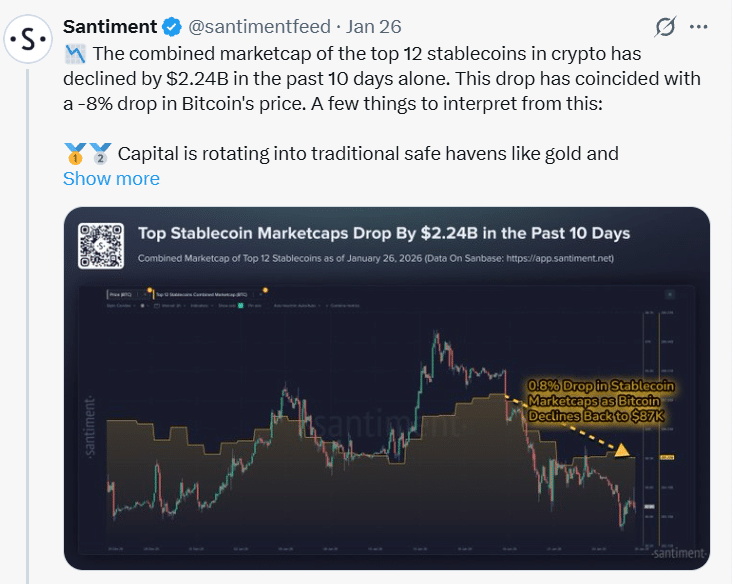
The stablecoin market cap decline has become more noticeable over the past ten days. This pace suggests faster capital outflows rather than a slow and orderly repositioning by investors.
Why is USDC leading the downturn?
USDC has been responsible for most of the recent decline in the stablecoin market. Its market capitalization has fallen by more than $4 billion over the past ten days and is down by around $6 billion since mid-December, leaving its total value at $71.65 billion.
In comparison, USDT has seen a much smaller drop of just over $1 billion during the same period, with its market value now at $186.25 billion. Analysts believe this imbalance shows that U.S.-related regulatory uncertainty is affecting USDC more strongly, adding further pressure to the stablecoin market cap decline.
What does shrinking stablecoin supply mean for liquidity?
Stablecoins such as Tether (USDT) and USD Coin (USDC) act as the main source of easily available liquidity in crypto markets. Santiment explained in a post on X that when traders sell bitcoin or other cryptocurrencies, the funds usually stay within the market in the form of these stablecoins.
When stablecoin supply starts to fall, it signals that “money is leaving crypto instead of waiting on the sidelines.” This shift reduces the amount of capital available to support quick price recoveries, making the stablecoin market cap decline a clear obstacle to stronger market momentum.
How are bitcoin and other tokens responding?
Bitcoin has managed a modest rebound, rising from a weekend low around $86,000 to about $89,140.26. Even with this price move, analysts warn that the durability of these gains remains uncertain.
The supply of stablecoins has continued to shrink during this period, limiting the amount of capital ready to flow back into risk assets. As a result, the stablecoin market cap decline could slow or weaken recovery attempts across both bitcoin and alternative cryptocurrencies.
Is regulation influencing investor behavior?
Regulatory delays also appear to be shaping current market behavior. The decline in USDC supply has come alongside stalled progress on the proposed Clarity Act, which is intended to create a regulatory framework for dollar-pegged tokens in the United States.
Aurelie Barthere, principal research analyst at Nansen, said in an email that investors and traders are effectively pricing out near-term U.S. regulatory momentum, pointing to shifting priorities in Washington ahead of the midterm elections. She added that approval of the bill would represent a meaningful upside catalyst for the market.
How does this trend connect to institutional flows?
The pullback in stablecoins has occurred alongside institutions withdrawing billions of dollars from U.S.-listed spot bitcoin exchange-traded funds. These outflows point to a broader reduction in risk appetite among large investors.

Taken together, these developments reinforce the signal behind the stablecoin market cap decline, showing that capital is moving out of the crypto ecosystem rather than remaining positioned for dip-buying. Historically, stronger market recoveries have tended to begin only after stablecoin supply starts to expand again.
Conclusion
Stablecoin market cap decline highlights a period where reduced liquidity, cautious investor sentiment, and regulatory frustration are coming together at the same time. The ongoing drop in stablecoin supply suggests that less capital is available to support strong market moves.
Analysts warn that until this supply stabilizes or begins to rise again, confidence across crypto markets may remain weak. As a result, rebounds in bitcoin and other digital assets could stay fragile, with recoveries likely to be slower and less decisive even during short-term rallies.
Glossary
Liquidity: Liquidity is how quickly assets can be traded without big price changes.
Capital Outflows: Capital outflows mean money is moving out of crypto.
USDT (Tether): USDT is the most used stablecoin for trading and storing value.
USDC (USD Coin): USDC is a stablecoin backed by U.S. dollars and issued by Circle.
Bitcoin ETF: A Bitcoin ETF allows bitcoin investment through traditional markets.
Frequently Asked Questions About Stablecoin Market Cap
Why are stablecoins pulling back from the market?
Stablecoins are declining because investors are moving money out of crypto.
What do Bitcoin ETF outflows signal?
Bitcoin ETF outflows suggest reduced institutional confidence in the short term.
How are stablecoin declines linked to ETF withdrawals?
Both show that capital is leaving the crypto ecosystem at the same time.
Why are stablecoins important for crypto recoveries?
Stablecoins provide liquidity that supports buying during market recoveries.
What does the current trend suggest about market direction?
The current trend suggests ongoing caution and limited near-term upside.