

This article was first published on Deythere.
- Solana DEX Volume Plummets to Lowest Levels Since 2024
- The Pressure From Ethereum Layer-2 Expansion Is Intensifying
- Why Did $80 Become a Crucial Battlefield for SOL?
- DApp Revenue Strength Provides a Fundamental Cushion
- Total Value Locked Still Shows a Wide Gap With Ethereum
- Conclusion
- Glossary
- Frequently Asked Questions About Solana DEX Volume Activity
Solana DEX volume has plummeted and become one of the most closely eyed developments in altcoins this week, with traders nervously speculating on whether SOL is even capable at present of holding above the $80 level.
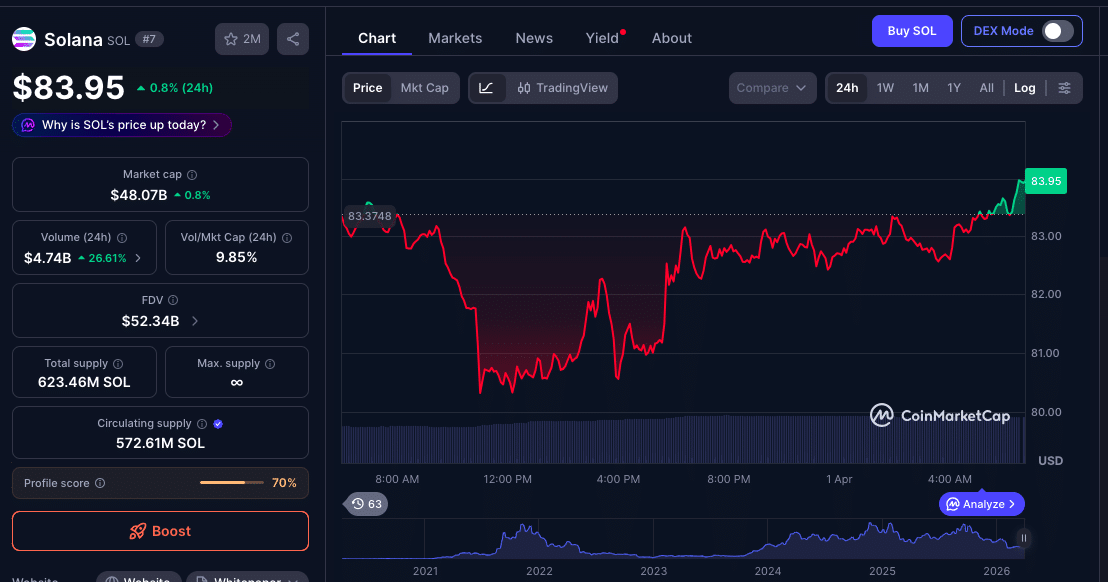
After it was unable to move above $93, Solana’s native token entered a period of correction again, trailing about 11%, and repeatedly challenging a fragile support zone. Meanwhile, falling decentralized exchange activity and waning network fees have brought fears of flagging demand across the ecosystem.
However, despite this; Solana continues to show resilience in metrics that matter more in the long run especially in revenue-generating decentralized applications.
Solana DEX Volume Plummets to Lowest Levels Since 2024
The most immediate concern causing the bearish sentiment is the contraction in decentralized exchange activity.
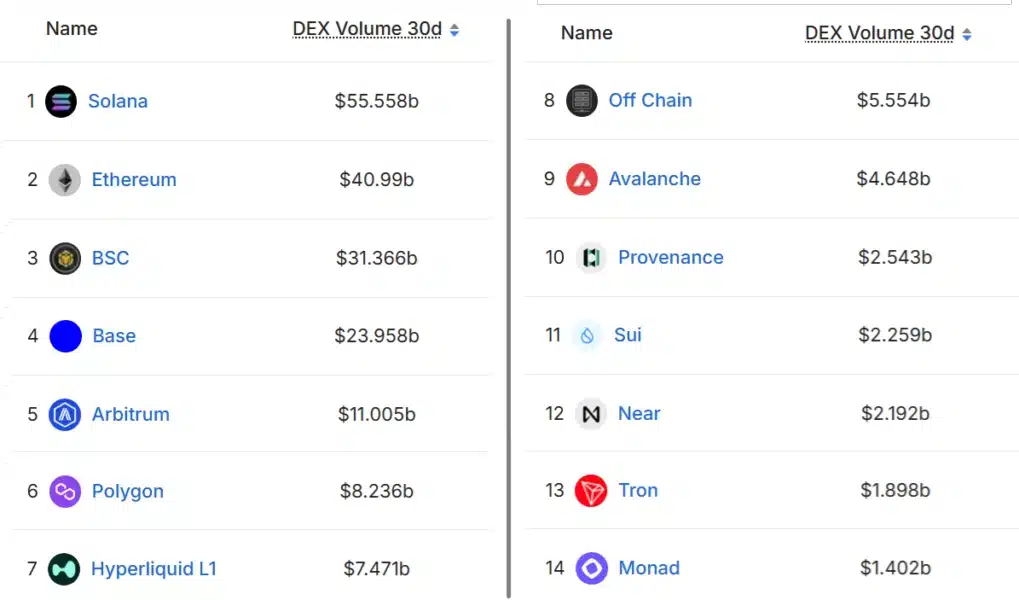
According to recent data, Solana’s monthly DEX volume dropped to around $55.5 billion in the past month, its lowest level since September 2024. This decrease is a huge reduction from the previous times when speculators, particularly those trading meme coins, sent the network activity soaring.
As a result, network fees have also tracked the same downward path. In March, Solana generated $18.5 million in fees, down from over $30 million in January. That 42% drop shows just how closely linked the network’s revenue is to trading activity.
Liquidity conditions have also deteriorated. Market analysis indicates that lower DEX involvement can amplify price fluctuations, given that thinner liquidity makes it easier for sell pressure to drive prices down.
All these signals show why traders are increasingly pricing in the possibility of a deeper correction toward $75 if present market conditions continue.
The Pressure From Ethereum Layer-2 Expansion Is Intensifying
While Solana’s activity cools down, Ethereum’s entire ecosystem is getting traction particularly when one includes Layer-2 networks.
Despite Ethereum’s mainnet-based DEX volume falling to $41 billion in March, the rising activity across Layer-2 chains like Arbitrum, Base, Polygon and Optimism changed this competitive balance.
Ethereum’s DEX market share rose to 42%, up from 33% two months prior. Ethereum’s scaling approach lets activity spread across networks without the friction of losing a cohesive ecosystem.
This trend is not completely unfamiliar. Past data shows that Ethereum periodically surpasses Solana in DEX dominance when speculative trading slows down on Solana.
Why Did $80 Become a Crucial Battlefield for SOL?
From a price perspective, the $80 area has become a psychological and technical support zone.
After being rejected near $93, SOL has since tested this level on multiple occasions, a sign that buyers are still stepping in but with decreasing conviction.
The concern is that if the decline in DEX volumes continues and suppresses network fees as well as user activity, the market could react accordingly which would imply weakening demand for the token itself. That, in turn, raises the likelihood of a drop to $75.
However, price support in crypto markets is hardly a function of just one metric. While trading activity is a powerful factor, it doesn’t tell the whole story for an ecosystem, particularly a complex one like Solana’s.
DApp Revenue Strength Provides a Fundamental Cushion
With DeFi volumes on DEXs continuing to crash, Solana continues to outperform competition in respect of one metric that has always meant greater network health: high-fidelity decentralized applications.
In the last 30 days, Solana had 13 DApps that generated at least $1 million in revenue, outperforming Ethereum with just 11 and beating out BNB Chain and Base.
This metric is important because revenue indicates long-term user activity, not just speculative trading. While Helium and other ecosystem projects continue to attract users and capital, Solana maintains its appeal for developers.
Even more strikingly, Solana generated about 80% more in network fees than Ethereum did during the same time frame, even with Ethereum’s larger total value locked.
While Ethereum dominates in terms of liquidity and infrastructure, Solana still shines on the efficient conversion of user activity into revenue.
For investors, while the drop in Solana DEX volumes indicates short-term weakness, strong DApp monetization indicates that it is far from becoming irrelevant.
Total Value Locked Still Shows a Wide Gap With Ethereum
A further aspect influencing market mood is the difference between total value locked.
Solana has a TVL of approximately $6.3 billion as compared to Ethereum’s $54.1 billion. This gap is a testament to Ethereum’s role as the main capital base for decentralized finance.
But TVL is only part of the story. Solana’s lower fees and higher throughput means it can produce competitive or even superior revenue with a small amount of capital locked in the system.
Yet the gap stresses the fact that Ethereum’s ecosystem is deeply more capitalized, giving it an edge in periods of market uncertainty.
Conclusion
The decline of the Solana DEX volume brings with it obvious short-term risks, especially as Ethereum’s Layer-2 ecosystem booms and is able to divert more trading activity than before away from decentralized venues on its own chain.
Meanwhile, the ability of Solana to build its own ecosystem generates revenue that helps counteract this and should not be discounted.
For now, the $80 mark is still the next line of support. A firm hold above this level amidst the pressure could trigger resurgence and lead to reclaim a more stable path. A collapse, though, would likely reinforce negative sentiment and bring prices down toward $75.
Glossary
DEX (Decentralized Exchange): A trading platform facilitating cryptocurrency trades without any intermediaries.
TVL (Total Value Locked): The total value of assets on deposit within a blockchain’s DeFi ecosystem.
Layer-2: Overlays built on a base blockchain protocol to enhance speed and minimize cost
Network Fees: Payments made by users to process transactions on a blockchain.
DApp: Decentralized app, running on top of a blockchain infrastructure.
Frequently Asked Questions About Solana DEX Volume Activity
What is causing Solana DEX volume to decrease?
The drop is largely caused by decreased trading activity following a slump in speculative sectors, such as meme coins.
The $80 support level for SOL: What does it mean?
It’s an important price level where buyers have consistently stepped in, and a loss of it could invoke more downside.
How is Ethereum’s performance impacting Solana?
Ethereum’s Layer-2 networks have usurped a greater share of DEX activity, making room for more competition.
Is Solana still fundamentally strong?
Yes. DApp revenue and developer activity remain high, suggesting the ecosystem is still active despite falling volumes.
Could SOL recover soon?
It will make a recovery depending on renewed trading activity and broader market sentiment.