
This article was first published on Deythere.
- How a ruble-backed stablecoin crossed $100B so fast
- The on-chain footprint behind the headline
- Where the liquidity sits and why USDT still matters
- The slowdown: when growth meets real-world friction
- What A7A5 signals for stablecoins going into 2026
- Conclusion
- Frequently Asked Questions (FAQs)
- Glossary of Key Terms
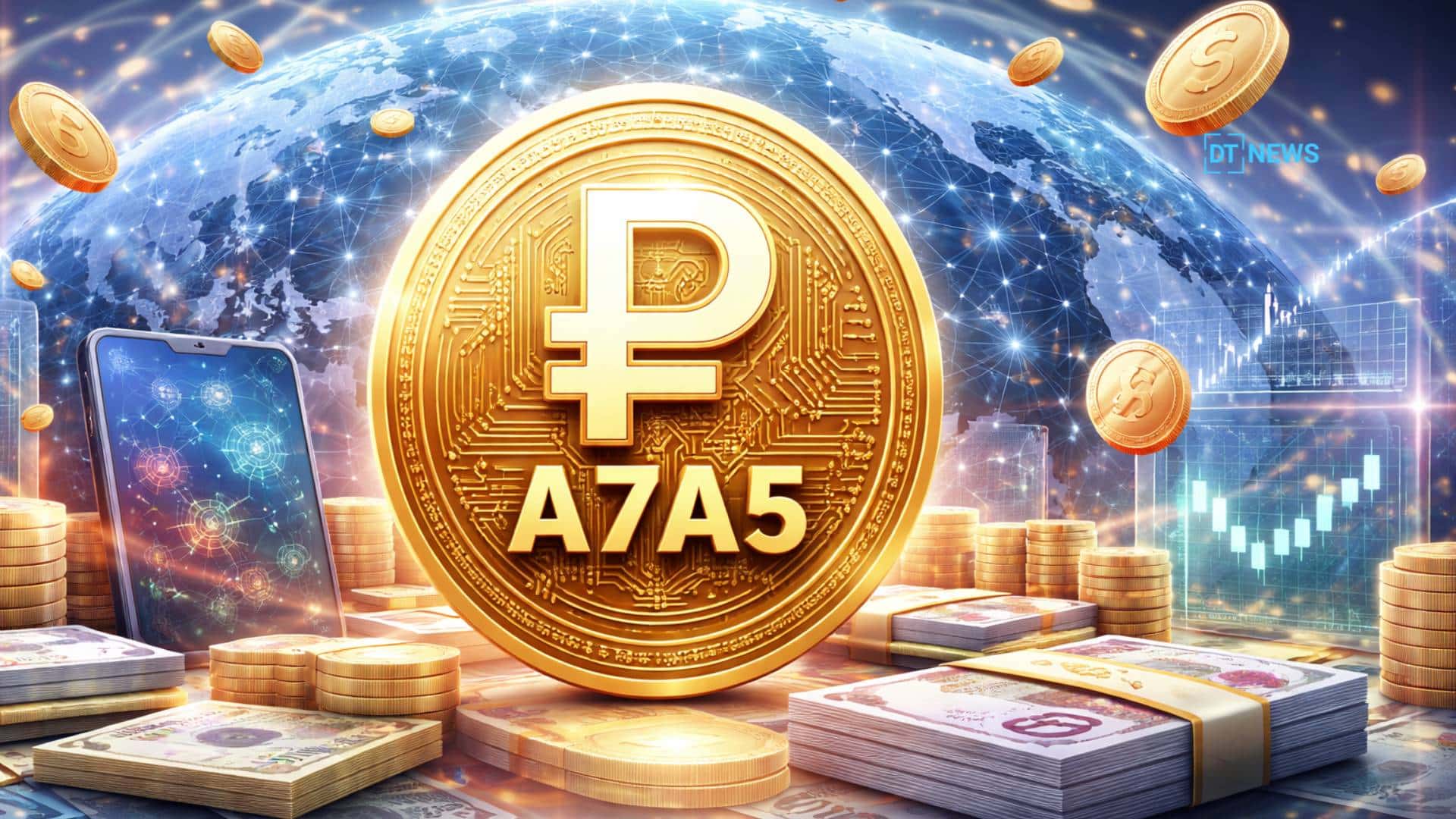
A7A5 has quietly become one of the most watched stablecoin stories of the year, not because it is flashy, but because the numbers are hard to ignore. The token, described as a ruble-backed stablecoin, has processed more than $100 billion in on-chain transactions in less than a year, according to a new report from blockchain analytics firm Elliptic.
That figure matters for a simple reason: stablecoins do not move that kind of value unless there is real demand behind them. In this case, the demand appears to be tied to cross-border payment rails built to function even when traditional routes feel blocked, slowed, or politically risky. Elliptic’s findings frame A7A5 as a tool that expanded rapidly, then started cooling off as enforcement pressure and liquidity limits kicked in.
How a ruble-backed stablecoin crossed $100B so fast
A7A5 launched in January 2025, created by Russia-based cross-border payments firm A7 LLC. The project positions itself as being backed 1:1 by ruble deposits, reportedly held at Promsvyazbank (PSB), a state-owned bank that has faced international sanctions.
From the outside, it reads like another pegged token trying to capture a niche. Under the hood, the motive looks sharper: build a bridge between ruble liquidity and global crypto liquidity at a time when business flows are under intense scrutiny. The result is a ruble-backed stablecoin that did not need mainstream listings to generate activity, because the use case was already waiting for it.
Elliptic says the token operates across Ethereum and TRON, which is a practical choice. Ethereum brings deep infrastructure and compatibility, while TRON is often used for low-fee stablecoin transfers when speed and cost matter more than brand perception.

The on-chain footprint behind the headline
The report estimates A7A5 has processed nearly 250,000 transactions across 41,300 distinct accounts. That is not a small test community. That is a network effect, especially for an asset that most retail traders have never interacted with directly.
One detail stands out in Elliptic’s timeline: activity jumped sharply in late September 2025, when users gained the ability to purchase the token using PSB bank cards. That kind of “on-ramp convenience” tends to flip a switch. It takes something that feels specialized and turns it into something operational, like adding more lanes to a busy highway.
Elliptic also notes holder growth accelerating, with around 35,500 accounts holding A7A5, up from 14,000 in July 2025. For a ruble-backed stablecoin, that is meaningful adoption in a short window, even if much of it is likely concentrated among active payment users rather than long-term investors.
Where the liquidity sits and why USDT still matters
For many users, A7A5 is not the final destination. It is the connector. Elliptic’s data points to roughly $17.3 billion in exchange volume, split between A7A5/RUB and A7A5/USDT pairs. Those pairings give away the playbook. It is rubles moving in, USDT moving out, with the token acting as the pass-through.
This is also why the story keeps circling back to USDT, even though A7A5 is the centerpiece. In sanction-heavy corridors, traders and businesses tend to prefer assets with the broadest acceptance and the deepest liquidity, and USDT still sits at the center of that universe. Elliptic describes A7A5 functioning as a “safe harbor” in ruble terms, while USDT remains the preferred asset once the value needs to travel further.
The slowdown: when growth meets real-world friction
A7A5’s current supply is roughly 42.5 billion tokens, worth about $547 million based on ruble valuation, according to Elliptic’s overview. Yet the more revealing signal is not market size, it is momentum. The report notes that large new issuance appears to have stopped around late July 2025, and daily transfer volumes have dropped from a peak near $1.5 billion per day to around $500 million per day.
That is what enforcement pressure looks like in crypto. It rarely arrives as one dramatic shutdown. It shows up as thinning liquidity, fewer easy access points, and higher operational risk. The token has also faced restrictions at the interface level, including being added to a token blocklist on a major decentralized trading interface in November 2025, limiting casual access for users who rely on front-end tools instead of direct smart contract interaction.
For a ruble-backed stablecoin, that kind of friction matters because the value proposition is speed and convenience. Once either one gets compromised, usage naturally cools.
What A7A5 signals for stablecoins going into 2026
The A7A5 story lands at an awkward but important moment for the stablecoin market. Regulators have been pushing for tighter oversight, while traders keep using stablecoins as the default settlement layer for crypto-to-crypto movement. What A7A5 demonstrates is that stablecoin demand can scale rapidly outside the dollar system when the incentives are strong enough.
At the same time, it also highlights a ceiling as a ruble-backed stablecoin can grow fast inside a specific network, but expanding beyond that network becomes difficult when major liquidity gateways get restricted and compliance pressure rises. The token may still move meaningful value, yet the path to broader legitimacy becomes narrower with each added constraint.
Conclusion
A7A5 reaching $100 billion in transactions is not just a milestone, it is a case study in how stablecoins evolve when they are built for utility first and visibility second. The token’s rise shows how quickly a payment-focused stablecoin can scale when it solves a real friction point, especially in cross-border flows. Its slowdown, however, is the reminder that crypto markets still depend on liquidity access, trusted rails, and operational breathing room. In 2026, the stablecoin winners will not only be the ones that peg well, they will be the ones that can survive pressure without losing usability.
Frequently Asked Questions (FAQs)
What is A7A5 used for?
A7A5 is mainly used as a ruble-to-crypto bridge, helping users move value into broader stablecoin liquidity.
How did A7A5 reach $100B in transactions so quickly?
Elliptic points to growing access options, including card-based purchase ability, plus strong demand for cross-border settlement routes.
Is A7A5 available on major exchanges?
Trading has been concentrated on a limited number of venues and liquidity routes, rather than broad mainstream listings.
Why did activity slow down after mid-2025?
Issuance reportedly tapered off and transaction volumes fell as sanctions-related pressure and access restrictions increased.
Glossary of Key Terms
Stablecoin: A cryptocurrency designed to hold a steady value by pegging to a currency or asset, often used for trading and payments.
On-chain transactions: Transfers recorded directly on a blockchain, visible through public transaction data.
TRON: A blockchain network often used for fast, low-fee stablecoin transfers.
Ethereum: A major smart contract blockchain that supports tokens, decentralized finance apps, and stablecoin infrastructure.
Liquidity: The ease of buying or selling an asset without significantly moving its price, usually driven by active markets and deep trading volume.
Sanctions evasion: Attempts to bypass financial restrictions imposed by governments, often by using alternative payment rails or intermediaries.
Reference