
This article was first published on Deythere.
- What Is the Robinhood Chain Testnet?
- Why Did Robinhood Launch Its Own Layer 2 Network?
- How Does the Testnet Work?
- What Do Q4 2025 Financial Results Reveal?
- What Are Robinhood’s Plans for Developers and the Ecosystem?
- What Does This Mean for Tokenized Assets?
- Conclusion
- Glossary
- Frequently Asked Questions About Robinhood Chain Testnet
Robinhood Chain testnet has officially launched, marking the company’s first public step toward creating its Ethereum Layer 2 network for tokenized assets and decentralized financial applications. This launch comes alongside Robinhood’s Q4 2025 financial report, which recorded $1.28 billion in revenue and a net income of $605 million.
While total revenue increased 27% compared to last year, it fell short of analyst expectations. At the same time, crypto revenue dropped 38%, reaching $221 million. The rollout of the testnet underlines Robinhood’s efforts to grow its blockchain infrastructure and expand its services beyond traditional brokerage offerings.
What Is the Robinhood Chain Testnet?
The Robinhood Chain testnet is a public environment for developers to explore Robinhood’s Ethereum Layer 2 network built on Arbitrum technology. The network is meant to support tokenized real-world assets, decentralized finance applications, and broader on-chain financial services.

Johann Kerbrat, SVP and GM of Crypto and International at Robinhood, explained that the testnet is meant to set the foundation for a new ecosystem focused on tokenized assets and to help developers connect with DeFi liquidity across the Ethereum network. Infrastructure partners such as Alchemy, Allium, LayerZero, and TRM are already connecting to the network, providing support for testing, analytics, compliance, and cross-chain features.
Why Did Robinhood Launch Its Own Layer 2 Network?
Robinhood Chain testnet is designed with regulatory compliance built directly into the blockchain layer, which is critical for tokenized securities and regulated financial products. Unlike general-purpose Layer 2 networks, Robinhood’s purpose-built chain focuses on the secure creation, issuance, and trading of tokenized assets while aligning with rules that differ across jurisdictions.
This approach allows financial products to operate within required legal frameworks rather than relying solely on smart contract controls. The network also supports 24/7 trading, faster settlement, and self-custody features, helping address the limits of current tokenized stock offerings on Arbitrum One.
How Does the Testnet Work?
Developers working on the Robinhood Chain testnet can rely on familiar Ethereum development tools to build and test their applications. Chainlink supplies the oracle system needed to bring real-world market data on-chain, while LayerZero supports communication between different blockchains. TRM is involved in transaction monitoring and compliance-related checks.
The testnet also includes dedicated test assets, such as Stock Tokens, which can be used for experimentation and integration with the Robinhood Wallet. This setup gives builders the opportunity to spot and fix potential issues ahead of the planned mainnet launch later this year.
What Do Q4 2025 Financial Results Reveal?
Robinhood posted $1.28 billion in revenue for the fourth quarter, missing analyst expectations of $1.35 billion but still showing a 27% increase compared with the same period last year. Crypto revenue declined sharply, falling 38% to $221 million. Operating expenses climbed 38% to $633 million, while adjusted operating expenses came in at $597 million, up 18% year-over-year.
Adjusted EBITDA reached $761 million, below the forecast of $833 million. The company reported net income of $605 million and ended the quarter with $4.3 billion in cash and cash equivalents. Transaction-based revenue increased to $776 million, up 15% from a year earlier, highlighting Robinhood’s ongoing dependence on brokerage activity even as it expands its blockchain-focused initiatives.
What Are Robinhood’s Plans for Developers and the Ecosystem?
Robinhood has set aside $1 million for the 2026 Arbitrum Open House program to support and attract developers. As part of this initiative, the company will organize four online Buildathons in New York City, Dubai, London, and Singapore, along with two in-person Founder Houses in New York City and London, to help grow the ecosystem around the Robinhood Chain testnet.
Steven Goldfeder, CEO of Offchain Labs, said, “With Arbitrum’s developer-friendly technology, Robinhood Chain is well-positioned to help the industry deliver the next chapter of tokenization and permissionless financial services. Working alongside the Robinhood team, we are excited to help build the next stage of finance.” The testnet gives developers and institutional partners the chance to build, test, and assess the network’s infrastructure ahead of a mainnet launch planned for later this year.
What Does This Mean for Tokenized Assets?
The Robinhood Chain testnet will support tokenized real-world assets, lending services, and perpetual futures markets. Features like cross-chain transfers and self-custody empower users to maintain control of their assets while accessing decentralized financial services.
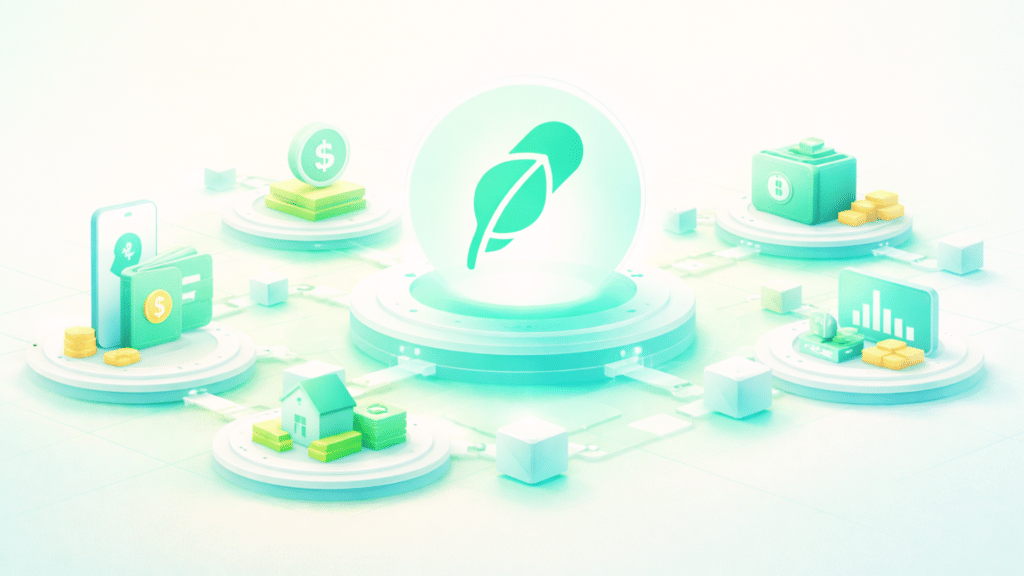
Robinhood plans to expand its tokenization engine to private equity, real estate, art, and other real-world assets. Early interaction with the testnet provides developers crucial insights for building regulated and compliant financial products.
Conclusion
Robinhood’s Robinhood Chain testnet marks a pivotal shift. The company moves beyond traditional brokerage into blockchain-based financial services. It brings together developer-friendly tools, strong regulatory compliance, and an expanding network of partners to build the groundwork for tokenized assets, round-the-clock trading, and decentralized applications.
Even with crypto revenue dropping in Q4 2025, this testnet rollout points to a deliberate strategic turn. Now developers and institutional partners have chance to test things out, setting up a mainnet debut later this year that could redefine financial infrastructure.
Glossary
Robinhood Chain Testnet: A trial network for testing apps before launch.
Ethereum Layer 2: A faster and cheaper network built on Ethereum.
Arbitrum: A scaling network that improves Ethereum speed.
Tokenized Assets: Real assets turned into digital tokens.
Cross-Chain Transfers: Moving assets between blockchains.
Frequently Asked Questions About Robinhood Chain Testnet
What is Robinhood Chain built on?
Robinhood Chain is built on Arbitrum. Which is an Ethereum Layer 2 network.
Why did Robinhood launch this testnet?
Robinhood launched testnet to support tokenized assets and expand into blockchain-based financial services.
What can developers build on testnet?
Developers can build tokenized asset platforms, DeFi apps, and other on-chain financial tools.
How does testnet get real-world data?
The testnet uses Chainlink to bring real-world market data onto the blockchain.
When will the Robinhood Chain mainnet launch?
Robinhood plans to launch the mainnet later this year. But it has not shared an exact date yet.