


This article was first published on Deythere.
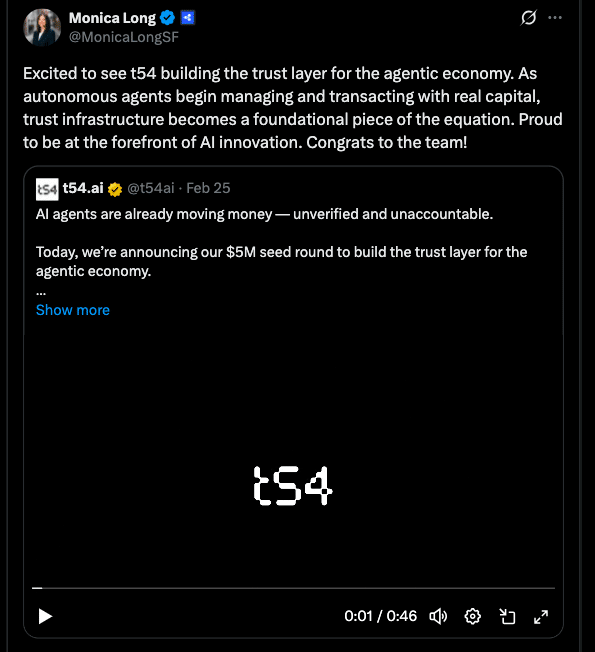
San Francisco startup t54 Labs announced on February 25 that it had closed a $5 million seed round of funding, with Ripple, alongside Franklin Templeton, Anagram and PL Capital as strategic investors.
Ripple’s president, Monica Long, wrote in a post on social platform X that as autonomous agents begin to manage and transact with real capital, trust is now essential. She added that Ripple was “proud to be at the forefront of A.I. innovation.”
Ripple continues to champion AI payments on XRPL as a natural progression of the blockchain’s utility, especially given that XRPL is now backed with over $550 million in ecosystem investment since 2017.
What Are Ripple and t54 Building Together?
t54 Labs describes itself as creating the “trust layer” for the upcoming agentic economy, meaning systems where software agents perform financial activity without having to get human signoff at every step.
Unlike many other AI stories in crypto with a focus on chatbots, the work here is anchored in risk controls, identity verification, and compliance tooling for autonomous agents.
Such components are really important if AI systems are to interact with regulated entities. A business that accepts automated payments needs to know who or what is on the other side; the identity of the agent, its permissions, how transactions are monitored and whether compliance requirements such as KYC and AML can be met.
Without this, institutions simply cannot use autonomous systems for real financial operations.
This effort includes identity checks, real-time risk monitoring, credit assessment and various other types of verification that are essentials for regulated commerce. Instead of assuming that an AI agent is no more than an anonymous wallet, t54 design embeds accountability into the transaction flow.
Stablecoins and RLUSD’s Growing Role
The use of stablecoins is one piece of the puzzle that experts say could determine the course of AI payments on XRPL going forward. When software agents negotiate, buy data, compute power or services, they need a digital dollar equivalent and not a token subject to volatile price swings.
Ripple’s US dollar-pegged stablecoin RLUSD continues to grow. Now, in mid-February 2026, Ripple minted another 20 million RLUSD bringing its total supply to about $1.53 billion.
In recent weeks, Binance enabled deposits of RLUSD directly on XRPL allowing users and systems to move this stable asset in different ways. That integration is intended to increase liquidity and allow real-time settlement. These moves are important as, without a reliable, stable asset, it would be hard to facilitate frequent autonomous micropayments.
Stablecoin allows automated systems to engage in transactions without the hassle of sudden swings in value. If agents decide to keep RLUSD on XRPL, they will potentially kick off another round of usage and demand.
How Tech Like x402 Fits In
There are also technical standards being developed, beyond trust layers and stablecoins that help make AI payments on XRPL easier.
One discussion in the ecosystem revolves around the so-called “x402” pattern, based on the HTTP 402 Payment Required status which allows an autonomous agent to be presented with a payment request and settle it immediately without human intervention.
This payment flow is different from current APIs or invoice systems. Instead of a subscription or manual billing, the agent interacts with a payment trigger which pays value directly on ledger, reducing overhead for both parties and increasing efficient process.
Although early and a work in progress, x402 is the type of technical building block developers are experimenting with when it comes to machine-native commerce.

How XRPL Compares to the Other Networks
Despite Ripple and t54 promoting AI payments on XRPL, data shows rival networks remain more active in deploying autonomous agents as of early 2026. Ethereum has the most total deployed AI agents, followed closely by Base.
However, Ripple’s is more targeted: it does not need XRPL to house the majority of agents to be successful. What really matters is whether XRPL will be the settlement and compliance backbone for a host of autonomous economic activity.
If so, even modest adoption can have real impacts with respect to stablecoin liquidity, participants in the Market and developers’ attention.
Ripple’s Broader Vision for 2026
Ripple’s expansion into AI-driven infrastructure is a continuation of its evolution. Ripple in 2026 revealed also that it had changed the way it supports XRPL ecosystem development, moving from centralized grants to a distributed funding model powered by regional hubs, venture partners and independent builders.
They include the rollout of programs to support institutional-grade applications such as stablecoin payments, regulated services and compliance tools rather than pure speculation tokens or developer handouts. That transition is in line with Ripple’s goal to establish XRPL for regulated, enterprise-grade blockchain applications.
Conclusion
The partnership with Ripple combined with the increasing demand for RLUSD and with the infrastructure of trust offered through t54 Labs and independent operators, is a breath of fresh air in how the blockchain industry thinks about autonomous finance.
AI payments on XRPL are now coming up in real-world infrastructure, combining blockchain settlement with compliance and identity tools.
The fundamentals are getting laid down now, and Ripple is bringing XRPL into that picture. This move is a pragmatic response: not another spasm of dancing to AI buzzwords, but systems enabling independent software agents (oversimplifying) to transact in ways secure and, maybe even acceptable by regulated institutions.
Glossary
AI payments on XRPL: Machine-to-machine transaction autonomous financial activity conducted on XRP Ledger blockchain.
t54 Labs: A startup building identity, risk and compliance infrastructure for AI agents executing digital payments.
XRPL: the XRP Ledger, a blockchain built by Ripple for quick and cheap settlement
RLUSD: Ripple’s regulated US dollar stablecoin.
Agentic economy: Describes an internet made up of AI systems acting as economic actors.
Frequently Asked Questions About Ripple AI Payment Infrastructure
What is Ripple to do with AI infrastructure?
Ripple views blockchain as part of the foundation for autonomous systems that can pay for services and resources without any humans involved. Its investment in t54 Labs enables their identity and compliance tooling for these agents.
What’s the function of RLUSD in AI payments on XRPL?
RLUSD provides a stable unit of account for frequent, automated transactions, reducing risk from token price swings.
Are these AI based payments available now?
Infrastructure such as trust layers, and technical patterns like x402 are coming up with experimental implementations, suggesting some of the first real world use cases to be seen.
What does this mean for XRP price? Will it go up?
Price is dependent on external market factors, which then decides its movement.