

























This article was first published by Deythere.
- Bitcoin’s Oversold Sign and RSI Story
- Current Price Action and What’s Going On
- Bitcoin Capitulation Signal: Market Checkpoints
- Institutional Flows and ETF Dynamics
- Macro Context and Liquidity Considerations
- Conclusion
- Glossary
- Frequently Asked Questions About Bitcoin Oversold Signals
- What does a Bitcoin oversold signal mean?
- Does an oversold signal guarantee a rally ?
- How do ETF flows affect Bitcoin price?
- Why is institutional investment important in this context?
- References
A rare Bitcoin oversold signal has just popped up warning of extreme momentum that in the past has preceded big bounces.
The 14-day Relative Strength Index (RSI), a popular momentum gauge, dropped below 30 in mid-November, a level that a lot of technical analysts reckon is a sign of panic selling or an “oversold” market.
In the past, readings like this have sometimes led to some huge rebounds. However, market watchers need to keep a close eye on other market factors too, like money flowing in/out of Bitcoin through spot ETFs, how easily traders can buy/sell large amounts of the currency, and how the price is behaving in response to all this.
Bitcoin’s Oversold Sign and RSI Story
In mid-November 2025, Bitcoin’s 14-day RSI dropped below 30, a sign lots of traders associate with extreme oversold territory.
According to a technical analysis shared by Julien Bittel at Global Macro Investor, as reported by sources, overlaying Bitcoin’s recent price action with historical instances where the RSI dropped below 30 showed that, on average, the price tends to go up about 90 days after such events.
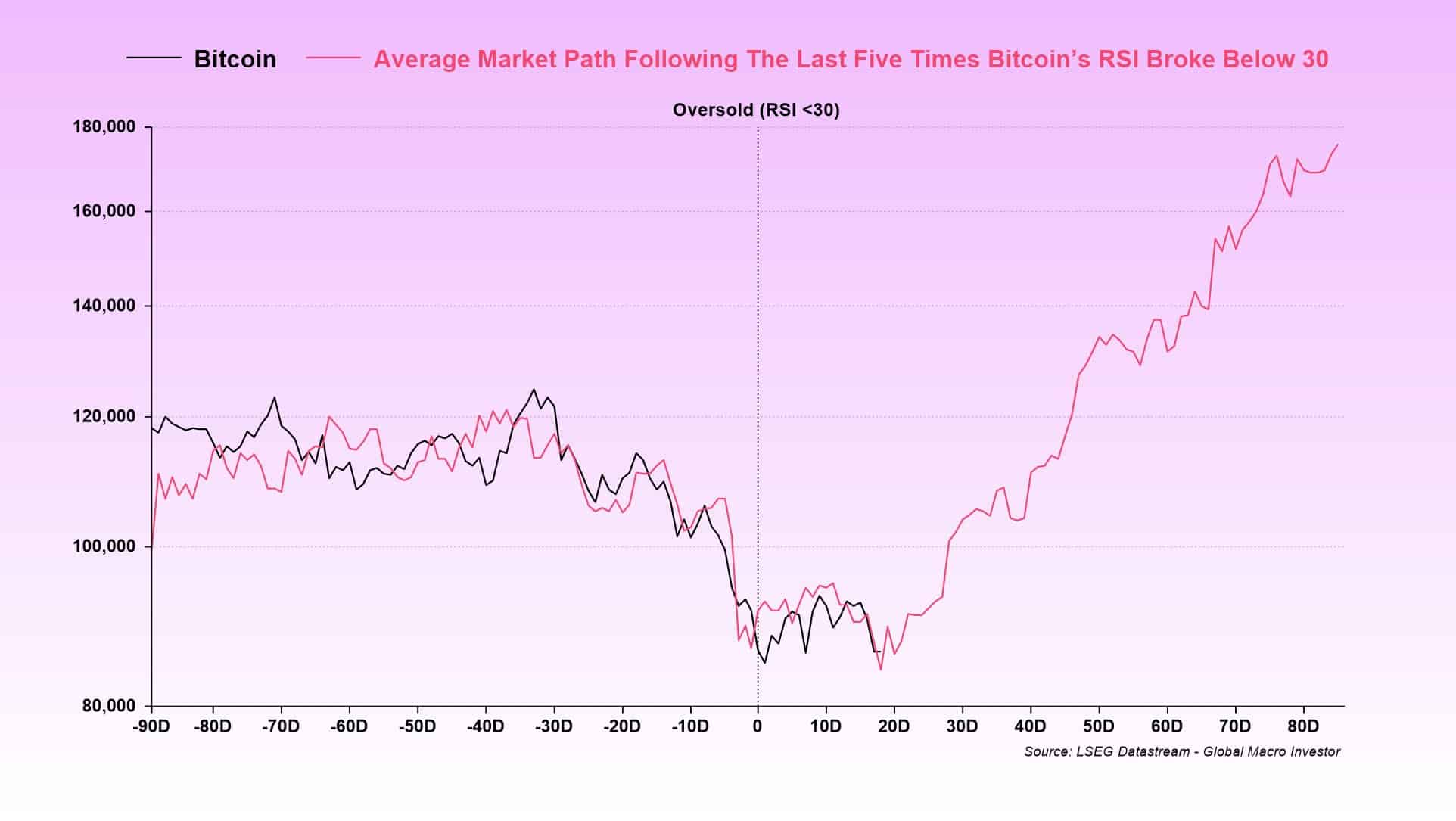
This average path indicated the price could go higher (i.e., $180k from the current price), although it’s worth noting that such overlays are statistical m rather than a strict prediction.
An RSI breach alone can’t guarantee a price will move a certain way, but can signal that selling pressure has reached levels that usually precede a big bounce.
Analysts caution that it needs to be put in the context of the bigger trend and trading volumes.
However, the current oversold signal does stand out as it is so rare, and the past has shown that readings like this can usually predict a big price bounce, especially when institutional flows come in.
Current Price Action and What’s Going On
As of late 2025, Bitcoin’s price is reflecting some intense correction and recovery attempts. After a big sell off in November that pushed the price below $90,000 and turned a lot of bulls into bears, Bitcoin showed some signs of stabilization and a bit of a price rebound into early December, trading in the mid-$80k to mid-$90k range.
This fits with the pattern seen after oversold conditions, where prices tend to recover back to average levels after a big drop.
Bitcoins’ range over this period has been influenced by major technical levels, including the $106,400 barrier that traders view as a key ceiling.
As a rule of thumb , holding above that kind of level often indicates that a temporary dip will just be a correction that eventually leads to a bigger uptrend, provided that buying interest keeps building .
On the flip side, if it fails to reclaim these levels then the market can expect the asset to stay stuck in a prolonged consolidation period where technical indicators aren’t giving us clear direction.
Sentiment also shifted as Bitcoin hit some extreme “fear” conditions in mid November. Extreme fear is usually characterized by the Fear and Greed Index and can often coincide with a price low when buyers eventually soak up excess selling pressure.
Bitcoin Capitulation Signal: Market Checkpoints
| Market Indicator | Latest Reading (Dec 2025) |
| Bitcoin Spot Price | $86,691.63 |
| 14-Day RSI Trigger | Fell below 30 in mid-November |
| RSI Mean Reversion | 40 as of mid-December |
| October Cycle High | $126,223 |
| November Local Low | $80,697 (Nov. 21) |
| Drawdown From Peak | 36% |
| Regime Pivot Level | $106,400 |
| Dealer Gamma Range | $86,000-$110,000 |
| Spot ETF Flow Shock | $523M IBIT outflow (Nov. 19) |
| Liquidity Tailwind | Fed rate cut to 3.50%-3.75% and $40B/month T-bill purchases |
| Event-Study Path Target | $180,000 (+90 days post-RSI break) |
Institutional Flows and ETF Dynamics
Institutional money flowing in and out of Bitcoin through spot ETFs has been a major factor in helping market position this year, right up to December.
Recent numbers show that there were some significant net inflows into U.S. spot Bitcoin ETFs – a total of around $223.5 million on Dec 10th , led by BlackRock’s iShares Bitcoin Trust (IBIT) and Fidelity’s Wise Origin Bitcoin Fund (FBTC). This can be a good indicator of what institutional players are thinking and can even act like a sort of barometer of confidence.
The recent pick up in net inflows came after a period of heavy outflows back in November, when BlackRock’s IBIT had a record one-day outflow of around $523 million as Bitcoin dipped below $90,000.
Historically, positive net ETF flows have tended to correlate with a price surge, as new capital flows into Bitcoin through these regulated investment vehicles which tend to pool together all the institutional demand.
For example, in early December, 5 straight days of net positive BTC ETF flows were able to help stabilize Bitcoin prices above key support levels after a wild few days.
This is just another way of saying that institutional participation can help to dampen down extreme price swings and contribute to a recovery phase after a period of overselling.

Macro Context and Liquidity Considerations
Aside from all the technical indicators and ETF flows, there are plenty of broader macroeconomic factors that can influence the way Bitcoin’s price behaves and how to interpret any oversold signals.
Central bank actions including changes to interest rates and injected liquidity have a big impact on risk assets like Bitcoin.
The Federal Reserve’s decisions, such as cutting interest rates and buying up treasury bills, helped to create a more liquid market that supported higher-risk asset appetite over time.
These decisions don’t directly target Bitcoin, but the way they affect the overall financial liquidity can have a big indirect impact on the capital allocated to digital assets.
Some analysts also study the links between money supply metrics, such as M2, and how they affect Bitcoin price movements.
For example, when liquidity conditions start shifting, it can lead to a situation where money supply comes back into asset markets but gets there late, i.e., after the initial move.
It is an unpredictable relationship, but when considering extreme technical signals like when the RSI suddenly breaks, this needs to be understood within a bigger picture of what’s going on with financial conditions and money shifting from one asset class to another.
When these views of macro liquidity and the institutional money flows in the market are put together, it gives you two different ways to look at a Bitcoin oversold signal.
An extreme reading on technicals starts to make more sense when it’s happening alongside changes in liquidity policy and concentrated capital flows via ETFs, which is saying that the market might’ve got to that point where the negative sentiment has peaked and conditions are lining up for the market to bounce back.
Conclusion
The Bitcoin oversold signal that kicked in back in November 2025 might just be turning things around for Bitcoin. A 14-day RSI of below 30 is rare and when it does happen, history suggests that a point has been reached where a lot of selling pressure has built up.
However, when that happens alongside some other big signals, such as renewed money coming in through ETFs and the way liquidity conditions are shifting, it all starts to look a lot more like a market that’s building up to stabilize and potentially have another run-up.
While there’s no guarantee that an oversold signal will automatically mean the price does a big turnaround, it is a useful framework for understanding when the sentiment and momentum have just reached rock bottom.
Glossary
Bitcoin oversold signal: what is seen when market conditions get bearish, as indicated by indicators like the Relative Strength Index
Relative Strength Index (RSI): basically a speedometer for how fast and how much the price of an asset is moving.
Spot Bitcoin ETF: an exchange-traded fund that actually holds onto some Bitcoin, and its value is directly linked to the current price, so people can buy in easily with regulated financial products
Net inflow: the amount of money that comes in minus the money that goes out of an ETF or investment product.
Liquidity: how much money is floating around in markets
Frequently Asked Questions About Bitcoin Oversold Signals
What does a Bitcoin oversold signal mean?
An oversold signal pops up when the RSI drops below a certain level, usually 30. Basically, it means there’s been a lot of selling going on and prices got extreme.
Does an oversold signal guarantee a rally ?
No, an oversold signal just means that, historically, this has been a time when the market has started to recover, but it’s no guarantee of what is going to happen next.
How do ETF flows affect Bitcoin price?
When new investors put money into a spot BTC ETF, that means they’re committing to buying some of that BTC, and that can help keep the price steady or even make it go up- but if a lot of people take their money out at the same time, that might put some downward pressure on the price.
Why is institutional investment important in this context?
When big investors start pouring money into BTC through ETFs, that brings more stability to the market, because it’s regulated money and there’s more liquidity around – that in turn can make investors feel a bit more confident and affect how they view the market