
This article was first published on Deythere.
- What the Bitcoin ETF Filing From Morgan Stanley Means
- Where the Solana Trust Fits in the Strategy
- What the Morgan Stanley Filings Tell About its Future
- Why These Morgan Stanley Filings Are Important for Institutional Crypto Access
- Conclusion
- Glossary
- Frequently Asked Questions About Morgan Stanley Filings
- What did Morgan Stanley file with the S.E.C.?
- Will the Bitcoin ETF actually hold Bitcoin itself?
- Is the Solana product an ETF?
- Have these Morgan Stanley filings been approved by the SEC?
- When will the products launch?
- References
Morgan Stanley has formally stepped into digital assets, with the filing of registration statements with the U.S. Securities and Exchange Commission for a spot Bitcoin exchange-traded fund and a Solana trust. The Wall Street bank plans to offer regulated investment products offering direct exposure to Bitcoin and Solana through traditional market protocols, according to filings submitted on Jan. 6, 2026.
The filings represent a change in tack for Morgan Stanley from its typical strategy on crypto. Instead of just offering other third-party crypto products, the company seeks to sponsor and manage its own investment vehicles.
This makes Morgan Stanley one of the largest and most established firms to offer such investments, while meeting existing securities regulatory requirements.
What the Bitcoin ETF Filing From Morgan Stanley Means
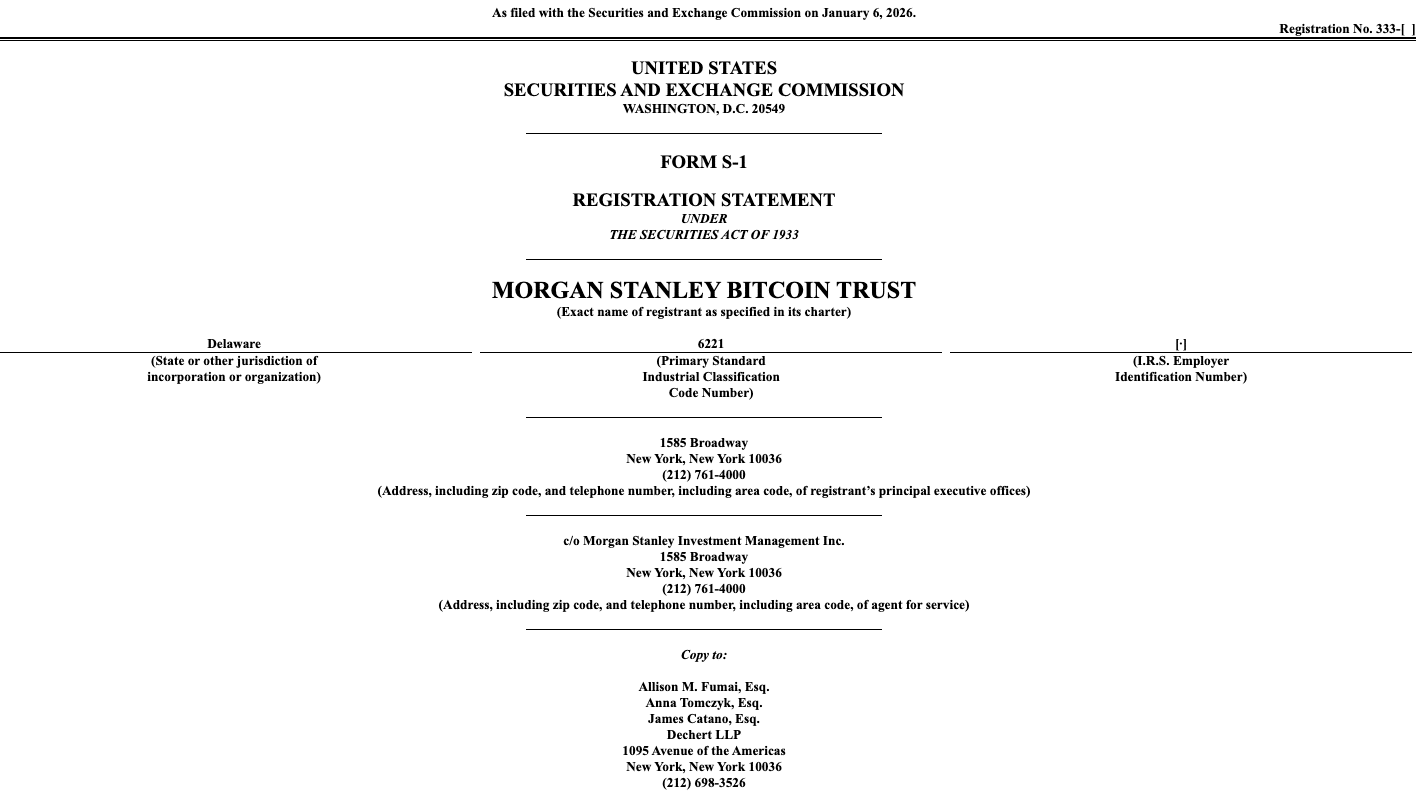
According to the Form S-1 registration that has been filed with the U.S. Securities and Exchange Commission (SEC), Morgan Stanley is looking to issue a spot Bitcoin exchange-traded fund called the Morgan Stanley Bitcoin Trust.
The proposed ETF is intended to track the price of Bitcoin, minus fees and expenses, without using derivatives, leverage or active trading.
The filing states that the trust will also directly hold Bitcoin. Its net asset value will be determined on a daily basis using the designated pricing benchmark based on spot market activity.
The fund is also passive and won’t try to time the market or change its holdings in response to swings in prices or volatility.
If it comes to market, the ETF’s shares will trade on a U.S. national securities exchange, though the filing does not mention an exchange or ticker for the listing.
The shares will be issued and redeemed in large blocks by authorized participants, which can purchase them either with cash or by exchanging Bitcoin.
Retail investors would buy and sell the product in the secondary market through brokerage accounts instead of interacting directly with bitcoin custody or blockchain infrastructure.
Where the Solana Trust Fits in the Strategy
In a separate Form S-1 filed, Morgan Stanley also registered for its Morgan Stanley Solana Trust, which is meant to correspond to the price of Solana. The Solana trust, according to the filing, will enable investors to have exposure to Solana in a regulated wrapper, like other commodity and digital currency trusts.
At this point, the filing does not refer to the Solana product as an ETF. Instead, it is designed as a trust that would own Solana for investors and shares would represent proportional ownership.
Like the Bitcoin offering, pricing will also be based on benchmarks created from spot market data.
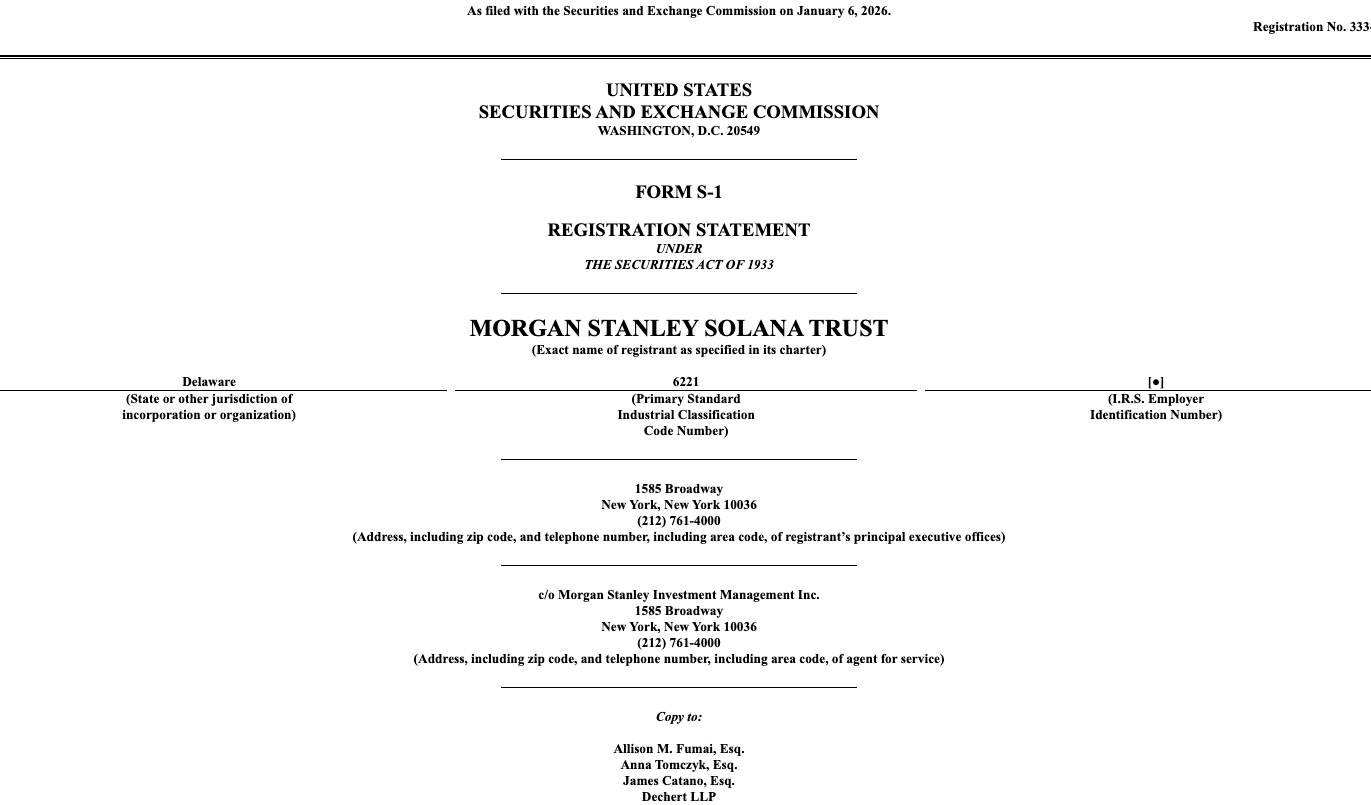
The filing for Solana suggests that Morgan Stanley is not restricting its crypto bets to just Bitcoin. With the pursuit of a Solana trust to sit alongside a Bitcoin ETF, the firm is now setting itself up to issue multiple regulated digital asset products under its own sponsorship.
The filings don’t give timing for regulatory approval or go-public dates, and can’t be taken as commitments of listing date or trading volume.
What the Morgan Stanley Filings Tell About its Future
The filings and plans show Morgan Stanley is not just becoming a distributor of digital assets. The registration statements say the firm will back, manage and supervise the products via its investment management division.
This method is enabling Morgan Stanley to incorporate digital assets into its current investment environment. The filings describe typical ETF and trust mechanics such as custody, valuation, authorized participant responsibility and secondary market trading.
Importantly, the Bitcoin ETF filing reveals that the fund will not engage in lending, staking or do anything to generate yield. Its sole purpose is to reflect the price of Bitcoin, net of expense. This structure mirrors that of other regulated spot commodity ETFs, rather than speculative or actively managed crypto products.
The filings note compliance with U.S. securities laws, such as those related to registration, disclosure and how it operates. There are no alternative offshore entities and experimental constructs mentioned in the documents.
Why These Morgan Stanley Filings Are Important for Institutional Crypto Access
Morgan Stanley runs one of the largest wealth management businesses in the United States, providing services to institutional and high-net-worth clients through a network of financial advisers. The SEC filings indicate that, at least, the firm is planning to provide crypto exposure via products that are natural fits in traditional investment portfolios.
Sponsoring its own Bitcoin ETF and Solana trust would allow Morgan Stanley to provide clients with regulated digital asset exposure without depending on outside issuers. This architecture allows the company to control product design, fee schedules, and distribution.
The filings also provide further evidence of a wider normalization of digital assets in regulated financial markets. Rather than casting crypto as a risky, experimental allocation, the documents discuss Bitcoin and Solana as assets that can pair with traditional investment vehicles subject to established regulatory regimes.
Crucially, the filings do not assert future adoption, price actions or market success. It’s all about structure, compliance, and design of operations with the new course material, again mirroring the tone of an institutional offering.
Conclusion
Morgan Stanley ETF filings have shown that the bank is strengthening its stride in regulated digital asset products. Morgan Stanley is applying for a spot Bitcoin ETF that would hold the actual crypto asset and a Solana trust to monitor Solana’s price.
The filings illustrate an evident migration toward in-house crypto product development in a fully regulated context.
No approval timelines have been offered, but the news suggests digital assets are becoming more of a staple than an accessory in Morgan Stanley’s investment offering.
Glossary
Spot Bitcoin ETF: is an exchange-traded fund that holds Bitcoin as its underlying investment, rather than futures or derivatives.
S-1: A registration statement to register securities for public offering that is filed with the SEC.
Trust structure: pooled ownership of assets that are managed on behalf of investors.
Authorized participants: financial institutions allowed to create or redeem ETF shares in large lots.
Net asset value: the per-share price of a fund, based on its underlying assets.
Frequently Asked Questions About Morgan Stanley Filings
What did Morgan Stanley file with the S.E.C.?
Morgan Stanley filed Form S-1 registration statements for a spot Bitcoin ETF and a Solana trust.
Will the Bitcoin ETF actually hold Bitcoin itself?
Yes. The ETF will hold Bitcoin directly, and there will be no derivatives or leverage, the filing says.
Is the Solana product an ETF?
The filing calls it a trust, not an exchange-traded fund.
Have these Morgan Stanley filings been approved by the SEC?
No approval has been issued. The filings represent the start of the regulatory review process.
When will the products launch?
The filings do not give timelines for approval or launch.