

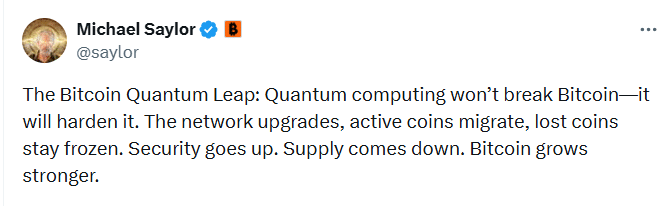
Michael Saylor has a talent for turning a dense technical topic into a clean, bullish soundbite. He argued that quantum computing will not break Bitcoin. In his framing, the network upgrades, active holders migrate, lost coins stay frozen, security rises, supply falls, and Bitcoin comes out stronger.
It is a comforting narrative, and parts of it are directionally true. Bitcoin can upgrade as cryptography can evolve, and markets can move on. The problem is that the hardest part is not math; it is timing and coordination, and a meaningful slice of today’s supply may already sit in places where quantum risk is not theoretical anymore; it is structurally baked in.
The weak point is not mining, it is signatures
Quantum fear headlines often talk like Bitcoin mining is the target. In reality, the sharper concern is digital signatures, the mechanism that proves a spender owns a coin. Bitcoin relies on elliptic-curve cryptography for signatures, including ECDSA and Schnorr, and a sufficiently capable fault-tolerant quantum computer running Shor’s algorithm could, in principle, recover private keys from public keys at scale.
That “sufficiently capable” part matters. The discussion is still about a future class of machines, not the devices in laboratories today. Some estimates put cryptographically relevant quantum systems at least a decade away, which sounds like plenty of runway, until the market remembers that Bitcoin upgrades are social systems first and software releases second.
Why “1.7 million coins at risk” keeps coming up
Saylor’s argument assumes that coins that are not actively moved will remain safely frozen. The uncomfortable wrinkle is that some coins are not merely idle, they are positioned in ways that reveal the public key already, which is the condition that would make Shor-style theft plausible once the hardware exists.
Older pay-to-public-key outputs expose the raw public key directly on-chain. More modern “pay-to-public-key-hash” styles keep the public key hidden behind a hash until the moment the coin is spent, meaning the key becomes visible during spending. Taproot is a separate twist: Taproot outputs encode a public key in the output itself from day one, so those outputs are “exposed” earlier in the lifecycle than many people assume.
The headline number in the debate is around 1.7 million BTC tied to early-era outputs with already-revealed public keys, plus additional exposure from Taproot usage and other patterns. Some analyses go further and estimate that roughly 25% of Bitcoin supply sits in outputs where public keys are already revealed, which is why the topic refuses to stay in the “someday” bucket.
The upgrade path exists, but it is not free
On the defensive side, the world is not starting from zero. The U.S. National Institute of Standards and Technology has finalized post-quantum cryptography standards, including signature standards such as ML-DSA and SLH-DSA, and the broader security industry is already moving toward migration plans.
Bitcoin could adopt post-quantum signatures through new output types, hybrid designs, or staged migration techniques that let old and new systems coexist for a period. Technical research communities are actively exploring how to do this with workable performance.
Still, there is a price tag. Post-quantum signatures tend to be larger and heavier to verify, which can translate into more block space consumed per transaction, higher fees during busy periods, and higher node costs. If Bitcoin is a global settlement layer, even small increases in per-transaction weight can ripple into real user experience and real market narratives.

And then there is governance. Bitcoin has no central authority that can order everyone to upgrade. A successful transition would require broad alignment across developers, miners, exchanges, custodians, and large holders, with incentives that stay intact over years, not weeks. That is the part Saylor’s quote glides past, even if the optimism is understandable.
Indicators that matter to markets, not just engineers
If traders and long-term allocators ever start pricing “quantum risk” seriously, the signals will likely be visible in boring places first. The share of coins sitting in exposed output types matters because it defines the surface area. Taproot adoption trends matter because they change what is visible on-chain earlier. Fee behavior matters because it hints at how painful a migration could be if larger signatures become the norm.
There is also a subtle operational angle: even hashed-key outputs reveal a public key when they are spent, and researchers have described hypothetical “sign-and-steal” racing scenarios in the mempool if a future attacker can extract keys fast enough and front-run a transaction. It is not a present-day emergency, but it is a reminder that the real-world battlefield is messy, not a whiteboard.
Conclusion
Saylor is not wrong that Bitcoin can harden in response to quantum progress. Bitcoin has upgraded before, and cryptography is not static. What the confident one-liner misses is that the transition is not automatically bullish. A meaningful amount of BTC appears to sit in already-exposed forms, and the difference between “frozen lost coins” and “stolen dormant coins” is not philosophy; it is execution and timing.
If the ecosystem treats the next decade as a planning horizon rather than a distant sci-fi timeline, Bitcoin can emerge with stronger guarantees. If coordination slips, the market may discover, the hard way, that risk is rarely priced at the moment it becomes obvious.
FAQ
Can quantum computing break Bitcoin mining?
Mining uses SHA-256, and quantum speedups there are not the primary concern compared with signature theft scenarios.
What exactly becomes vulnerable in a quantum scenario?
Outputs where the public key is already revealed can become targets because a powerful quantum computer could derive the private key from that public key.
Why are some coins called “already exposed”?
Some older output types publish public keys directly, and Taproot outputs include a public key in the output itself, making exposure structural rather than optional.
Is there a real post-quantum replacement for today’s signatures?
Yes. NIST has finalized post-quantum signature standards such as ML-DSA and SLH-DSA, which are candidates for systems seeking quantum resistance.
What makes upgrading Bitcoin difficult?
The cryptography is only one piece. Coordinating a widely adopted upgrade across a decentralized ecosystem is the slow, politically hard part.
Glossary of key terms
ECDSA: A widely used elliptic-curve signature scheme used in Bitcoin to authorize spending, vulnerable in principle to Shor’s algorithm on a sufficiently capable quantum computer.
Schnorr signatures: A newer signature scheme used by Taproot that improves efficiency and privacy, but relies on similar elliptic-curve assumptions as ECDSA.
Shor’s algorithm: A quantum algorithm that can solve certain math problems fast enough to undermine elliptic-curve cryptography, given a large fault-tolerant quantum computer.
Taproot (P2TR): A Bitcoin upgrade that uses Schnorr signatures and introduces new spending conditions; Taproot outputs encode a public key in the output itself.
P2PK and P2PKH: Older Bitcoin output styles. P2PK exposes a public key directly, while P2PKH hides it behind a hash until spending.
Post-quantum cryptography (PQC): Cryptographic algorithms designed to remain secure even against powerful quantum computers, including standards like ML-DSA and SLH-DSA.