

What if the next 100x meme coin isn’t already trending on every exchange but is still quietly pricing itself in real time? As meme coin capital rotates back into early-cycle setups, investors are increasingly asking whether the biggest upside will come from chasing familiar names or from identifying presales that are still shaping their valuation. That question has pushed APEMARS into focus this week, as its presale officially goes live at Stage 3, locking in a $0.00002448 price while the project continues to reference a $0.0055 listing level, creating a visible 22,367% upside gap that early participants are tracking closely.
- 1. APEMARS – The 100x Meme Coin Opportunity Still in Its Early Window
- Why Stage 3 Matters More Than Most Investors Realize
- 2. Peanut the Squirrel (PNUT): Viral Identity Meets Small-Cap Speculation
- 3. Pepe (PEPE): Liquidity King With Size Constraints
- 4. Bonk (BONK): Solana’s Flagship Meme Trade
- 5. ApeCoin (APE): Brand Power, Muted Price Action
- 6. Pudgy Penguins (PENGU): From Collectibles to Capital Markets
- 7. Floki (FLOKI): Marketing Muscle Still Matters
- 8. Dogwifhat (WIF): Branding Over Complexity
- 9. SPX6900 (SPX): Valuation Strength, Liquidity Constraints Remain Key Watchpoints
- 10. Fartcoin (FARTCOIN): Momentum-Driven Trading Activity Dominates
- 11. Baby Doge Coin (BABYDOGE): Established Community, Limited Price Discovery
- 12. Brett (BRETT): Ecosystem Exposure Shapes Market Narrative
- Final Thoughts: Rethinking Where the Next 100x Meme Coin May Come From
- FAQs About the 100x Meme Coin
- 1. What is considered a 100x meme coin?
- 2. Are meme coins still a good investment in 2026?
- 3. How does a presale affect meme coin returns?
- 4. What makes APEMARS different from other meme coins?
- 5. Is the APEMARS presale currently live?
- Summary
Against that backdrop, this listicle breaks down APEMARS alongside 11 other meme coins currently on investor watchlists, including Pepe, Bonk, Floki, and Baby Doge Coin. While many of these tokens already command liquidity and attention, APEMARS stands out for a different reason: it is still in its price-discovery phase, offering not only presale access but also staking participation immediately after joining, with staking rewards activating two months post-listing. That combination of early entry, defined tokenomics, and delayed yield activation is precisely the type of setup that has historically produced the most asymmetric meme-coin returns when timing aligns.
1. APEMARS – The 100x Meme Coin Opportunity Still in Its Early Window
What if the next 100x meme coin isn’t something you chase after it explodes, but something you enter while the price is still being built? That’s the position APEMARS is in right now. While many meme coins already feel “discovered,” APEMARS is still shaping its journey through a structured presale designed to reward those who act early, not late.

APEMARS is currently in Stage 3 of its live presale, priced at $0.00002448, while the project’s planned $0.0055 listing price continues to anchor investor expectations. That price gap alone represents a 22,367% upside from Stage 3, which explains why APEMARS is increasingly being discussed as a serious 100x meme coin candidate heading into 2026. This is not about hype alone. It’s about timing, structure, and entering before the crowd realizes the window is closing.
Why Stage 3 Matters More Than Most Investors Realize
Stage 3 is where early momentum starts to become visible. At $0.00002448, APEMARS is still priced far below where it plans to list, yet it has already progressed past its earliest discovery phases. This is often the zone where experienced investors step in, because the risk feels more defined while the upside remains asymmetric.
The presale follows a fixed timer-based structure, meaning each stage moves forward whether people are ready or not. If demand accelerates and a stage sells out early, the system automatically advances to the next stage at a higher price. The timer does not pause. It does not wait. This creates natural pressure for investors who understand that every stage skipped is upside permanently lost.
With Stage 3 live now and later stages already mapped out, many see this as the last phase where entry prices still feel “cheap” in hindsight terms.
A $1,750 Scenario Investors Are Quietly Running Right Now
Let’s bring this down to real numbers that investors actually think about.
A $1,750 entry at Stage 3, priced at $0.00002448, secures a large APEMARS allocation while the project is still in its presale phase. With a planned $0.0055 listing price, that same position carries a projected 22,367% upside from Stage 3 alone.
In simple terms, this is the kind of setup where investors later say, “I knew about it, but I waited.” If APEMARS reaches its listing target, a $1,750 position moves far beyond a small speculative bet and into territory that most people only see after the opportunity has already passed. That’s why Stage 3 is being treated as a decision point, not a maybe.
This is the window where outcomes are still asymmetric, prices are still being shaped, and hesitation quietly becomes the most expensive move.
According to insights tracked by best crypto to buy now, early-stage presales tend to attract the highest asymmetric interest during emerging market cycles.
How to Buy APEMARS in the Live Presale
Joining the APEMARS presale is designed to be straightforward, even for first-time buyers.
First, connect a compatible crypto wallet directly on the APEMARS presale page. Once connected, select the cryptocurrency you want to use for the purchase. After that, enter the amount you wish to invest. If you have a referral or bonus code, you can apply it during this step to unlock additional benefits.
Once the transaction is completed, your purchased APEMARS tokens will appear inside your presale dashboard, where you can track your allocation and progress as the presale moves through its stages.
2. Peanut the Squirrel (PNUT): Viral Identity Meets Small-Cap Speculation
Peanut the Squirrel has quietly built a recognizable identity in the meme coin space, driven by character branding rather than ecosystem promises. With a market capitalization of around $83.3 million, PNUT remains firmly in the small-cap category, which keeps it attractive to short-term traders hunting volatility. Analysts often note that its relatively steady daily volume of $12.8 million reflects consistent community engagement, even in quieter market sessions.
What keeps PNUT in the news cycle is not utility expansion but social traction. Tokens like this tend to resurface quickly when meme sentiment accelerates, though sustained upside typically depends on renewed viral moments rather than structural growth.
3. Pepe (PEPE): Liquidity King With Size Constraints
Pepe remains one of the most cited meme coins in daily market commentary. Sitting at a $2.4 billion market cap with more than $340 million in 24-hour volume, PEPE has effectively graduated into a high-liquidity meme asset. This makes it attractive for large traders and market makers, but also places natural limits on exponential upside.
From an analyst perspective, PEPE’s role is now closer to a sentiment barometer than a breakout candidate. It moves when meme appetite is strong, but expectations of it becoming the next 100x meme coin have largely faded due to its scale.
4. Bonk (BONK): Solana’s Flagship Meme Trade
Bonk continues to feature prominently in Solana-related market updates. With a market cap near $918.8 million and daily volume above $83 million, BONK is often treated as a proxy trade for Solana ecosystem optimism. News cycles around Solana upgrades or network activity frequently spill over into BONK price action.
Analysts tend to classify BONK as a momentum-driven asset, where upside is tied more to ecosystem-wide catalysts than to BONK-specific developments.
5. ApeCoin (APE): Brand Power, Muted Price Action
ApeCoin still benefits from its association with Yuga Labs and the broader NFT cultural footprint. However, with a market cap of roughly $156.3 million and relatively modest volume, APE has struggled to reclaim speculative momentum. Market commentary often frames it as a brand token rather than a meme trade, which changes investor expectations.
APE tends to resurface in news tied to NFT ecosystem developments rather than meme rotations, making it less reactive during pure meme rallies.
6. Pudgy Penguins (PENGU): From Collectibles to Capital Markets
Pudgy Penguins has successfully transitioned from an NFT collection into a broader brand-driven token economy. With a $755 million market cap and strong trading volume, PENGU is frequently cited as an example of meme culture evolving into consumer-facing intellectual property.
Analysts view PENGU as relatively mature. Its upside is increasingly linked to brand execution and partnerships rather than meme volatility alone.
7. Floki (FLOKI): Marketing Muscle Still Matters
Floki remains one of the most aggressively marketed meme coins in the space. With a market cap of $486.3 million, FLOKI continues to appear in headlines due to its promotional campaigns and ecosystem ambitions. While price action has stabilized compared to earlier cycles, FLOKI still reacts strongly during meme-focused market bursts.
Market analysts often describe FLOKI as a retail-driven momentum asset, where sentiment and visibility play a larger role than scarcity mechanics.
8. Dogwifhat (WIF): Branding Over Complexity
Dogwifhat’s rise is frequently cited in discussions about how simple branding can outperform complex narratives. At a $375.9 million market cap, WIF maintains strong liquidity and visibility, especially on Solana-focused platforms.
Its appeal lies in recognizability, not innovation, which keeps it relevant but also caps long-term asymmetry compared to earlier-stage plays.
9. SPX6900 (SPX): Valuation Strength, Liquidity Constraints Remain Key Watchpoints
SPX6900 continues to surface in analyst commentary due to the contrast between its valuation and its trading depth. With a market capitalization of approximately $539.4 million, SPX sits among mid-tier meme assets by size. However, its 24-hour trading volume of $7.6 million remains relatively low compared to peers in the same capitalization range.
From a market structure perspective, this imbalance means price movements can be more sensitive to moderate order flow. Analysts generally classify SPX as a higher-risk speculative asset, where short-term price action can deviate sharply from broader market trends. As a result, coverage around SPX tends to focus on liquidity conditions rather than long-term adoption metrics.
10. Fartcoin (FARTCOIN): Momentum-Driven Trading Activity Dominates
Fartcoin’s presence in recent market updates reflects its role as a sentiment-responsive meme asset. With a market capitalization near $374.5 million and relatively strong daily trading volume of $73.8 million, FARTCOIN demonstrates consistent short-term liquidity compared to many similarly sized meme tokens.
Analysts typically view FARTCOIN as a momentum-dependent instrument, where price action is closely tied to shifts in retail participation rather than protocol development. As a result, news references tend to appear during periods of heightened trading activity rather than through sustained fundamental developments.
11. Baby Doge Coin (BABYDOGE): Established Community, Limited Price Discovery
Baby Doge Coin remains one of the longer-standing meme assets, still maintaining an active holder base. At a market capitalization of approximately $120 million and 24-hour volume around $5.6 million, BabyDoge trades with relatively low volatility compared to newer meme entries.
Market commentary often frames BabyDoge as a legacy retail asset, supported by community continuity rather than speculative inflows. Coverage typically centers on ecosystem updates and engagement milestones, with price movements reflecting gradual shifts rather than aggressive re-rating.
12. Brett (BRETT): Ecosystem Exposure Shapes Market Narrative
Brett’s relevance in current coverage is largely tied to its association with the Base ecosystem. With a market capitalization of roughly $173.6 million and daily volume near $8.4 million, BRETT is often discussed within the context of Base-related adoption trends rather than as a standalone meme phenomenon.
Analysts tracking ecosystem-linked meme tokens note that BRETT’s performance has shown correlation with broader Base network sentiment. As a result, its market outlook is frequently framed around infrastructure growth and ecosystem participation rather than independent speculative momentum.
Final Thoughts: Rethinking Where the Next 100x Meme Coin May Come From
Across this list, it’s clear that most established meme coins now trade with well-defined market positions. Tokens like Pepe, Bonk, Floki, and Pudgy Penguins continue to attract attention through liquidity and brand strength, but their price movement is increasingly tied to overall market conditions rather than early discovery.
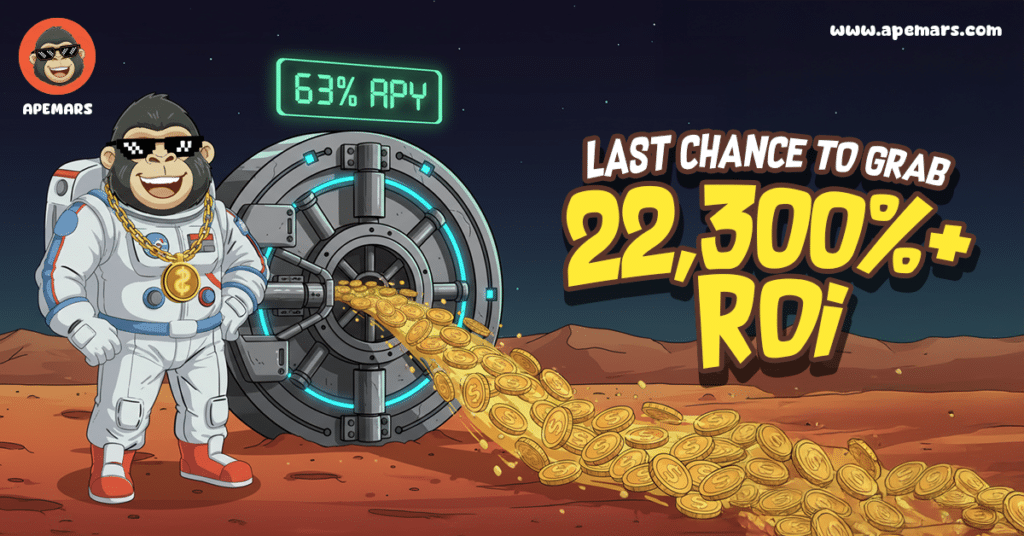
That’s why some investors are looking earlier in the cycle when considering the next 100x meme coin. APEMARS stands out here, with its presale live at Stage 3, priced at $0.00002448, and a referenced $0.0055 listing level. The resulting 22,367% gap from Stage 3 pricing highlights a stage where valuation is still forming, not yet settled.
While no outcome is guaranteed, history shows that many missed opportunities were visible before they became obvious. As established meme coins reflect where capital has already flowed, early-stage projects like APEMARS point to where timing and patience may still matter most.

For More Information:
Website: Visit the Official APEMARS Website
Telegram: Join the APEMARS Telegram Channel
Twitter: Follow APEMARS ON X (Formerly Twitter)
FAQs About the 100x Meme Coin
1. What is considered a 100x meme coin?
A 100x meme coin is a cryptocurrency that has the potential to increase one hundred times from its entry price. These opportunities usually appear early in a project’s lifecycle, often during presales or initial launches, before wide exchange listings and large-scale market attention.
2. Are meme coins still a good investment in 2026?
Meme coins can still offer opportunities in 2026, but risk levels vary significantly. Established meme coins tend to move with the broader market, while early-stage projects may offer higher upside alongside higher uncertainty. Timing, structure, and market conditions remain critical factors.
3. How does a presale affect meme coin returns?
Presales allow investors to enter at fixed prices before public trading begins. Returns depend on demand after listing and overall market sentiment. Presales with clear stages, transparent pricing, and defined supply mechanics often attract investors seeking asymmetric early-stage opportunities.
4. What makes APEMARS different from other meme coins?
APEMARS stands out due to its structured multi-stage presale, fixed pricing progression, and supply reduction mechanisms built into its roadmap. Rather than relying only on hype, it emphasizes timing, staged entry, and clearly defined token distribution.
5. Is the APEMARS presale currently live?
Yes, the APEMARS presale is live at Stage 3. The current presale price is $0.00002448, with a referenced listing price of $0.0055. This creates a visible pricing gap that some investors monitor when evaluating early-stage meme coin opportunities.
Summary
This article reviewed leading meme coins to understand where investors are currently focusing and how market maturity affects upside potential. While established names like Pepe, Bonk, and Floki continue to dominate liquidity, their growth is increasingly tied to overall market conditions. As a result, attention is gradually shifting toward early-stage structures when assessing the next 100x meme coin. APEMARS enters this discussion with its presale live at Stage 3, priced at $0.00002448, and a referenced $0.0055 listing level. The 22,367% difference between presale pricing and projected listing levels highlights an early valuation phase rather than a settled market price. This comparison helps frame how timing, structure, and entry stage influence potential outcomes.