

This article was first published on Deythere.
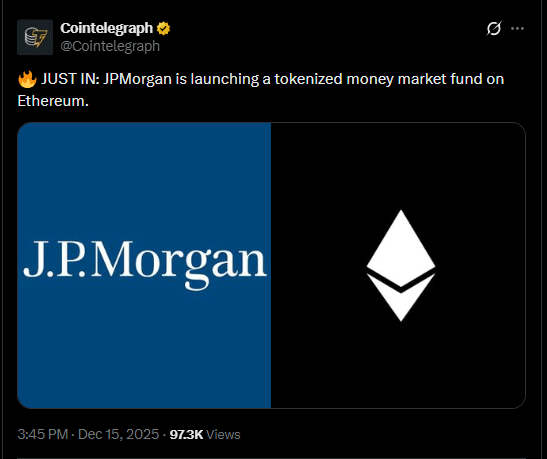
JPMorgan tokenized money has quietly stepped into the spotlight, not with fanfare, but with purpose. When one of the world’s largest banks moves a conservative cash product onto a public blockchain, it signals more than experimentation. It suggests a shift in how institutions think about money itself.
This development comes at a time when financial infrastructure is under pressure to modernize. According to the source, large asset managers now prioritize faster settlement and more transparency as markets grow more complex. JPMorgan’s decision reflects that demand rather than chasing crypto hype.
From Paper-Heavy Systems to Programmable Settlement
At its core, JPMorgan tokenized money is a vanilla MMF (money market fund) but happens to be issued as blockchain tokens on Ethereum. Each token represents ownership in a short-term, low-risk asset like U.S. Treasury bills. The investment profile stays conservative. The delivery system changes entirely.
Traditional money market funds rely on legacy clearing systems that can take days to settle. Blockchain technology cuts that delay dramatically. A recent study published by the Bank for International Settlements explains that near-instant settlement reduces counterparty risk and improves liquidity efficiency, especially for institutional portfolios handling daily cash movements.
Ethereum is a main player in this system. By the latest CoinMarketCap report, Ethereum is still among one of the most popular blockchains based on market cap and developer activity. Its unique contract-based model lends predictability and transparency to financial products.
JPMorgan Tokenized Money And the Trust Factor
For JPMorgan, trust is the currency that matters most. Money market funds attract institutions because of stability, not innovation. Tokenization enhances oversight rather than replacing safeguards.
Every transaction is recorded on-chain. Holdings become visible in real time. A financial transparency report published by the World Economic Forum notes that real-time data access improves audit accuracy and reduces operational blind spots. That same logic applies here.
The blockchain layer also reduces dependency on intermediaries. Clearing, reconciliation, and reporting processes shrink as they are automated. For financial analysts, this translates into lower operational friction. For blockchain developers, it demonstrates how decentralized tools can support regulated finance.
A Signal to the Broader Financial System
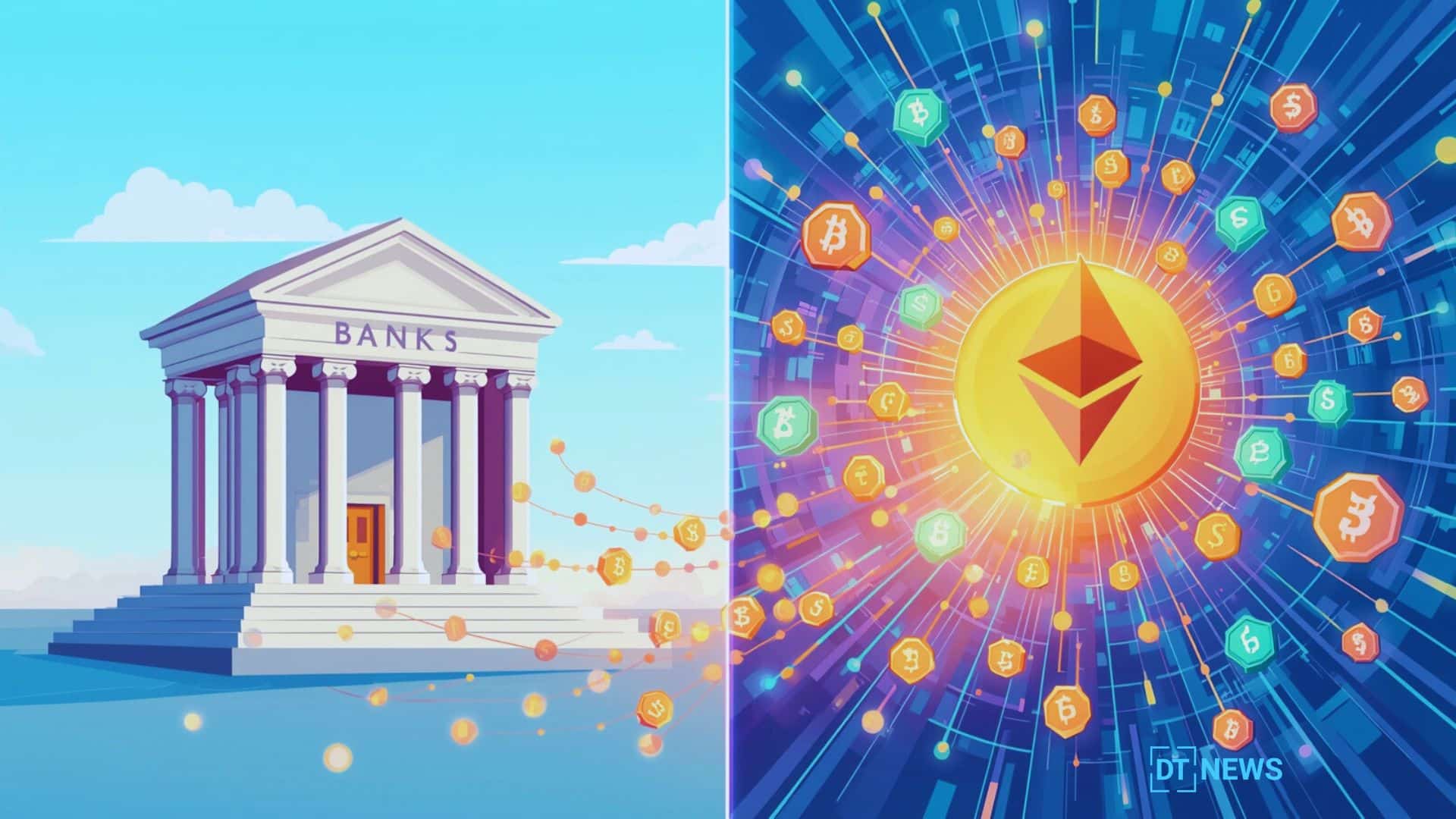
The launch of JPMorgan tokenized money sends a clear message across global banking. Blockchain is no longer confined to experimental labs. It is entering production systems under regulatory supervision.
Industry researchers tracking tokenized securities have noted that this phase focuses on infrastructure rather than disruption. A detailed analysis from the Securities and Exchange Commission highlights how tokenization can coexist with existing compliance frameworks when applied to familiar assets.
This approach also explains why JPMorgan avoided volatile crypto products. The bank positioned this fund for institutional clients seeking liquidity tools, not speculative exposure. That distinction reassures regulators and reinforces market confidence.
What This Means For Future Finance Professionals
For financial students, JPMorgan tokenized money offers a real-world example of how traditional products adapt to new technology. For crypto enthusiasts, it validates the role of public blockchains in serious finance. For developers, it highlights the growing demand for secure, compliant, clever contract design.
Researchers also point to interoperability as the next step. Tokenized funds could eventually interact with other on-chain systems, enabling faster collateral movement and more efficient treasury operations.
Conclusion
JPMorgan tokenized money does not shout about revolution. It demonstrates evolution. By placing conservative cash tools on blockchain rails, the bank shows how finance can move faster without losing discipline. For an industry built on trust, that balance may define the next decade.
FAQs About JPMorgan Tokenized Money
1. What is JPMorgan tokenized money?
It is a blockchain-based version of a regulated money market fund issued by JPMorgan.
2. Why use Ethereum?
Ethereum offers security, transparency, and programmable contracts suitable for financial instruments.
3. Is this aimed at retail investors?
No. The product targets institutional investors and corporate treasury operations.
4. Does tokenization change the fund’s risk level?
No. The underlying assets remain low risk. Tokenization improves settlement and visibility.