

This article was first published on Deythere.
- The Growth Engine of Hyperion: Five Revenue Streams Scaling Together
- The “Triple-Dip” Strategy Creating 3x Yield Efficiency
- Buybacks and Supply Reduction Keep Constant Pressure on Demand
- Volatility in Treasuries Showcases Strength and Risk
- Conclusion
- Glossary
- Frequently Asked Questions About Hype Price
- Why is HYPE price rising?
- What is Hyperion’s triple-dip strategy?
- Is HYPE a real revenue backed project?
- What Are the Risks of HYPE Price?
- What is Hyperion’s 2026 outlook?
- References
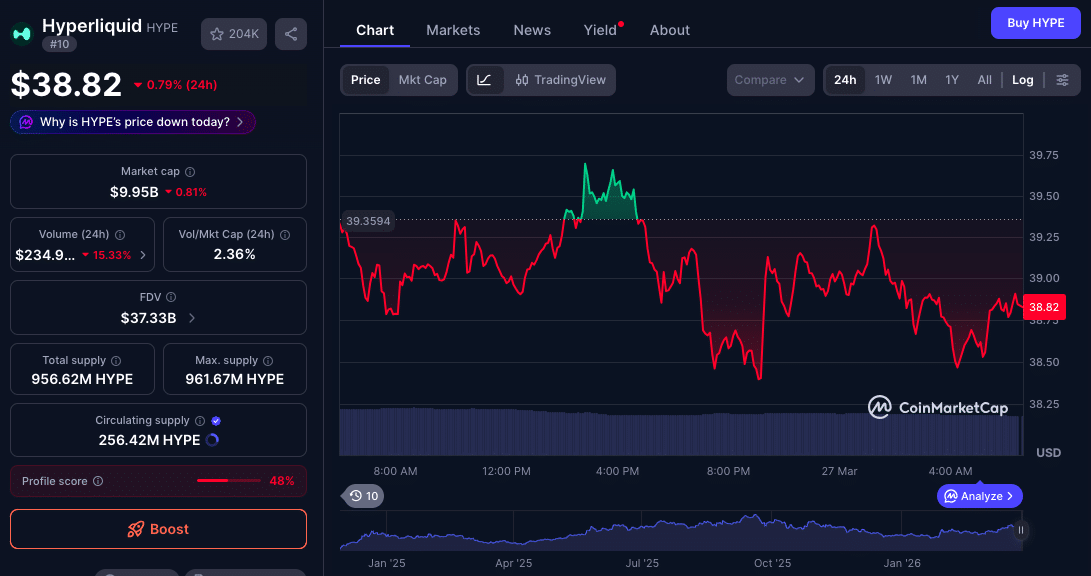
HYPE price recently surged more than 60% year-to-date, from less than $25 to close to $40 as investors changed their focus away from speculative momentum and toward revenue-linked crypto models.
This surge comes after solid financial results were released by Hyperion DeFi, the first publicly traded company in the US to be built on top of the Hyperliquid ecosystem. The company posted 64% quarter-over-quarter revenue and an 87% increase in adjusted gross profit for Q4 2025.
What’s remarkable is not only growth but efficiency. Across the same time period, Hyperion cut operating costs by 30%, while its business grew across several DeFi verticals.
The Growth Engine of Hyperion: Five Revenue Streams Scaling Together
The current HYPE price momentum is closely tied to Hyperion’s diversified business model, which goes far beyond simply holding tokens.
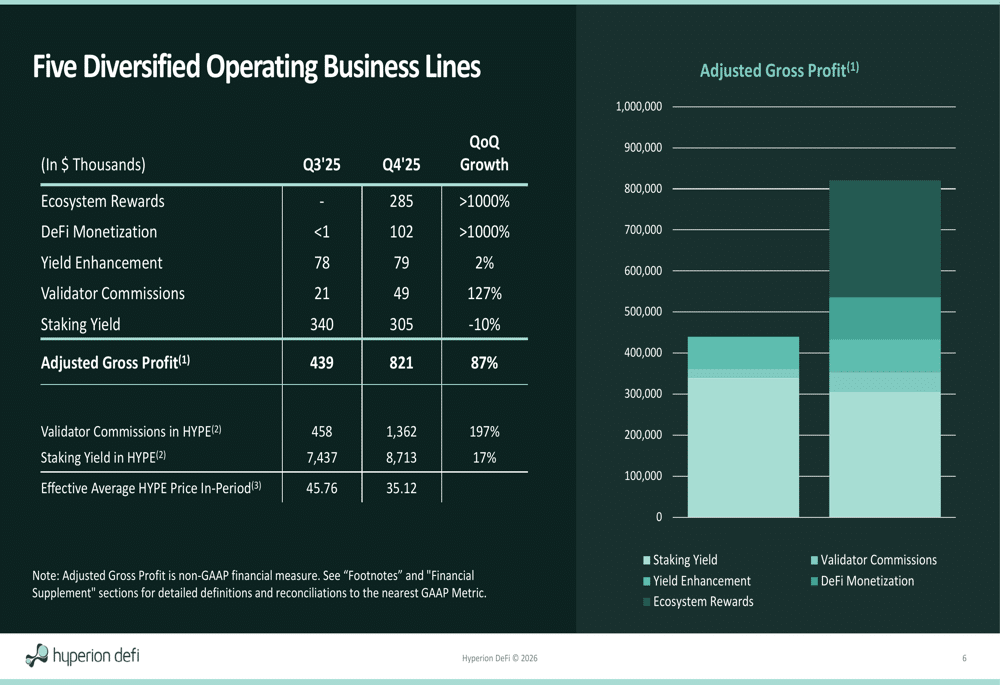
The company operates across five fundamental DeFi revenue lines: staking yield, validator commissions, yield enhancement strategies, DeFi monetization and ecosystem rewards. When combined, these segments were responsible for moving adjusted gross profit from $439k in Q3 2025 to $821k in Q4; a change of (87%) YoY over the course of only one quarter.
Much of the strongest growth came from newer segments. DeFi monetization revenue surged from under $1,000 in Q3 to over $102,000 in Q4, while ecosystem rewards generated $285,000 after the previous quarter reported no earnings.
Meanwhile, validator commissions saw a 197% uptick, while staking rewards registered a 17% increase in token terms as steady expansion was seen across both old and new revenue streams.
The “Triple-Dip” Strategy Creating 3x Yield Efficiency
A core aspect underlying HYPE price surge is Hyperion’s so-called “triple-dip” strategy.
Unlike single-function token use, Hyperion can deploy the same HYPE tokens across all activities at once. The process involves token staking, redeploying into DeFi strategies like lending or trading infrastructure, and harvesting extra ecosystem rewards.
This approach generated roughly 3x base staking income in Q4-2025, greatly increasing capital efficiency.
This means that every unit of HYPE spreads over a dozen yield streams at once, boosting total returns without needing for additional capital.
From an investors standpoint, this model enhances the HYPE price outlook as it directly links token demand to utility and income generation rather than passive holding.
Buybacks and Supply Reduction Keep Constant Pressure on Demand
Trading and on-chain interactions generate fees for Hyperliquid, which are subsequently used to repurchase HYPE tokens from the market. These tokens are then taken out of circulation, deflating supply over time.
The difference between this and traditional token burns is that it is directly based on real usage. Higher trading volume leads to an equal measure of buyback activity creating sustained demand pressure.
Though daily numbers vary, on-chain activity has nonetheless generated real revenue for The Protocol and fully delivered the feedback loop of usage; buybacks and price support.
This also offers some insight into why HYPE price has moved upwards.
Volatility in Treasuries Showcases Strength and Risk
Beyond solid operational results, the HYPE price narrative does not come without risks.
Hyperion financial results show that its treasury is highly sensitive to token price fluctuations. The firm posted a net loss of around $39.7 million in Q4 2025, mainly due to decline in the value of its HYPE holdings, down from a net income of $6.6 million the previous quarter.
Though the business is generating genuine revenue, its balance sheet remains linked to volatilities in the crypto market.
As of March 2026, Hyperion still holds around 1.93 million HYPE tokens worth $73.9 million, revealing the magnitude of its exposure and potential upside if prices continue to rise.
Conclusion
Looking ahead, Hyperion has forecast adjusted gross profit of between $4 million and $6 million by 2026; about four times its performance in 2025. Should this growth happen, it would further create a path between revenue and value behind the token that could lead to continued upward pressure on the HYPE price.
On the other hand, sustainability will rely on a high level of on-chain activity. A decline in trading volume or user activity can undermine the buyback mechanism and diminish demand.
At the same time, competition within the DeFi sector remains intense, and regulatory uncertainty continues to shape the market environment.
Glossary
HYPE price: The market price of the HYPE token in the Hyperliquid ecosystem.
DeFi: Decentralized Finance – finance applications built over a blockchain network
Staking: A process of locking tokens to earn rewards and assist in network operations.
Validator: A type of node that validates transactions and secures a blockchain.
Buyback: This is when a token is purchased from the market in order to decrease its circulating supply.
Frequently Asked Questions About Hype Price
Why is HYPE price rising?
Due to strong revenue growth, token buybacks, and growing DeFi traction on Hyperliquid.
What is Hyperion’s triple-dip strategy?
It enables the same tokens to produce other income streams at once, thus increasing overall yield.
Is HYPE a real revenue backed project?
Yes, revenue from staking, trading fees, DeFi monetization and ecosystem rewards.
What Are the Risks of HYPE Price?
Treasury volatility and dependence on continued on-chain activity
What is Hyperion’s 2026 outlook?
The company expects to see $4 million to $6 million of adjusted gross profit, roughly four times what it did in 2025.