

Decentralized applications (dApps) are software in which the backend code is running on a blockchain network instead of a centralized server. In other words, one can build a dApp by writing smart contracts which are self-executing code on the blockchain, and linking those to a web-based frontend.
- What is a Decentralized Applications (dApps)?
- Why Build a dApp? (Trends and Opportunities)
- Required Conditions and Tools Needed to Build a dApp
- Step-by-Step Guide: Building Your First dApp
- Expert Insights
- Conclusion
- Glossary
- Frequently Asked Questions About How to Build a Dapp
- What exactly do the term decentralized applications (dApps) refer to?
- What programming language do we need to use for dApp development?
- Is it possible to build and test a dApp without using real cryptocurrency?
- References
What is a Decentralized Applications (dApps)?
A decentralized application (dApp) is an application that runs directly on a blockchain and consists of both on-chain code and a user interface. Unlike normal apps (e.g. Google or Facebook); a dApp has no single control server. Instead; its smart contracts (the backend) live on a peer-to-peer network such as Ethereum. There are several benefits, which include no downtime, user privacy, censorship resistance, immutable data.
For instance, the Ethereum documentation points out that dApps offer zero downtime, allow users to remain anonymous and render data tampering impossible. But this also implies that code can’t be modified post-deployment, making testing absolutely critical.
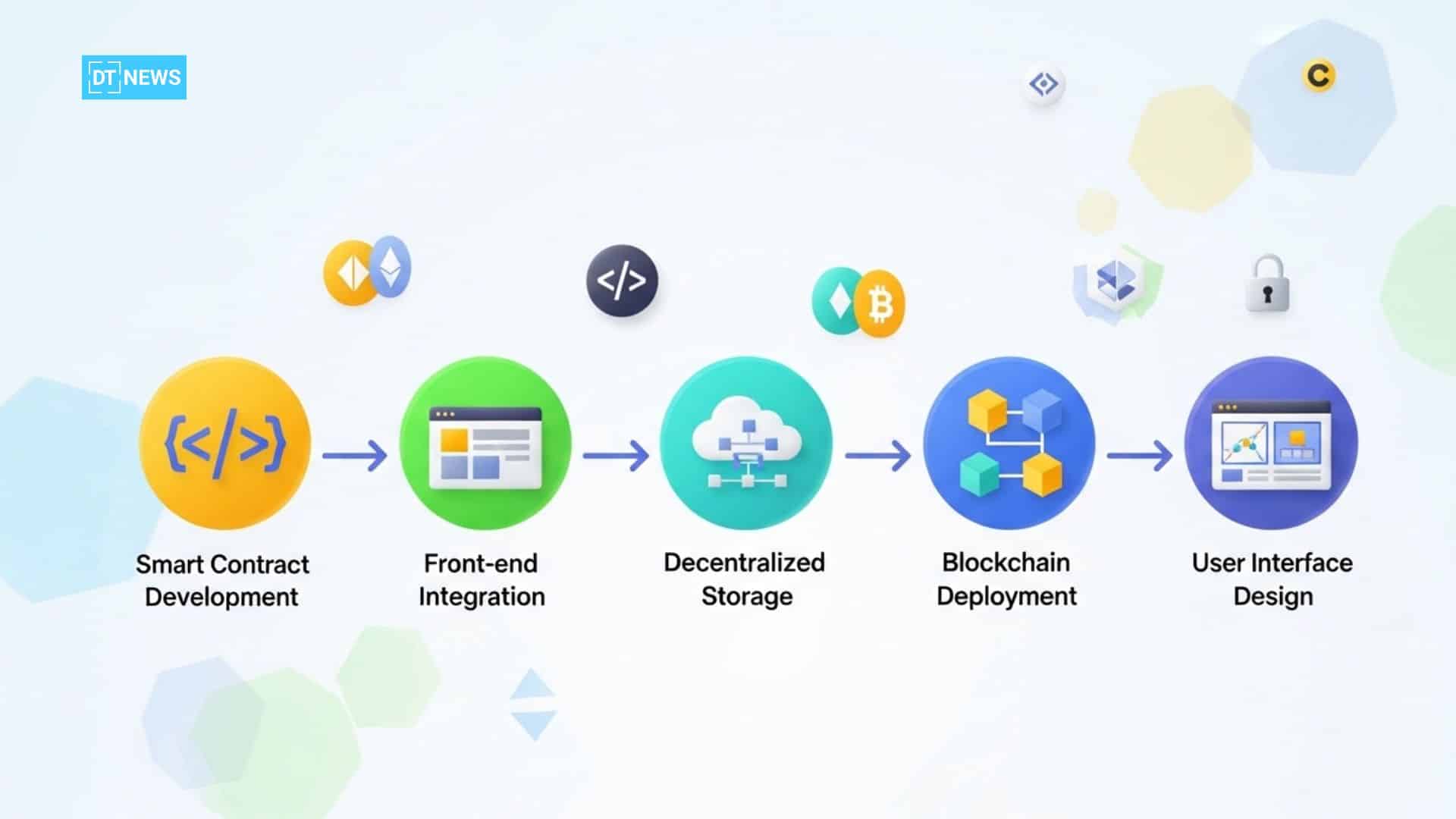
Some essential components of a dApp consist of:
Smart Contract (Backend) : The core logic running on blockchain(e.g. Ethereum). They are written in blockchain-specific languages most notably Solidity for Ethereum and they hold/store/execute the app’s governing rules.
Frontend (User Interface): A regular web UI (HTML/CSS/JavaScript, common practice is using React or similar) that users interact with. The smart contract is accessed by the frontend using web3 libraries (Web3. js or Ethers. js).
Wallet/Provider: A crypto wallet like MetaMask for example or a service like Infura or Alchemy that connects the frontend to the blockchain networks. It enables users to sign transactions (e.g.. send cryptocurrency) in the browser.
Data Storage: Large data (images, files) isn’t stored on-chain (too expensive). Instead; dApps typically utilize decentralized storage solutions such as Filecoin or IPFS for media and archives. Only required state and references are maintained by the blockchain.
This architecture allows for trustless and transparent dApp.
Why Build a dApp? (Trends and Opportunities)
Decentralized applications are rapidly growing in importance. Recent research estimates put the global decentralized applications dApp market at $30 billion in 2024; with forecasts exceeding $70 billion by the end of 2030. More than 70% of all blockchain activity today; is generated through dApps (like decentralized exchanges, games; NFT markets).
Notable examples of leading dApps are Uniswap (a decentralized exchange built on Ethereum); Axie Infinity (a blockchain game); and Decentraland (a blockchain-based virtual world). These showcase the different ways dApps can manifest; from finance to gaming and within the metaverse. For a developer or entrepreneur; to build a dApp is just like cracking into a growing market. Experts from the industry highlight that learning dApp development is essential for innovation in Web3.
So when asking how to build a dApp, rest assured this is a skills that is in hot demand. But first, there’s need to understand the fundamentals such as ideas, developer tools, and a clear project plan.
Required Conditions and Tools Needed to Build a dApp
Before getting into coding, there’s need prepare with some essential tools and concepts:
Programming Language: Solidity (for EVM blockchains) or Vyper is used in most of the Ethereum dApps. Solidity is the most popular Ethereum Virtual Machine blockchain programming language. Other chains use other languages: e.g. Rust for Solana; or Python for some non-EVM platforms.
Node.js and npm: There’s need for Node.js to be installed in order to use modern dApp tools which are often distributed as npm packages.
Development Environment: A code editor like VS Code; and an IDE for smart contracts is needed. Beginners often use Remix IDE (a web-based editor) to write; compile, and deploy Solidity contracts. On the other hand; tools like Hardhat or Truffle run on machines for local testing. One example is Hardhat; which gives a local Ethereum-like network and the ability to run both tests and scripts.
Wallet: A web3 wallet like MetaMask (browser extension or mobile app) is needed to interact with a dApp. It will be required to authorize transactions. Tools like MetaMask inject a web3 provider; so that your frontend can request signature and payment.
Libraries: Ethers. s or Web3.js are JavaScript libraries that allow the builder’s frontend to call smart contract functions. Frontends use Web3.js or Ethers. js to connect with contracts, using the user’s wallet to send transactions.
Blockchain (Testnet/Mainnet): Use a test network in development. Ethereum does have free testnets (e.g. Sepolia, Goerli) that offer openings for getting test Ether. This allows the builder to deploy and test their transactions without burning real crypto. Then; it can be deployed to a mainnet or other less expensive EVM chain such as Polygon or Binance Smart Chain.
In essence; the basic tools that will be needed to build a dApp are smart contract languages (Solidity, Remix/Hardhat), for web development (HTML/CSS/JS, React); and a way to connect (MetaMask, Ethers.js). When setting up, ensure your Node.js environment and wallet setup is configured with various testnet funds.
Step-by-Step Guide: Building Your First dApp
Here are the simple steps to build a decentralized applications dapp:
- Plan Your dApp: Define the purpose of your dApp and its solution like, saving a message on-chain, or just sending a token. Sketch user flows (what users will do);and data you need. Choose which blockchain you like best (Ethereum for broad support, or a faster chain if you want speed or low fees). Explore existing dApps to get some inspiration. Popular developer tools: dAppRadar; GitHub smart contract repos.
- Set Up the Development Environment: Installing Node.js and a code editor. Follow prompts to make a simple project. These will generate folders (for contracts; scripts; tests) from Hardhat. Also install libraries (ethers.js; dotenv for keys) when required.
- Write the Smart Contract: Create a Solidity file in your contract folder (for example; SimpleStorage.sol). Use the latest version. Save and compile it. Ensure there are no errors.
- Test the Smart Contract: Create manual tests or automated tests. Hardhat can also run local tests (using of Mocha/Chai) for fast testing. Early testing is good to quickly catch bugs because once deployed on-chain, contracts cannot be modified. For manual testing; deploy to a local network or Remix’s JavaScript VM and call functions in the UI.
- Deploy to a Testnet: Choose a test network (Sepolia, Goerli, etc.); and get some test Ether from a faucet. Configure your hardhat.config.js (or use Remix’s environment) to deploy. What a builder needs is to get some test ETH, basically fund their MetaMask or Hardhat account. If you are using Remix; change to a testnet in its environment and hit Deploy. Take note of the contract’s address after deployment.
- Build the Frontend (UI): Build a basic web UI using react or just HTML/JS.
- Connect the Frontend to Blockchain
- Deployment of the Frontend and Finalization of Your dApp: You can deploy your UI once everything is functioning. As a decentralized alternative to this, you can upload your site on IPFS. In this manner the entire dApp (both front and backend) is decentralized. Ensure the contract address and network configuration in your code is set to the final network be it mainnet or chosen blockchain. Finally, share your dApp’s URL and have others try it with their MetaMask.
Here’s a table comparing some popular blockchain options (many of them Ethereum-compatible) for building dApps:
| Blockchain | Contract Language(s) | Use-Cases |
| Ethereum | Solidity; Vyper | Largest dApp ecosystem; used in most DeFi and NFT projects |
| Binance Smart Chain | Solidity (EVM-based) | Lower fees than Ethereum; hosts many DeFi apps (e.g. PancakeSwap).. |
| Polygon | Solidity (EVM-based) | Layer-2 for Ethereum; faster and cheaper transactions for similar apps. |
| Avalanche | Solidity (C-Chain EVM) | High throughput; custom subnets; used for finance and enterprise dApps. |
| Solana | Rust (also C/C++) | Very fast & low fees; popular for DeFi and NFTs (uses Rust on-chain). |
| Polkadot | Rust (Substrate framework) | Multi-chain ecosystem; parachains for specialized dApps (e.g. gaming). |
Expert Insights
Experts say that to build a dApp in the current age is more than just knowing how to code, but by having awareness around the blockchain trends. Security and audits are also high on the agenda. As smart contracts are immutable after deployment; industry best practice requires extensive testing (unit tests, integration tests); and even professional audits for any serious-value dApp.
Market-wise, analysts predict strong growth. The compound annual growth rate (CAGR) of the dApp market is estimated to be 18% spanning through 2025-2030, according to a reports.
For a developer; this means that skills in how to build a dApp could be rewarding as more and more enterprises embrace blockchain. At the same time; one must stay updated on changes. Ethereum’s transition to Proof-of-Stake and rollups (2024+) help scaling while new chains like 2025’s Optimism/Starknet are faster to deploy.
In summary, building a dApp today means utilizing the latest tools and keeping up with Web3 trends like interoperability and decentralized storage. The benefits which include zero downtime, censorship resistance; remain compelling but developers should also be alert to the disadvantages such as maintenance difficulty or possible congestion. Any new dApp developers can confidently enter the ecosystem equipped with this knowledge and head start.
Conclusion
How to build a decentralized applications dApps now depends on knowledge about blockchain fundamentals, smart contract development and Web3 tools. One begins with a clear idea, then create a dev environment, build and test a smart contract and then implement a web-based front-end that connects libraries like Ethers.js.
From there; one deploys the contract to a testnet using something like MetaMask to interact with one’s wallet and then build the UI, even choosing to host it on decentralized IPFS.
Be mindful of the benefits (security, transparency) and challenges (updating code is hard) of dApps. Through regular development and thorough testing; newcomers can deploy their first dApps.
Glossary
Blockchain: functions as a distributed system which uses decentralized peer-to-peer networks to maintain its ledger through a sequence of interlinked blocks. The dApps which operate on blockchains execute smart contracts while keeping their stored transactions permanent.
dApp (Decentralized Application): A decentralized application which runs on its backend system through blockchain deployment. The application operates without centralized server management because it uses a distributed network of nodes to function.
Smart Contract: A self-executing program operates on the blockchain according to its specific predetermined conditions.
Web3: The term Web3 describes an internet version which uses blockchain technology to establish decentralized systems; that enable users to manage their personal information.
The Ethereum Virtual Machine (EVM): The runtime environment for executing smart contracts on the Ethereum network.
Solidity:: functions as the primary programming language that developers use to create smart contracts for Ethereum networks. Solidity shares JavaScript syntax; as its programming structure. Developers choose Solidity for implementation because it generates EVM bytecode; through its compilation process.
Frequently Asked Questions About How to Build a Dapp
What exactly do the term decentralized applications (dApps) refer to?
A dApp operates its backend functions through decentralized blockchain technology. The system connects a smart contract which contains on-chain logic;; to a standard frontend user interface. The decentralized nature of a dApp results from its backend operations which take place on a peer-to-peer network.
What programming language do we need to use for dApp development?
The majority of dApps on Ethereum or compatible chains are built using Solidity.. Solidity is the most widely-used programming language for the Ethereum Virtual Machine. Different chains implement different programming languages; Solana uses Rust while other chains use Vyper. The frontend development process will require you to use Javascript together with Ethers.js library and other libraries.
Is it possible to build and test a dApp without using real cryptocurrency?
Yes. Use blockchain test networks. These networks offer test ETH via faucets; which are free test tokens. You just deploy and interact with your dApp there the same way you would on mainnet.
What are some notable examples of dApps?
Decentralized finance apps and games are examples of popular dApps. Some of the most popular dApps have been Uniswap (an Ethereum-native token exchange); Axie Infinity (a blockchain game); and Decentraland (a virtual world). Our dApps can go from financial services to entertainment, as these real-world examples depict.