
This article was first published on Deythere.
- Background: Ondo Finance’s Tokenization Initiative
- How the Trading of Tokenized Stocks Work on Solana
- Why Solana? Speed, Scale, and Compliance
- Regulatory and Compliance
- Traditional vs. Ondo Tokenized Stock Trading Features
- Institutional Partnerships and Market Impact
- Conclusion
- Glossary
- Frequently Asked Questions About Ondo Finance Tokenized US Stocks
- What are tokenized stocks?
- How are the tokens pegged to actual stocks?
- Why use the Solana blockchain?
- When will tokenized US stocks on Ondo launch?
- Will token holders get dividends?
- References
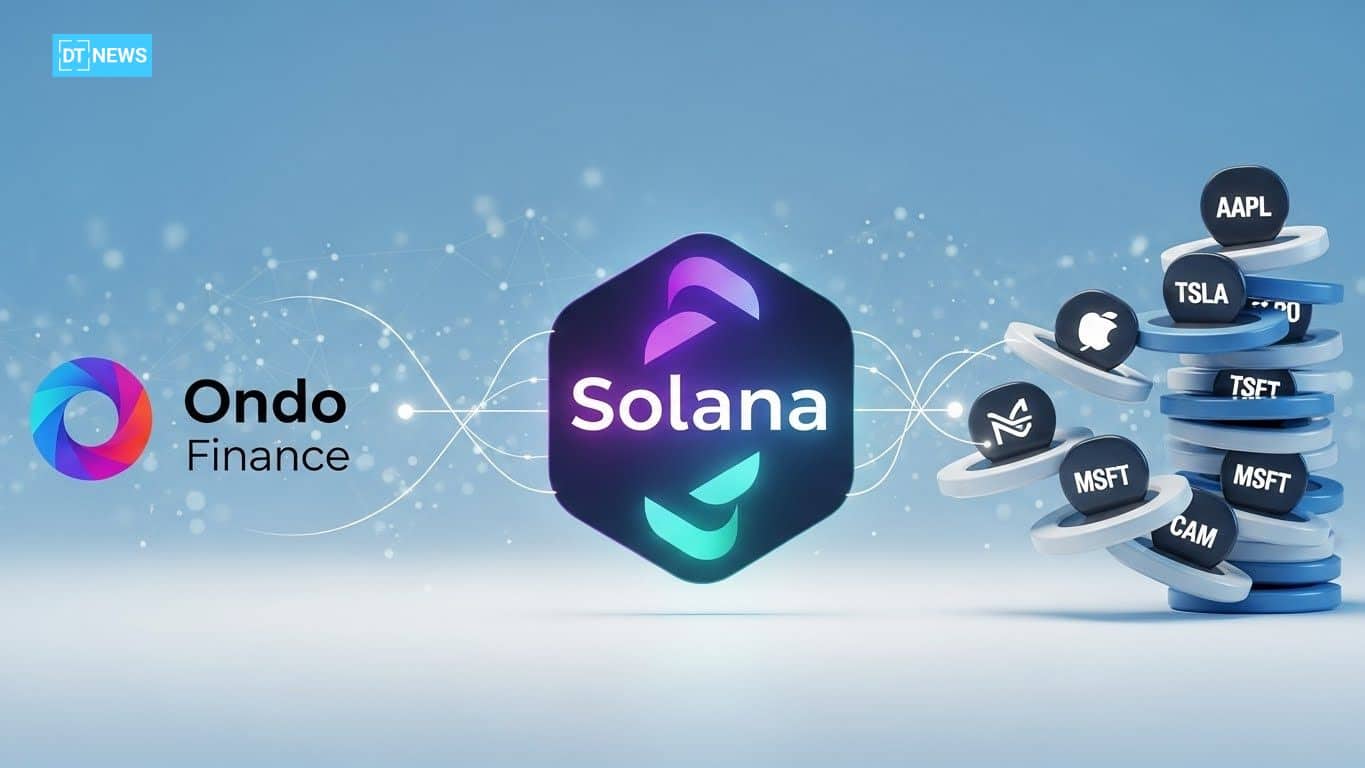
Ondo Finance plans to expand its platform for tokenized US stocks and ETFs onto the Solana blockchain by early 2026. Under such a system, investors would be able to trade the tokenized shares of U.S. stocks 24 hours a day, 365 days per year, with near-instant settlement.
These stock tokens are tokenized and custody-backed, meaning the regulated broker-dealers or custodians hold the actual shares of a company, while on-chain holders receive only the economic benefits like dividends
Taking advantage of the high throughput and ultra low fees on Solana, Ondo Finance tokenized US Stocks on Solana introduces a fast, efficient trading experience similar to that of crypto markets but with the legitimacy of real equities.
Background: Ondo Finance’s Tokenization Initiative
Ondo Finance is a fintech start up that aims to be a bridge between real-world financial assets (RWAs) onto blockchains. The company’s current Global Markets platform already includes tokenized exposure to more than 100 U.S. stocks and ETFs on blockchains such as Ethereum and BNB Chain.
In total, the Ondo platform has issued about $300-365 million in tokenized RWA, ranking it among one of the larger players in the space.
In 2025, Ondo teamed up with Chainlink so that each of these stock tokens has their own unique data feed for price and corporate actions like dividends.
This Chainlink collaboration introduces an oracle layer that enables on-chain token prices to always reflect the true economic value of stocks on which they’re based.
This development in Solana comes after Ondo expanded to BNB Chain in October 2025 which gave it access to 3.4 million daily users. The Solana move shows what Ondo is after: to bring traditional assets into crypto wallets so investors “should be able to hold US equities inside the same wallet they use for stablecoins.
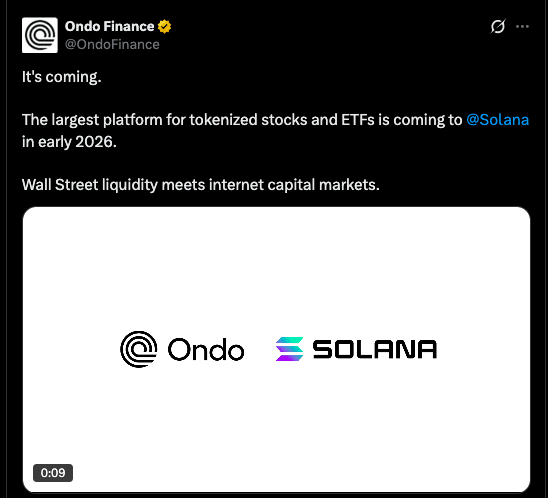
Ondo Finance announced the launch on Solana, slated for early 2026.
How the Trading of Tokenized Stocks Work on Solana
Ondo’s model is custody-backed. When an investor wants a tokenized share, actual stock is deposited with a regulated custodian (like BNY Mellon or State Street). Ondo then mints a new token on Solana that embodies the share.
The custodian will sell the stock and burn the token when tokens are redeemed. This mint/burn strategy works to keep the token supply pegged 1:1 to shares.
Importantly, token holders receive all of the economic returns (price changes, dividends), but do not receive the legal entitlement or shareholder rights as this continues to be held by the custodian.
In reality, that means the token value tracks the stock’s performance but voting rights or some other form of ownership stay off-chain.
Trading operates on a 24/5 vs 24/7 hybrid schedule. The tokens can be created or redeemed during U.S. trading hours 24hrs a day on weekdays.
However, once minted, the tokens can circulate and change hands on Solana all day and night. In other words, creation/redemption follows a 5-day schedule but secondary trading is non-stop.
This structure ensures prices stay anchored: Ondo uses Chainlink’s custom oracles to aggregate live stock prices and account for corporate actions.
For instance, if a stock pays a dividend, the oracle feed updates the value of the token to reflect that information and on-chain price actually captures all returns. On-chain settlement is nearly instant.
Traditional equity transactions have a T+1 schedule, typically the next day. In contrast, Ondo’s token trades on Solana confirm in seconds or minutes. This efficiency is fast and the capital-saving. A user could purchase an on-chain tokenized share before the New York Stock Exchange opens, and instantly use it elsewhere on-chain (as opposed to waiting for cash settlement a day later). All of this occurs as the actual custody ledger is itself updated.
Why Solana? Speed, Scale, and Compliance
Solana was selected based on its speed and the relatively low cost. It processes blocks in 400ms, and transaction fees are usually less than 0.01cents.
By contrast, Ethereum’s higher gas fees have the potential to make frequent trading or fractional-share transfers costly. Solana’s network already supports millions of daily active users, many using trading focused apps. Tokenized stocks in familiar Solana wallets makes it easier for retail crypto traders to access.
Beyond that, Solana provides strong token programmability. Its Token Extensions allow Ondo to code in custom logic directly on the token contract.
For example, Ondo can hard core that only verified wallets (or those from jurisdictions which have passed certain tests) could ever hold its stock tokens. This architecture necessarily means that compliance checks such as blocking unverified addresses, or routing tokens through a legal wrapper, must happen within the network itself.
In all, Solana’s retail adoption, execution speed, low fees and onchain compliance features are well suited for Ondo’s ambitious feats into trading model.
Regulatory and Compliance
Tokenization also introduces a new level of compliance that must be executed with attention to detail. Ondo is aware that tokens are securities, so it must comply with U.S. laws on custody, brokerage and etc.
To offer these tokens, the company and its partners will also need to file registered offerings with the SEC, obtain an exemption or potentially register as transfer agents or broker dealers for this program.
Real-world custodians will maintain custody of the shares under SEC custody rules, subject to stringent insurance and auditing for investors. The Solana-based tokens will have built-in restrictions: for instance, transfer hooks can prevent wallets from specific countries or non-accredited investors if that’s required as needed. Chainlink’s partnership also brings a regulatory role in responding to robust, auditable price feeds.
IIn late 2025, the SEC closed a confidential investigation into Ondo without taking action. While not an SEC approval, this does seem to indicate that regulators have given Ondo some clarity around its products.
The company now caters to international users first, with simplified KYC down for non-U. S. participants. This tactic allows Ondo to launch on Solana in the United States without straying afoul of stringent retail U.S. rules, at least for now. Any eventual U.S. retail offering will need additional approval from the S.E.C.
Traditional vs. Ondo Tokenized Stock Trading Features
| Feature | Traditional U.S. Stocks | Ondo Tokenized Stocks on Solana |
| Trading Hours | Weekdays 9:30-16:00 ET (6.5h); limited pre/post trading. | 24/7 global trading (any day, any time) |
| Settlement Time | Typically T+1 (next business day). | Near-instant on-chain finality (seconds) |
| Price Discovery | Market-driven during trading hours. | Continuous pricing via blockchain oracles (with last-close or indexed price off-hours). |
| Custody of Assets | Held by brokers or CSD (DTCC). | Held by regulated custodians; tokens represent claims on those assets. |
| Regulatory Treatment | Well-established SEC oversight and SIPC protection. | Treated as securities; will use built-in compliance (KYC/eligibility) onchain |
| Fees | Per-trade broker commissions (often $0 now) and exchange fees. | Very low blockchain fees ($0.00025 per transfer); possible creation/redemption fees. |
Institutional Partnerships and Market Impact
Ondo’s Solana initiative is supported by heavyweight partners demonstrating confidence in the industry. State Street Investment Management and Galaxy Asset Management announced $200 million private liquidity fund (SWEEP) on Solana with Ondo Finance set to seed the funds.
On the market side, tokenized RWAs are growing at a fast pace. Industry data lists the total of tokenized assets somewhere around $700 million, with Ondo in the lead at over $300M.
Competing projects such as Backed Finance and Securitize exist, but Ondo’s history in fixed-income (USDY treasury fund >$500M AUM) and its push on Solana gives it an edge.
If Ondo’s launch succeeds, it could become a template for others. Combining TradFi and DeFi like this might open up new markets and liquidity pools to investors everywhere.
Conclusion
Ondo Finance tokenized US stocks’ on Solana aims to provide traditional U.S. equity ownership plus blockchain efficiency. The program offers 24/7 trading, atomic settlement and embedded compliance enabled by custody-backed tokens and Solana’s powerful capabilities.
Its current product infrastructure (tokenization), institutional relationships (State Street, Galaxy, Chainlink) and SEC cleared inquiry suggest the plan is feasible.
However, success depends on navigating regulations, creating liquidity and gaining investor trust.
Glossary
Tokenization: When a real-world asset (like stocks) is made into digital tokens on a blockchain. Usually a token will represent a share of an asset.
Real-World Asset (RWA): An asset, either physical or financial in nature, from traditional off-chain markets (equities, bonds, real estate) that gets imported onto a blockchain.
Custody-Backed: A model by which real assets exist and are held by trusted custodians; the onchain tokens have real asset backing.
Oracle: A deliverable (like Chainlink) that provides real-world data (such as prices, dividends) into a blockchain smart contract.
Solana Token Extensions: advanced features (like Transfer Hooks) that allows code to run on every token transfer for compliance checks and custom logic.
Frequently Asked Questions About Ondo Finance Tokenized US Stocks
What are tokenized stocks?
These are tokens that indirectly represent shares of an actual company. Each token is secured 1:1 by a real share held by a custodian, so the holders of tokens experience price changes and dividends without actually holding legal title
How are the tokens pegged to actual stocks?
Ondo uses a mint/burn system. New tokens are created when the real shares are deposited with a custodian, and existing ones are destroyed as they’re redeemed for the real stock. This preserves the relationship between token supply and real shares.
Why use the Solana blockchain?
Solana provides very fast transaction times (blocks every 400ms), and minuscule fees ($0.00025 per trx). Its included Token Extension capabilities enables Ondo to embed KYC, and transfer restrictions directly in the token’s code.
This makes Solana ideal for high-frequency trading-like use cases while enforcing securities rules on-chain.
When will tokenized US stocks on Ondo launch?
Ondo Finance revealed they will be releasing tokenized US stocks and ETFs on Solana in early 2026. This timetable is based on receiving the required regulatory approvals in 2025-2026.
Will token holders get dividends?
Yes. As the tokens are economic, any dividends or corporate actions on the underlying shares will be passed through.