

Ethereum price prediction has become one of the most searched topics in crypto circles as ETH nears its longest monthly losing streak since 2018. The contrast feels sharp. Network activity is breaking records, yet price action tells a colder story.
- When Bitcoin Acts Like an Index and ETH Trades Like a Risk Asset
- Ethereum Price Prediction Collides With Ethereum ETF Outflows
- Record Transactions, Yet a Tougher Value Story
- Three Paths That Could Rewrite the Streak
- Conclusion: A Repricing, Not a Repeat of 2018
- Glossary of Key Terms
- FAQs About Ethereum Price Prediction
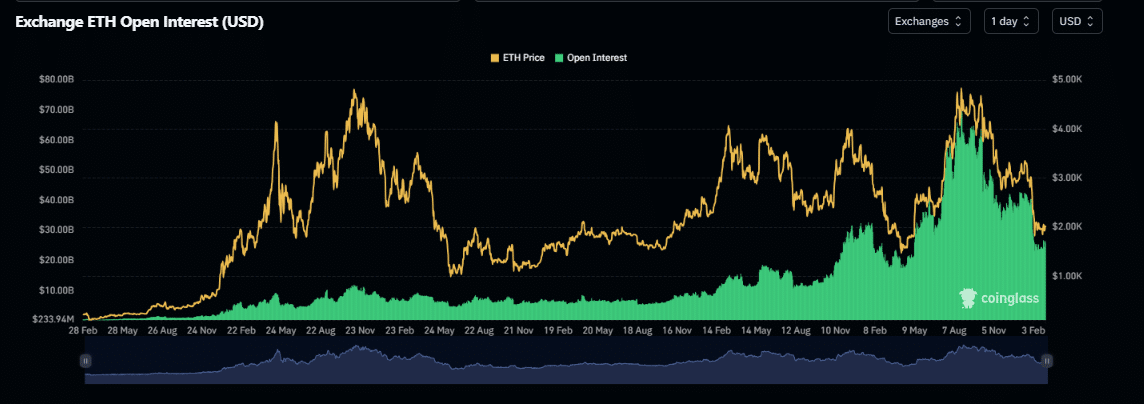
According to the source, ETH has logged six straight monthly losses since September 2025, falling nearly 60 percent from its August 2025 high of $4,953 to below $2,000. Verified data shows ETH trading near $1,950 at press time, with market capitalization and volume both reflecting cautious sentiment. This gap between strong usage and weak price now drives the broader Ethereum price prediction debate.
When Bitcoin Acts Like an Index and ETH Trades Like a Risk Asset
In recent selloffs, Bitcoin has behaved like a benchmark, while Ethereum has moved like a high-beta risk trade. That shift matters for Ethereum price prediction. When liquidity dries up and macro fear rises, investors cut risk first. ETH often sits at the top of that list.
Data from this derivatives tracker shows ETH futures open interest has dropped from nearly $70 billion in August 2025 to around $24 billion. That 65 percent decline reflects heavy deleveraging. Options markets add more tension.
Traders are paying a premium for downside protection, with short-term implied volatility hovering in the high 70 percent range. A one standard deviation move now implies roughly $200 swings in a single week. That range alone keeps Ethereum price prediction models wide and uncertain.
Ethereum Price Prediction Collides With Ethereum ETF Outflows
Ethereum price prediction also faces pressure from persistent Ethereum ETF outflows. Over the past four months, nine U.S. spot ETFs have recorded about $2.6 billion in net redemptions. Ethereum ETF outflows signal more than short-term selling. They reveal a lack of sustained institutional conviction.
Without strong inflows, rallies rely on derivatives rather than fresh capital. That dynamic increases fragility. Ethereum ETF outflows also shape sentiment among financial analysts who track capital flows closely. In past cycles, strong ETF demand provided a cushion. Today, Ethereum ETF outflows remove that safety net and complicate every Ethereum price prediction.
Stablecoin data adds another layer. The market cap of USDT has declined for two consecutive months, a rare trend not seen since the 2022 Terra collapse. A shrinking stablecoin base means fewer fresh dollars entering crypto markets. Ethereum price prediction models often rely on expanding liquidity. Right now, that engine looks stalled.
Record Transactions, Yet a Tougher Value Story
While price struggles, the network thrives. On-chain data from this analytics platform shows Ethereum’s seven-day average transactions reached nearly 2.9 million in early February. Layer-2 adoption and the Dencun upgrade reduced fees and expanded throughput. Developers continue to build across tokenized assets, stablecoins, and decentralized finance.
However, scaling has complicated valuation. The so-called ultrasound money thesis depends on fee burn exceeding issuance. In quieter periods, issuance can outpace burn, as shown on this supply tracker. That shift makes Ethereum price prediction less tied to automatic deflation and more tied to broader demand.
In simple terms, Ethereum is more useful than ever, but fee compression lowers direct base-layer revenue. The network grows, yet token value capture becomes harder to model. That tension sits at the heart of today’s Ethereum price prediction challenge.
Three Paths That Could Rewrite the Streak
Market observers now see three realistic paths. A capitulation phase could push prices toward the lower edge of volatility ranges if Ethereum ETF outflows continue and liquidity stays flat. A long consolidation could follow, where ETH trades sideways while leverage slowly clears. The final scenario involves a liquidity turn, driven by easing macro pressure and stabilizing Ethereum ETF outflows.
Each path carries implications for Ethereum price prediction. A liquidity rebound could reframe ETH as an indispensable settlement layer rather than a simple fee-burn story. Until then, uncertainty rules the tape.

Conclusion: A Repricing, Not a Repeat of 2018
Ethereum price prediction today reflects a network under stress, not a broken system. Unlike 2018, Ethereum now holds deeper institutional relevance and broader adoption. Yet Ethereum ETF outflows, reduced leverage, and slower stablecoin growth create a tough backdrop.
The market appears to be repricing how ecosystem growth translates into token value. For students, analysts, and developers, the lesson is clear. Strong fundamentals do not guarantee short-term price strength. Liquidity, capital flows, and sentiment still steer markets. Whether this streak ends soon or stretches further will define the next chapter in Ethereum price prediction.
This article is for informational purposes only and does not constitute financial advice. Readers should conduct their own research before making investment decisions.
Glossary of Key Terms
Ethereum Price Prediction: An estimate of ETH’s future value based on market data, liquidity trends, and macroeconomic factors.
Ethereum ETF Outflows: Net redemptions from U.S. spot Ethereum exchange-traded funds, signaling capital leaving the product.
Open Interest: The total value of outstanding futures contracts, often used to measure leverage in markets.
Fee Burn: A mechanism introduced by EIP-1559 that removes a portion of transaction fees from circulation.
Stablecoin Supply: The total market value of dollar-pegged tokens, often viewed as crypto market liquidity.
FAQs About Ethereum Price Prediction
Why is Ethereum price prediction difficult right now?
High volatility, Ethereum ETF outflows, and shifting liquidity trends make short-term forecasts uncertain.
Do Ethereum ETF outflows mean long-term weakness?
Not necessarily, but persistent outflows reduce institutional buying support.
Is Ethereum still growing as a network?
Yes. Transaction activity and layer-2 adoption remain near record levels.
Could liquidity return soon?
A macro shift and renewed stablecoin growth could support a stronger rebound.