
The dawn of new 6G wireless networks and sophisticated edge computing is changing the internet. Service providers want to ensure data integrity, enable privacy protection and automate resource sharing by continuously embedding decentralized ledgers and smart contracts in 6G and edge architectures.
- The Next Step: 6G and Edge Computing
- Blockchain’s Role in 6G Networks
- Benefits of Blockchain in 6G/Edge
- Blockchain Enhancing Edge Computing
- Industry Developments and Pilots forBlockchain 6G Networks
- Expert Analysis: Industry Perspectives on Blockchain 6G Networks
- Conclusion
- Glossary
- Frequently Asked Questions About Blockchain 6G Networks
Blockchain technology is now seen as the main enabler of 6G and edge technology. Its features such as immutability, decentralization, smart contracts; can solve 6G’s trust and scale problems.
With the rollout of Blockchain 6G networks, more blockchain pilots can be expected to address identity and access along with data integrity. This creates a future where wireless networks will operate less like centralized telecoms and more like decentralized platforms on the internet.
The Next Step: 6G and Edge Computing
6G isn’t just “5G Plus”; it holds out terabit speeds, microsecond latency, and widespread coverage through all terrestrial, satellite and even underwater links. These capabilities will enable large-scale IoT, holographic communications, autonomous systems and AI-based services.
Meanwhile, edge computing takes processing out of central clouds and down to base stations and devices. It minimizes latency and bottlenecks, allowing for real-time analytics and responsiveness.
However, 6G brings with it new security and trust challenges. With users and machines constantly networks, regular centralized security models can fail to scale. Experts say 6G will need continuous learning and self-organization, from connection-centric to intelligence-centered designs .
Researchers have suggested to use blockchain to “corroborate trust among isolated networks” in 6G with the aim of securing access control and data integrity.
In short, blockchain 6G networks could serve as the foundation for the futuristic internet’s, while ledgers and smart contracts ensure devices and data behave appropriately across the 6G system.
Blockchain’s Role in 6G Networks
The intrinsic features of blockchain such as immutability, decentralization, anonymity and transparency can support trust among isolated networks to secure access control, authentication, better integrity, secrecy and effectual resource sharing in 6G.
Decentralized Identity and Authentication: 6G will connect way more devices (IoT sensors, drones, vehicles, etc.), so scalable identity management is important. Instead of needing a central authority, blockchain can hep with self-sovereign identity where each device or user has an on-chain verifiable digital ID. This enables mutual authentication without a single point of failure.
For instance, for registering new IoT device in the network, their credentials can be stored on a blockchain. These credentials are then verified by peers in the network via consensus, preventing spoofing and Sybil attacks. Blockchain’s immutability and decentralization enhance access control, authentication, and better integrity”in 6G networks as pointed out in several studies.
Secure Data Integrity and Traceability: Ensuring that the data hasn’t been tampered with is critical in 6G’s decentralized space. Blockchain secures an immutable ledger where anything written on-chain or logged cannot be changed. This is particularly useful for edge data, where processing occurs outside secure data centers. Blockchain 6G networks provide a built-in audit trail, making systems self-certifying and resilient to insider or external tampering.
Spectrum and Resource Management: 6G will be deeply dependent on advanced spectrum utilization (for example, cognitive radio, dynamic sharing) and on demand edge resources. Blockchain can help improve spectrum access by creating a flexible database of usage rights. A recent survey has found that blockchain-enabled mechanisms in 6G-IoT spectrum management can result in enhanced security, transparency, and efficiency. Another important advantage is avoiding conflicts; a blockchain log of channel allocations ensures that two parties are never the same.
Decentralized Security Framework: Edge computing and 6G expose many attack surfaces (e.g. insecure IoT endpoints). As an essential global technology, blockchain can be considered a zero-trust security backbone because it is distributes trust. By using blockchain, edge nodes would also be able to agree on anomaly reports and allow the cross-checking of threat intelligence without exposing raw data.
Certain research even integrates blockchain with AI/ML, so threat patterns such as intrusion events can be captured in an immutable manner. As a whole, these roles mean in 6G networks, blockchain serves as a tamper-proof monitor of health in the system.
Benefits of Blockchain in 6G/Edge
| Function | Regular Approach | Blockchain-Enhanced 6G/Edge |
| Identity Management | Centralized PKI/SIM cards | Decentralized IDs on-chain; self-sovereign identity (SSI) |
| Device Authentication | Core network auth servers | Peer-verified via immutable ledger |
| Data Integrity | Local logs, central servers | Tamper-proof blockchain records; audit trails for edge data |
| Resource/Spectrum Sharing | Static allocation, central registry | Smart-contract based sharing; fair, dynamic spectrum market |
| Trust and Privacy | VPNs, Access controls | Zero-trust framework with blockchain, ZK-proofs |
| Orchestration | Manual configuration | Automated by smart contracts (e.g., edge compute marketplace) |
This table shows how Blockchain integrates with 6G and edge concepts to solve scale and trust issues. For instance, rather than a single authority enforcing spectrum access rights, smart contracts could transparently mediate such access. According to researchers, IoT data owners retain control under blockchain and thus can ensure secure exchanges in 6G environments.
Blockchain Enhancing Edge Computing
Edge computing moves computation closer to users; it also decentralizes the network. This is something that blockchain naturally complements as blockchain offers a distributed trust layer at the edge.
Recent research confirms that edge + blockchain improves performance of IoT. That means that edge nodes operating blockchain protocols can handle security processes on-site, eliminating latency issues and offloading bandwidth load from central networks.
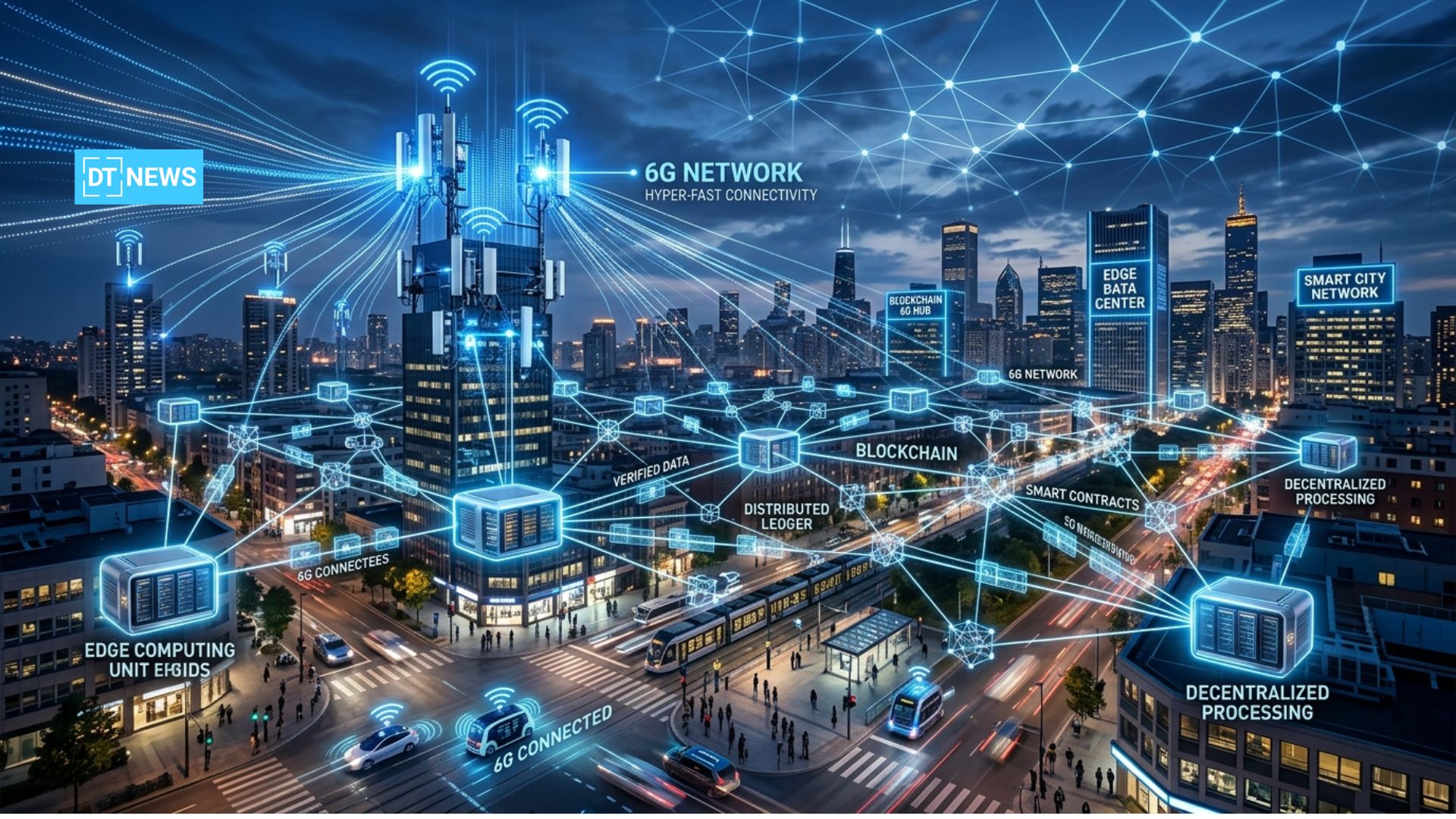
A possible implementation of the blockchain-enabled edge architecture may look like this: A lightweight blockchain node or ledger shard runs on each edge server or even on powerful IoT device.
When the edge device itself processes the data (e.g.: A camera identifying an object), it can immediately produce a hash of the result and write it to the ledger. Nearby nodes validate the block to reach an agreement that those observations are real. This accelerates trust within collaborative edge AI.
Federated learning at the edge is another use case; model updates from many devices can be aggregated, and the updates validated via blockchain to make sure that they are legitimate and originate from a valid participant.
Edge/blockchain combination also helps in security offload. A blockchain network of edge nodes can share threat intelligence instead of having each edge device manage its own keys and firewalls.
For instance, when a sensor admits compromise, an on-chain alert blocks similar devices all over the region without central coordination. This decentralized security resonates with the vision for 6G of trustworthy networking through collaboration.
However, there are challenges. Operating edge running blockchains uses energy and adds a certain amount of latency. Lightweight modern blockchain protocols for IoT are being developed. Standardization bodies (e.g., 3GPP, IEEE) are also looking at these problems.
It is worthy of note that both Nex G Alliance and TTA (Technology Telecommunications Association, Korea) have active working groups on 6G security and distributed ledger integration. They note that the use of blockchain needs to balance throughput and delay requirements.
Industry Developments and Pilots forBlockchain 6G Networks
Many 5G/6G projects now leverage blockchain elements. For example:
C-RAN Security Demos: In late 2025, a European consortium showcased an end-to-end 6G radio access network slice that leverages blockchain-protocol-based authentication. The station and user each had a cryptographic identity registered on a permissioned ledger that established the handover without central keys.
Edge AI Marketplaces: Cloud providers (AWS, Azure) have conducted trials of pilot marketplaces whereby edge devices can rent compute to each other. The use of blockchain smart contracts for payment and scheduling validates this model by proving decentralized edge resource sharing.
National 6G Frameworks: Several countries have adopted blockchain into their exploration for 6G, like China and India. China’s IMT-2030 Standard Draft mentions distributed ledger in urban testbeds by ensuring the effective coordination of spectrum resources. India’s 6G forum is reportedly funding research to apply blockchain to achieve secure rural networks which can extend coverage using community nodes.
These developments only further affirm that blockchain is transitioning in 6G contexts. Huawei, Ericsson, and Qualcomm vendors have research efforts on applying blockchain to 6G use cases for security. Huawei, for example, has patents pertaining to the possible application of blockchain with quantum encryption in 6G access networks to afford security into the future.
Other standards groups have started to look at how DLT (distributed ledger tech) can be included in the trust model for future networks.

Expert Analysis: Industry Perspectives on Blockchain 6G Networks
Leading analysts and academia all agree that blockchain adds value to 6G/edge, but it isn’t so simple. According to experts, the complexity of Blockchain 6G network itself almost necessitates new trust frameworks. Dr. Aarti et al. (2025) acknowledged that 6G networks will need to implement “distributed security frameworks such as blockchain” to ensure trust.
This complements the views of industry leaders (e.g. Nokia’s CTO) that 6G is “AI-native and secure-by-design.” Another analysis reinforces the role of blockchain in sharing and decentralizing core functions: “The intrinsic features of blockchain can validate trust among segregated networks to guarantee 6G access control, authentication, and integrity”.
But they also point to challenges: the nature of wireless means nodes are moving at a high speed, so transaction validation must happen in milliseconds. Scholars cite regulatory and standardization challenges to fusing blockchain with cellular tech. Potential solutions include on-chain/off-chain hybrids that allow sensitive data to remain off-ledger but provide verifiable proofs on chain.
In short, experts regard blockchain 6G network and edge as complementary. It builds trust as well as decentralizes control, representing the vision of “trustworthy networks” behind 6G.
However, in order to provide the level of performance necessary for telecoms, new optimized DLT protocols and governance mechanisms are required.
Conclusion
Blockchain 6G Networks are set to change how edge and wireless systems establish trust. With decentralized ledgers and smart contracts embedded across the 6G stack, carriers will be able to automate authentication and establish data integrity as well as allocate resources in ways that cannot be done with regular systems.
The combination of blockchain and edge computing opens up ultra-secure, low latency IoT services; devices will transact peer-to-peer with trust-less payments backed by their identity on chain and smart contracts will allow edge servers to cooperate.
Pilot projects in the industry already prove this hybrid approach can succeed. But experts warn that making this vision a reality will require solving throughput and governance challenges. In reality, 6G/edge systems operators will almost certainly utilize private or consortium blockchains designed for speed, to integrate trust without slowing down the network.
This next generation of wireless and edge computing will rely heavily on blockchain techniques in order to achieve its security, transparency and decentralization objectives.
Glossary
6G: The sixth generation of wireless technology, expected by around 2030. It promises ultra high-speed (terabits/s), near-zero latency, and integration of terrestrial, satellite and other networks.
Edge Computing: Where processing occurs based on a distributed computing model whereby data is processed in close proximity to the data source, such as base stations, local servers or IoT devices rather than central cloud servers.
Blockchain: A distributed collection of records with entries (blocks) chained cryptographically.
Smart Contract: A piece of code kept on a blockchain that executes automatically if and when specified conditions are met.
Distributed Ledger Technology (DLT): A more general term for shared ledgers that are not necessarily block-structured. Often used interchangeably with blockchain.
Zero-Trust Networking: A security approach that does not trust users by default; each request for access is validated. It can be used for zero-trust in 6G Blockchain networks, which is achievable via immutably verified device identities and policies.
Cognitive Radio: A wireless system that can sense unused bands of the spectrum and use them dynamically. Blockchain can facilitate tracking and enforcing spectrum use in cognitive 6G systems.
Frequently Asked Questions About Blockchain 6G Networks
What is a blockchain 6G network?
Blockchain 6G network refers to a future 6th-generation wireless network that leverages blockchain to secure and coordinate its network functions.
How does blockchain enhance 6G security?
Blockchain gives tamper-proof log and a decentralized identity. A blockchain can replace a single database of valid devices with a ledger of approved devices and their accompanying cryptographic keys. It also allows smart contracts to automatically enforce security policies at the edge.
Will blockchain slow down 6G?
Standard blockchains (e.g., Bitcoin) are not fast enough. But studies are targeting specialized, lightweight blockchains or side chains specifically for telecom use. The decentralized nature of the blockchain lends itself nicely to this.
Is there any real-world application of blockchain in telecom?
Yes, trials exist. Multiple telecom research teams have already prototyped 5G/6G network slicing and decentralized identity management using blockchain. There has also been demoed blockchain-based handover authentication and spectrum sharing pilots by consortia.
What is the Relationship Between Blockchain and Edge Computing?
Edge computing moves tasks to devices or small data centers nearby. Blockchain can run on these edge nodes to validate transactions or data. This means that many security checks are performed locally, minimizing the need to reach out to a central cloud and reducing latency and bandwidth consumption.
References
Disclaimer: This article is informational. It is not investment or technical advice. All analyses are based on source materials cited from industry and academia.