
This article was first published on Deythere.
- Why Trade Finance is Ripe for Blockchain
- Blockchain Trade Finance Projects and Pilots
- How Blockchain Enables New Trade Finance Models
- Challenges and Considerations
- Conclusion
- Glossary
- Frequently Asked Questions About Blockchain Trade Finance
- What is trade finance?
- How will blockchain alter trade finance?
- Are there concrete cases of blockchain in trade finance?
- What was the reason for the failure of some blockchain trade platforms?
- References
Trillions of dollars worth of goods is sent by international trade each year, but the finance that feeds that economy remains stuck in slow, paper-based systems.
The global trade finance market in 2024 was estimated to be approximately USD 9.7 trillion. Now, industry experts claim that blockchain trade finance, with its decentralized ledgers and smart contracts, could revolutionize this sector.
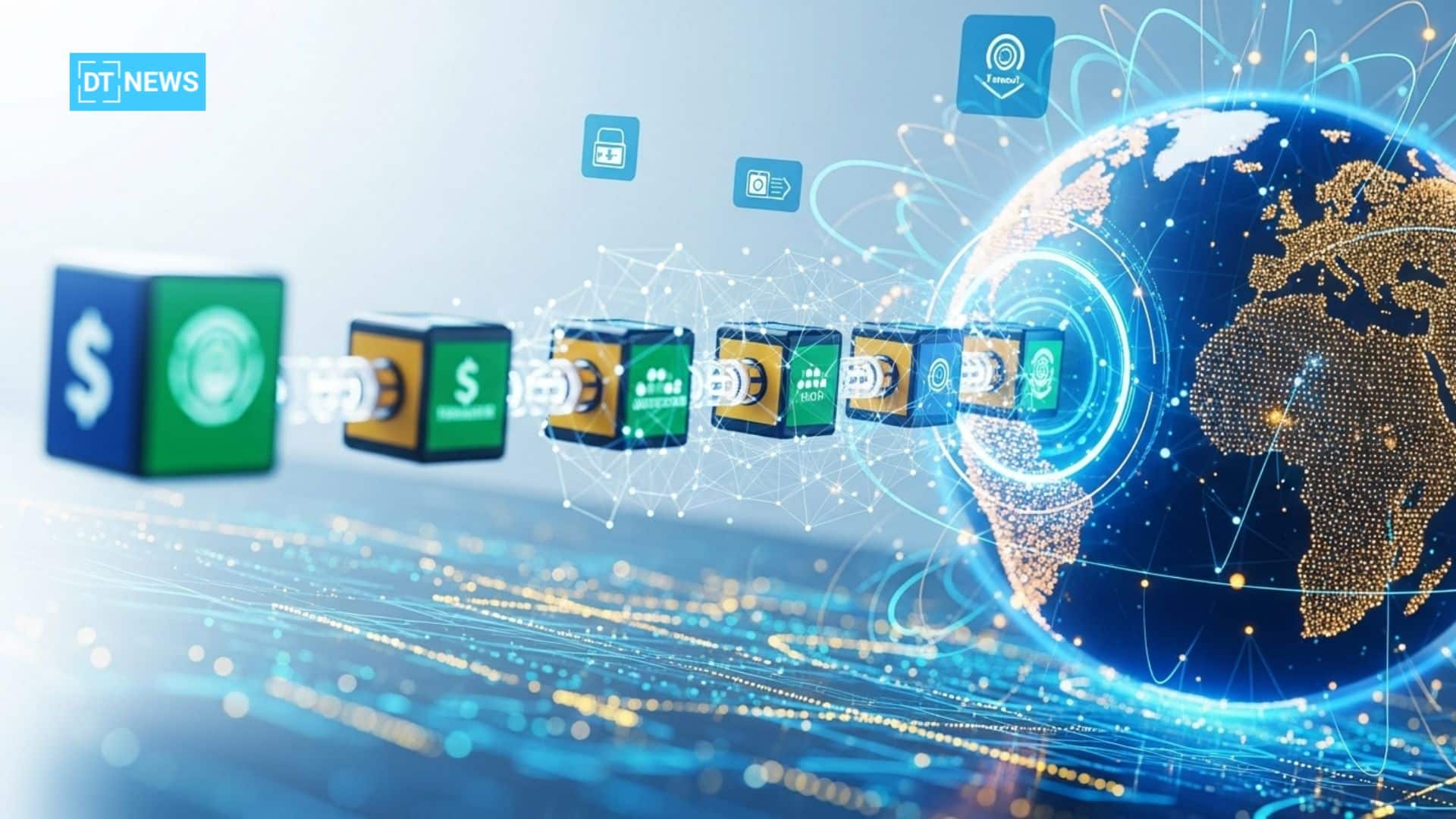
Blockchain replaces letters of credit, bills of lading, payments, and other trade documents with a shared record that is tamper-proof. Blockchain achieves transparency and fraud prevention in cross-border trades by making workflows digital and automated.
Why Trade Finance is Ripe for Blockchain
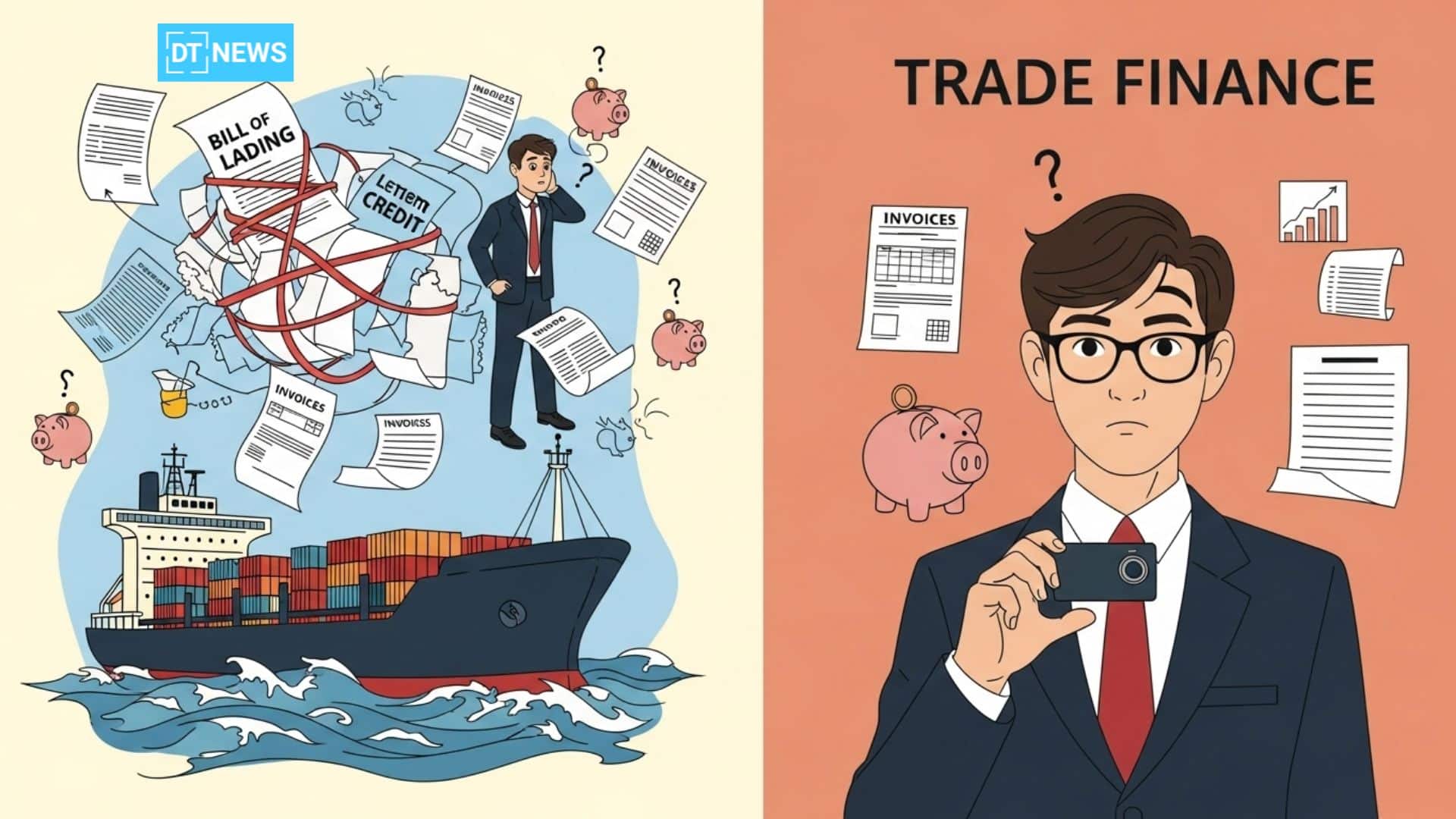
Traditional trade finance is notoriously fragmented and slow to move. Importers, exporters, banks, shippers and regulators each keep separate paper records. A single letter-of-credit transaction can involve weeks of back-and-forth and the physical exchange of documents before the exporter gets paid.
This is expensive, delayed and susceptible to fraud because paper bills of lading or invoices can be forged or lost, leading to billions in annual losses.
Blockchain trade finance deals with these problems through a shared ledger. Important trade elements such as the shipment status, document issuance and payments can be synchronized nearly instantly across all partners.
Since all peers reference the same unchangeable record, disputes and reconciliation shrink to the bare minimum. Importers, exporters, banks, shippers and regulators each keep separate paper records. Ultimately, blockchain creates a “single source of truth” for every trade, enhancing trust and efficiency.
Paper documents might take days or weeks to process, whereas contracts written in digital and even smart form can be settled within minutes.
For instance, a smart-contract letter of credit could confirm that shipping occurred and even release funds once contract conditions are met, shrinking what used to be a weeks-long process into hours.
Under the old system, each bank or shipper had its own ledger, making it hard to track a shipment’s status without manual checks. Today, with blockchain, updates are visible to all authorized parties immediately, increasing transparency.
Manual paperwork is error prone and slow. Many of these checks can be automated in onchain systems: for example, smart contracts can check that a bill of lading and an invoice match before payment is released. The risk of fraud (such as the copying of documents) is vastly curtailed with a blockchain record that can’t be tampered with after it’s been entered.
Blockchain Trade Finance Projects and Pilots
Banks, fintechs and governments are actively experimenting with blockchain for trade. For example, in July 2025, U.S. Bank executed the first 100 percent digital trade finance transaction in the United States via WaveBL on blockchain. A container shipment didn’t send paper bills of lading, but sent electronic bill of ladings via WaveBL.
The digital nature of the process reduced what once took days to minutes, ultimately serving the same purpose in a much faster and secure manner while providing compliance Christine Bravo of U.S. Bank noted this is “a step toward delivering the speed, transparency and reliability businesses need” in trade
Governments are also experimenting with blockchain for trade. In Brazil, the central bank’s Drex project (based on a digital Brazilian real on blockchain) is automating settlement of agricultural commodity trades.
Its pilot will tokenize e-bill-of-ladings with supply chain data embedded to automatically trigger payment when shipments fulfill agreed conditions.
Both Microsoft and Chainlink Labs are supporting the project; Chainlink notes that “blockchain-based trade finance would provide a greater level of efficiency, security, and transparency.
Other examples include:
Hong Kong (HKMA): the e-HKD+ initiatives allow banks to settle tokenized securities and money market asset products on-chain, making the case for Blockchain implementation within a regulated environment using Chainlink Oracles to enforce cross-jurisdiction regulatory rules.
Singapore (Project Guardian): MAS’s Project Guardian developed guidelines and prototypes for asset tokenization, in cooperation with J.P. Morgan and others. This ecosystem effort creates the way for future tokenized trade finance products. For instance, J.P. Morgan’s Kinexys effort has settled atomic swap transactions involving tokenized funds
Industry consortia: Platforms such as Marco Polo (a bank consortium focused on supply-chain finance) and Komgo (an oil and trading blockchain platform) have demonstrated how banks can present digital receivables and guarantees. Contour, a Corda-powered trade LC network supported by 24 banks, tested how it could lessen LC processing to an impressive 90%, from 10 days to under a day, but went out of business in 2023 due to funding issues.
Major Corporations: The Digital Container Shipping Association (DC/DSA) is aiming at a 100% implementation of electronic bill of lading by 2030. One of the early efforts was Maersk and IBM’s TradeLens blockchain for shipping (shut down in 2023). But recent ventures like Enigio’s eDocs channel as well as standardization efforts (EU’s MLETR electronic bills law) are resurrecting the drive for digital trade documents.
Trade hubs around the world are competing in a race to digitize export-import finance. Asia-Pacific Continues to dominate, accounting for more than 38% of the Share in Trade Finance Volume in 2025., due to cross-border commerce and enabling regulation (such as Singapore’s and South Korea’s digital trade policies).
North America’s fintech ecosystem and use of the dollar support its portion; Europe is proposing digital “data trusts” for trade under GDPR. The Middle East/Africa region is studying blockchain for high-growth corridors such as intra-GCC trade, however there are a number of deals in the region where the transactions continue to be dependent on traditional letters of credit.
How Blockchain Enables New Trade Finance Models
Blockchains offer tokenization and smart contracts, which are more than just paper. ICEX has envisaged that the invoices and receivables can be tokenized and traded on a marketplace in real time providing early capital to exporters.
A tradable invoice backed token could also be programmatically settled upon issuance. Analysts say the market for tokenized real-world assets like trade invoices, commodities or securities, could be worth hundreds of billions of dollars in 2026.
Even today, digital dollars or “stablecoins” are proving to be a convenient form of bridge currency; U.S. regulators via bills like the GENIUS Act and SEC guidance are formalizing how banks can hold and use stablecoins, which removes a hurdle for tokenized trade payments.
Concretely, banks and tech providers now offer integrated digital platforms: APIs connect ERP/supply-chain software to blockchains so that financing can be embedded into e-commerce.
Large retailers (e.g.Walmart Business) are running systems where purchase orders on their systems auto-call blockchain payment streams. In capital markets, BlackRock’s BUIDL (valued at more than $2.5billion) funds own tokenized U.S. Treasuries, indicating institutional demand for on-chain liquidity.
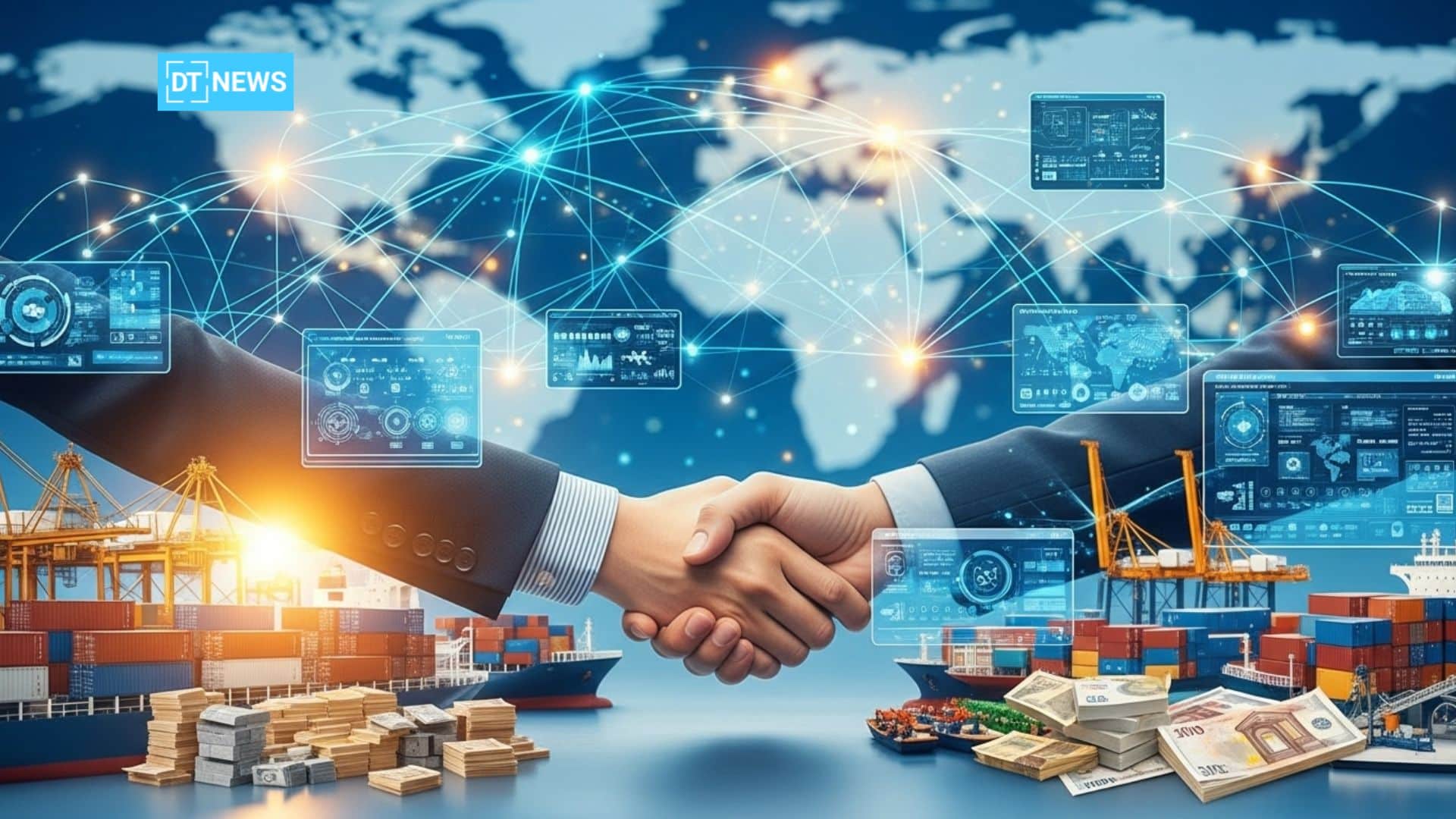
Blockchain acts as the shared global infrastructure upon which this trade finance, and all of finance more generally, can converge in order to make supply chain assets liquid and programmable.
Overall, a formal trade finance technology market is estimated to witness growth from.6 billion in 2025 to 98.8 billion by 2031 (at a CAGR of 3.5%).
Another forecasts trade finance flows globally to increase from $9.7 trillion in 2024 to $13 trillion by 2034, powered by digital and blockchain innovations.
The APAC region is expected to grow most rapidly (5.7% CAGR to 2031) because of heavy digitization and between fintech-driven solutions, aiding North America and ASEAN access global
Challenges and Considerations
This promise is not without its hurdles for blockchain trade finance. Interoperability and standards are major problems. Dozens of platforms have been created using different blockchains (R3 Corda, Hyperledger, Ethereum chains etc).
Regulatory clarity is inconsistent. Widespread adoption of the Model Law on Electronic Transferable Records (MLETR), as well as updated e-document laws, are a start, but many jurisdictions do not have clear rules governing cross-border blockchain contracts.
Banks also suffer from a number of compliance issues: trade finance KYC/AML processes are costly (banks spend $100-$175 million/year on KYC) and interfacing them with blockchains is far from straightforward.
Lastly, scale and buy-in are also challenges. Even those projects can fail without sufficient users and fundings. New platforms have to demonstrate both tech benefits and a sustainable business case that brings banks and corporates in.
Yet, blockchain trade finance is expected to go mainstream. As additional high-volume use cases (digital LCs, eBills of lading and tokenized receivables) are proven out, and infrastructure (CBDCs, global messaging standards) matures, the implications could be massive. Some analysts go so far as to forecast that the market for tokenized real-world assets such as trade finance assets, could touch tens of trillions of dollars by 2030.
Conclusion
Blockchain trade finance is tackling a multi trillion dollar industry, that has suffered for years from inefficiencies, with real-time and tamper-resistant processes.
Banks, governments, and tech giants are making strong investments; from Brazil’s Drex CBDC to the U.S. banks’ WaveBL pilots, there’s proof of concept successes.
While past consortia (Contour, we. trade, TradeLens) tripped up on adoption or funding, what they learnt is informing new developments.
Current blockchain platforms now value decentralization, interchain operability and integration that’s regulation-friendly and user-friendly. If adoption continues, trade finance could very well be the largest opportunity that blockchain is enabling, and with it faster, cheaper, more inclusive global trade.
Glossary
Blockchain: A decentralized digital ledger of transactions, the security of which is ensured through encryption.
Smart Contract: A program that can automatically execute on a blockchain to enforce contract terms (e.g. releasing payment upon delivery of goods).
Letter of Credit: A bank payment guarantee used in trade. Traditionally paper-based.
Bill of Lading (B/L): This is a document the carrier (a shipping line) provides as proof they have received cargo. It is the title to the goods.
Tokenization: The process through which a real-world asset (an invoice, loan, commodity and so on) is put into digital form as a string of computer code that represents ownership and can be traded on liquid markets.
Stablecoin: A cryptocurrency that is pegged to a stable asset (usually a fiat currency). Used for instant cross-border settlement.
Electronic Transferable Records (ETR): Digital documents (for example, an electronic L/C or B/L) that hold equal legal weight to paper by laws as UN’s MLETR.
Frequently Asked Questions About Blockchain Trade Finance
What is trade finance?
Trade finance refers to the financing, credit and risk mitigating options that enable international trade to flow. It covers instruments such as letters of credit, guarantees and supply-chain finance, which assist exporters, importers and banks in managing payments and risks when goods travel across national borders.
How will blockchain alter trade finance?
It allows workflows to be automated via smart contracts (e.g. auto releasing of funds on proof of delivery) and assets to be tokenized (e.g. invoices).
Are there concrete cases of blockchain in trade finance?
Yes. For instance, U.S. Bank has sent an electronic bill of lading for a container shipment over the WaveBL blockchain platform, cutting a process that ‘would have taken days’ down to minutes. Brazil’s central bank is testing automatic settlement of commodity trades on its Drex blockchain pilot. A number of banks have also tested digital letters of credit over consortium platforms.
What was the reason for the failure of some blockchain trade platforms?
Projects like Contour and we.trade showed technical promise (e.g. cutting LC processing time) but ultimately lacked enough funding or user adoption. Challenges included achieving critical mass of participants and coordinating many banks. These failures taught the industry to focus on interoperability, regulatory compliance and clear business models.