

























The Bhutan green Bitcoin economy is quietly taking shape, using the Himalayan nation’s abundant renewable energy and government-led investment strategies. By changing surplus hydropower into Bitcoin mining activities, Bhutan is developing a unique model of low-carbon digital asset creation that brings together careful financial management, environmental responsibility, and technological growth.
- What Is the Bhutan Green Bitcoin Economy?
- How Did Bhutan Start Its Green Bitcoin Journey?
- How Is Bitcoin Mining Structured in Bhutan?
- What Regulatory Framework Governs the Bhutan Green Bitcoin Economy?
- How Does Bhutan Balance Sustainability with Crypto Ambitions?
- What Are the Implications for Bhutan’s Economy and Technology Sector?
- How Does Bhutan’s Approach Compare Globally?
- Conclusion
- Glossary
- Frequently Asked Questions About Bhutan Green Bitcoin Economy
Officials say the initiative is a way to convert extra electricity into a liquid financial asset instead of letting it go unused. This digital reserve forms the foundation of a sovereign fund that helps support government spending while maintaining careful regulatory oversight.
What Is the Bhutan Green Bitcoin Economy?
The Bhutan green Bitcoin economy is the country’s government-backed method of mining and managing Bitcoin using extra carbon-free hydropower. Instead of treating Bitcoin like a speculative investment, Bhutan uses it as a foreign-currency liquidity buffer, turning energy that would otherwise go to waste into digital assets that support the national economy.
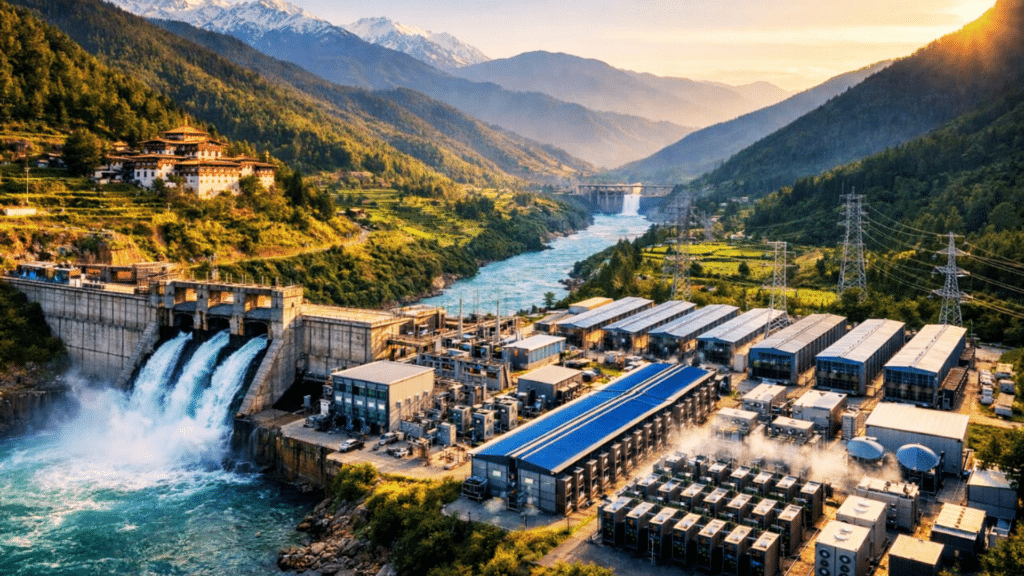
Druk Holding and Investments (DHI), the government’s investment arm, oversees mining operations in specific zones. The central bank, the Royal Monetary Authority (RMA), allows crypto activity only under a phased, sandbox-style system connected to Gelephu Mindfulness City, focusing on transparency and managing risks.
Experts point out that Bhutan treats Bitcoin as a strategic infrastructure tool rather than a speculative asset, making the Himalayan nation a leader in government-directed, renewable-powered cryptocurrency.
How Did Bhutan Start Its Green Bitcoin Journey?
Bhutan’s journey started by focusing on its most abundant and scalable natural resource: hydropower. The country’s energy planning documents, including the National Energy Policy 2025, highlight a realistic hydropower potential of 33,000 MW, in line with the Power System Master Plan 2040.
With domestic electricity demand around 1,000 MW, there is a large surplus of power. Instead of letting this extra energy go unused, Bhutan chose to turn it into value through large-scale Bitcoin mining.
Recent projects show how this plan is taking shape. In November 2025, India inaugurated the 1,020-MW Punatsangchhu-II hydropower project and provided a credit line to support closer energy cooperation. This extra electricity now serves as the main computing fuel for the Bhutan green Bitcoin economy.
How Is Bitcoin Mining Structured in Bhutan?
Mining operations are managed by DHI in partnership with Bitdeer. Since 2019, DHI has included cryptocurrencies in its portfolio, using Bitcoin as a way to increase foreign-currency liquidity. In May 2023, DHI and Bitdeer announced plans for a closed-end fund of up to $500 million to expand carbon-free digital asset operations.
This partnership uses Bhutan’s renewable energy and Bitdeer’s mining expertise to grow the Bhutan green Bitcoin economy efficiently. Officials highlight that mined Bitcoin acts as a financial buffer for seasonal changes in hydropower supply.
When river flows are high, surplus electricity is used for mining, and in drier months, Bitcoin holdings can be converted into electricity or imports. DHI CEO Ujjwal Deep Dahal explained that this approach treats Bitcoin strategically as a battery for the country’s energy and financial needs.
What Regulatory Framework Governs the Bhutan Green Bitcoin Economy?
The Royal Monetary Authority (RMA) takes a cautious approach to cryptocurrency. In April 2025, it issued a notice introducing a phased, sandbox-style framework for crypto activity. Mining and custody are limited to GMC-registered entities, which reduces retail exposure and strengthens risk management.
Gelephu Mindfulness City functions as a special jurisdiction with its own set of policies. Planned projects include a blockchain-linked currency called ter and a fully reserved digital bank, Oro Bank, which provide the infrastructure needed to support the Bhutan green Bitcoin economy.
Regulators stress that government-linked operations, clear reporting, and controlled participation are vital to prevent fiscal risks, financial crime, and losses caused by market volatility.
How Does Bhutan Balance Sustainability with Crypto Ambitions?
Bhutan clearly frames its Bitcoin operations as part of a low-carbon strategy. Coins mined using hydropower reduce emissions compared to mining with fossil fuels elsewhere. Officials note that this green coin approach connects financial innovation with environmental responsibility.
However, risks still exist. Bitcoin’s price volatility can affect government finances, and onchain estimates are not the same as audited reports. DHI and RMA continue to focus on transparency and governance to make sure the Bhutan green Bitcoin economy stays fiscally secure.
Experts, including World Bank analysts, point out that Bhutan’s model is not speculative but linked to infrastructure, using surplus energy for national benefit. By including digital assets in state planning, Bhutan shows how a small, energy-rich country can combine sustainability with technological growth.
What Are the Implications for Bhutan’s Economy and Technology Sector?
Mined Bitcoin has already supported public spending, including government salaries over the past two years, according to senior officials. By monetizing hydropower in this way, Bhutan creates a sovereign digital reserve that enhances national liquidity without tapping tax revenues.
The initiative also fosters domestic tech development. Partnerships with mining companies like Bitdeer and investment in blockchain infrastructure position Bhutan as a regional hub for green digital assets. Analysts argue that if hydropower expansion continues, this could translate into long-term economic diversification and job creation.
How Does Bhutan’s Approach Compare Globally?
Unlike most countries where crypto work stays private or just speculative, Bhutan’s way is state-directed, regulated, and renewable-powered. It offers a model for other places with plenty of green energy but not much local need.

The Bhutan green Bitcoin economy shows how a small country turns extra power into a digital export. It mixes smart finance with eco-friendly rules. Officials say this works only with more hydropower growth, careful reserve handling, and open reports.
Conclusion
The Bhutan green Bitcoin economy is a bold experiment that brings together renewable energy, careful financial planning, and digital innovation. Bitcoin mining under government supervision creates a liquid, low-carbon financial buffer that helps fund public operations, encourages technological development, and shows a new way for the state to manage digital assets responsibly.
While ups and downs in prices, clear rules, and openness stay as key hurdles, Bhutan’s method gives a real-world example of fitting cryptocurrency in a lasting way. By changing electrons into digital assets, the Himalayan kingdom changes how small, energy-rich countries use green resources for stronger economy and tech stability.
Glossary
Bitcoin Mining: Using computers to create new Bitcoin by solving digital problems.
Carbon-Free / Green Energy : Power made without pollution, like water or sunlight.
Hydropower: Electricity made from moving water in rivers or dams.
Liquidity Buffer: Extra assets kept to handle money needs in emergencies.
Oro Bank: A digital bank planned to manage Bhutan’s green Bitcoin safely.
Frequently Asked Questions About Bhutan Green Bitcoin Economy
How did Bhutan start this green Bitcoin initiative?
Bhutan started by using extra hydropower that was not needed for local electricity. And turned it into value through Bitcoin mining.
How does Bhutan use mined Bitcoin?
The mined Bitcoin acts as a financial buffer. And helps support government spending and foreign-currency liquidity.
Why is this approach called “green”?
It is called green as it uses clean hydropower instead of fossil fuels, reducing carbon emissions from Bitcoin mining.
How does this affect Bhutan’s economy?
It creates a state-backed digital reserve, supports public spending. It helps develop the domestic tech and blockchain sector.
What are the risks involved in Bhutan’s green Bitcoin economy?
Risks include Bitcoin price volatility, fiscal impacts, and the need for clear governance and audited reporting.