
This article was first published on Deythere.
- Blockchain notarization: A First for Legal Systems
- Tejouri: Global Digital Vault of Critical Assets
- Transforming Legal Trust and Verification
- Effects on Legal Systems and Worldwide Use
- Conclusion
- Glossary
- Frequently Asked Questions About DIFC Blockchain Legal Documents
- Why are DIFC’s blockchain legal documents safe?
- Are consumers worldwide able to use those services?
- Are these services legally recognized?
- Which documents does it support?
- How does Tejouri improve digital asset management?
- References
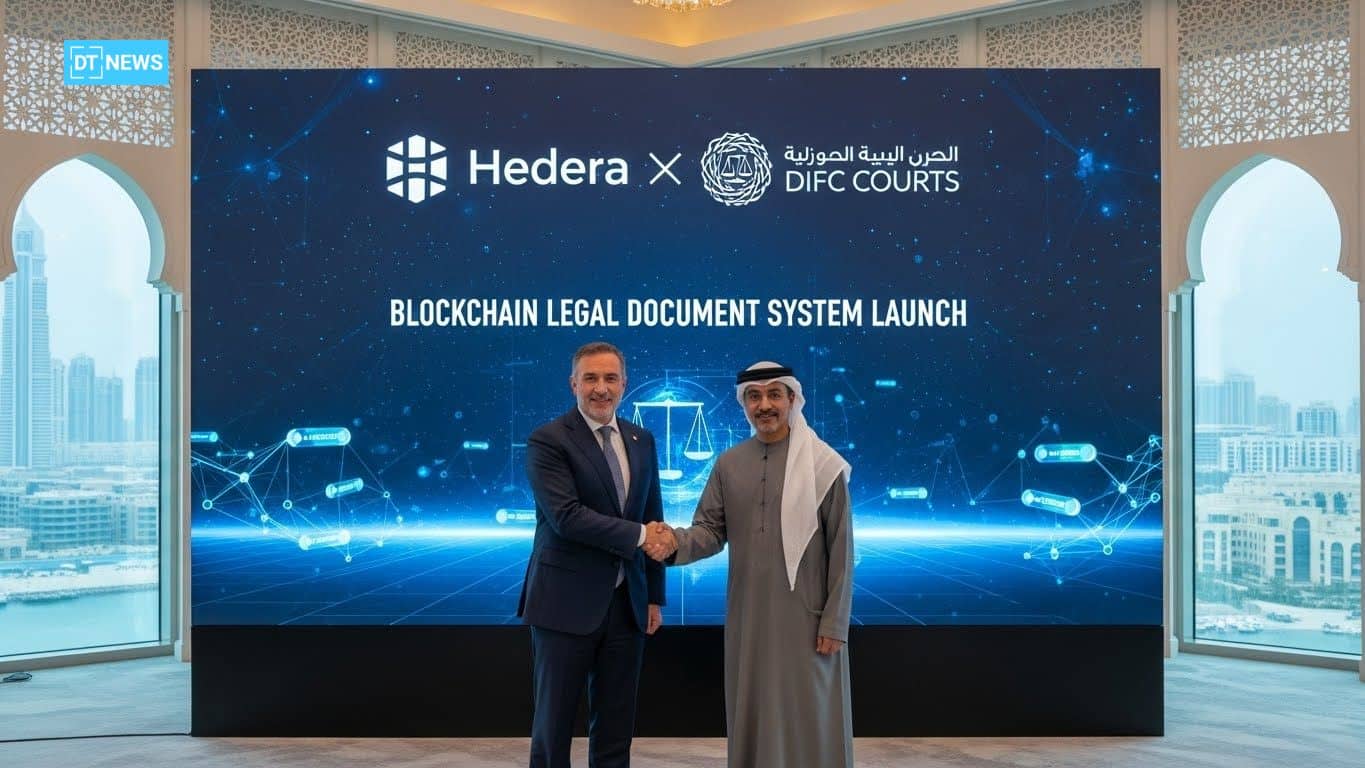
Dubai International Financial Centre (DIFC) Courts have partnered with the Hedera network to integrate blockchain legal document technology into its systems, advancing how important legal papers are secured, verified, and officially recognized.
By introducing cutting-edge services including notarization of English-language documents, digital wills and a worldwide digital vault named Tejouri, the initiative capitalizes on Hedera’s ultra-fast, low-cost and green blockchain to infuse transparency, credibility, and legal trust into the issuance and verification process of documents.
Blockchain notarization: A First for Legal Systems
The DIFC Courts launched a blockchain-backed Notary Service, the first of such service available in the United Arab Emirates, with all notarization occurring on the Hedera public blockchain and being recorded as immutable.
This service is based on Dubai Law No. (2) of 2025, as issued by His Highness Sheikh Mohammed Bin Rashid Al Maktoum, Vice President and Prime Minister of the UAE and Ruler of Dubai.
Notary Officers authorized under this framework can now administer oaths, affirmations, and declarations; and certify true-copies of documents which are command verified with cryptographic timestamps on Hedera.
This scheme largely mitigates fraud, manipulation and loss by making notarization events permanent and publicly verifiable.
The service is available in three execution modes: Automated Self-Service, Live virtual notarization and In-persion sessions, the service has been designed to offer flexibility that caters for both modern digital demand and traditional legal expectations.
Notarized documents in this chain characteristic include affidavits, wills, powers of attorney, trade licenses and title deeds to name just a few important pieces securely held on-chain.
Justice Omar Al Mheiri, director of the DIFC Courts, said that this addition was a mission to bring “confidence, clarity and certainty” to the UAE’s common law system in English; so that businesses and individuals have greater peace of mind on how the law works.
Tejouri: Global Digital Vault of Critical Assets
Tejouri, a global digital vault that archives important documents and digital assets has also been integrated by the DIFC Courts. This tool allows people and legal entities to store securely everything from title deeds and insurance contracts to wills and large multimedia files.
Where Tejouri differs is its implementation of Hedera’s distributed ledger technology (DLT), which makes sure that every item it catalogues is tamper proof and verifiable anywhere in the world.
Users can manage access requirements for sensitive documents by biometric authentication and strong encryption, specifying rules for future issues, inheritance or compliance compliance checks.
Tejouri’s architecture enables secure transmission and storage of documents without regard for geographical boundaries, e.g., a user in one country can trust that a document stored through the above system has legal integrity anywhere in the world.
This international reach is essential for global business transactions, cross-border compliance verification and offshore estate planning.
The platform is also compatible with DIFC’s Digital Assets Will service, which lets eligible individuals to non-custodially manage and distribute digital assets such as cryptocurrencies or NFTs among a legally recognized digital inheritance plan.
Transforming Legal Trust and Verification
Looking at history, systems for storing, moving and verifying documents have been fragmented and manual in nature, prone for inefficiencies and fraud.
The blockchain concept aligns these two scenarios completely: it turns the verification process to be something that cannot change and can be verified independently.
Every time a notarization or issuance is made, it generates a verifiable credential which can be compared against the public Hedera ledger.
Marco Salzmann, a researcher quoted in reports about the initiative, described that use of blockchain technology ensures that the “verification and validation begins directly at the source,” cutting fraud points down significantly and increasing trust for onboarding, compliance or international business validations.
By converting document hashes into ledger entries, the system attaches a timestamp and cryptographic proof of existence at a precise moment, countering disputes over authenticity or backdating.
Hedera’s public consensus service makes these timestamps predictable, trustworthy, and free from single-party control, establishing further confidence in the system’s neutrality.
The connectivity also enables global standard compliance by publishing the documents as verifiable credentials compliant with popular token standards (e.g., ERC20), thereby connecting legacy legal architectures and digital asset ecosystems.
Effects on Legal Systems and Worldwide Use
The use of blockchain to power the judiciary infrastructure in Dubai is a part of an ongoing collaboration between DIFC Courts and Hedera, The Hashgraph Association, Deca4 Advisory and other technology partners. This partnership provides not only technological certainty, but also legal clarity and compliance with governance restrictions by balancing innovation and regulatory visibility.
This project has implications beyond that of notary services. Dubai is pioneering an approach that other judicial systems around the world could replicate by incorporating blockchain in legal documents and procedures within a core government service.
The blend of verifiable credentials, cryptographic security and legal enforceability paints a blueprint for digitizing land registries, corporate filings, IPR records and other legacy document systems.
It also enhances the trust of foreign investors and firms doing business in or through the UAE, since they will now have indisputable proof that legal acts made in execution of their transaction is reliable and cannot be tampered with, thereby minimizing risk when engaged in cross-border transactions and compliance processes.
Conclusion
Combining sophisticated cryptographic verification with time-tested legal principles, the launch of Notary in Dubai will enable notarized documents to attest their own authenticity and global availability.
Features like Tejouri’s digital vault and blockchain-anchored notarization are changing the way most critical documents are saved, sent and verified.
With the increasing visibility of this model, it may also act as an example to courts and government entities, which are looking to modernize their legal offering, to add greater confidence in a more digital world.
Glossary
Blockchain Legal Documents: This is concerned with the official documents and certificates that are issued or verified by utilizing blockchain technology so that they remain indisputable (un-modifiable) as well as transparent.
DLT(Database ledger Technology): A shared database, where records are kept across multiple nodes and also cannot be altered.
Notary Service: A legal function that verifies, witnesses, and certifies documents, now augmented with blockchain verification.
Verifiable Credentials (VC): A piece of information that can be independently verified to a decentralized ledger.
Frequently Asked Questions About DIFC Blockchain Legal Documents
Why are DIFC’s blockchain legal documents safe?
Documents on blockchain are protected by cryptographic timestamping to the Hedera public hashgraph, retaining their immutability whilst remaining independently verifiable without reliance on a central authority.
Are consumers worldwide able to use those services?
Yes. Services, such as Tejouri and the blockchain-driven notarization process are available internationally, users can store and confirm documents anywhere in the world.
Are these services legally recognized?
Yes. Blockchain-enabled notarization and DIFC Courts-approved services are based on Dubai Law No. (2) of 2025.
Which documents does it support?
The services cover a variety of documents such as affidavits, wills, powers of attorney, trade or title deeds and any other English-language legal documentation.
How does Tejouri improve digital asset management?
Tejouri is a secure digital vault running on Hedera, which allows users to store and manage important documents and digital assets complete with pre-set access rights and inheritance rules.