This article was first published on Deythere.
- Inside NATO’s DIANA Program and its Defense Goals
- Neuron’s Role within Hedera NATO DIANA
- What NATO’s DIANA Selection Means for Hedera and Decentralized Tech
- Industry and Innovation Implications of Hedera NATO DIANA Signals,
- Conclusion
- Glossary
- Frequently Asked Questions About Hedera NATO DIANA
- What is Hedera NATO DIANA?
- Who runs DIANA?
- What technology does Hedera provide?
- Why would NATO be interested?
- When does the DIANA program start?
- References
Public distributed ledger Hedera and its ecosystem project Neuron, are reportedly breaking into defense innovation, with the new partnership between NATO’s Defense Innovation Accelerator for the North Atlantic (DIANA) program, although an official press release is yet to be issued.
The NATO DIANA initiative accepted a record 150 trailblazing innovators from across all 24 NATO countries to its inaugural Challenge Program of the new year that addresses innovation in dual-use technologies in critical defense domains like autonomous systems and secure networks.
Inside NATO’s DIANA Program and its Defense Goals
The Defense Innovation Accelerator for the North Atlantic (DIANA) is a NATO initiative to promote dual-use innovations that are applicable in both commercial and defense contexts, related to several areas of capability.
These include advanced communications, autonomy and unmanned systems, access to space and data enablement technologies.
Firms will be given contract-backed funding as part of the 2026 Challenge Program and access to NATO’s wide-ranging accelerator network and test ranges.
These resources are designed to assist pool participants in honing and proving out solutions that could be incorporated into Allied defense capabilities.
The scale of the program is also notable. 3,680 applications were reviewed with 150 companies accepted, double its capacity compared to previous years.
Neuron’s Role within Hedera NATO DIANA
Neuron, known for being a decentralized infrastructure provider (DIP), is developed on the Hedera network and concentrates mainly on real-time data coordination, autonomous machine interaction, and decentralized service networks (DSN).
These features such as secure, low-footprint data indexing and device synchronization in particular, are one with NATO’s concern for distributed systems that can operate in contested environments.
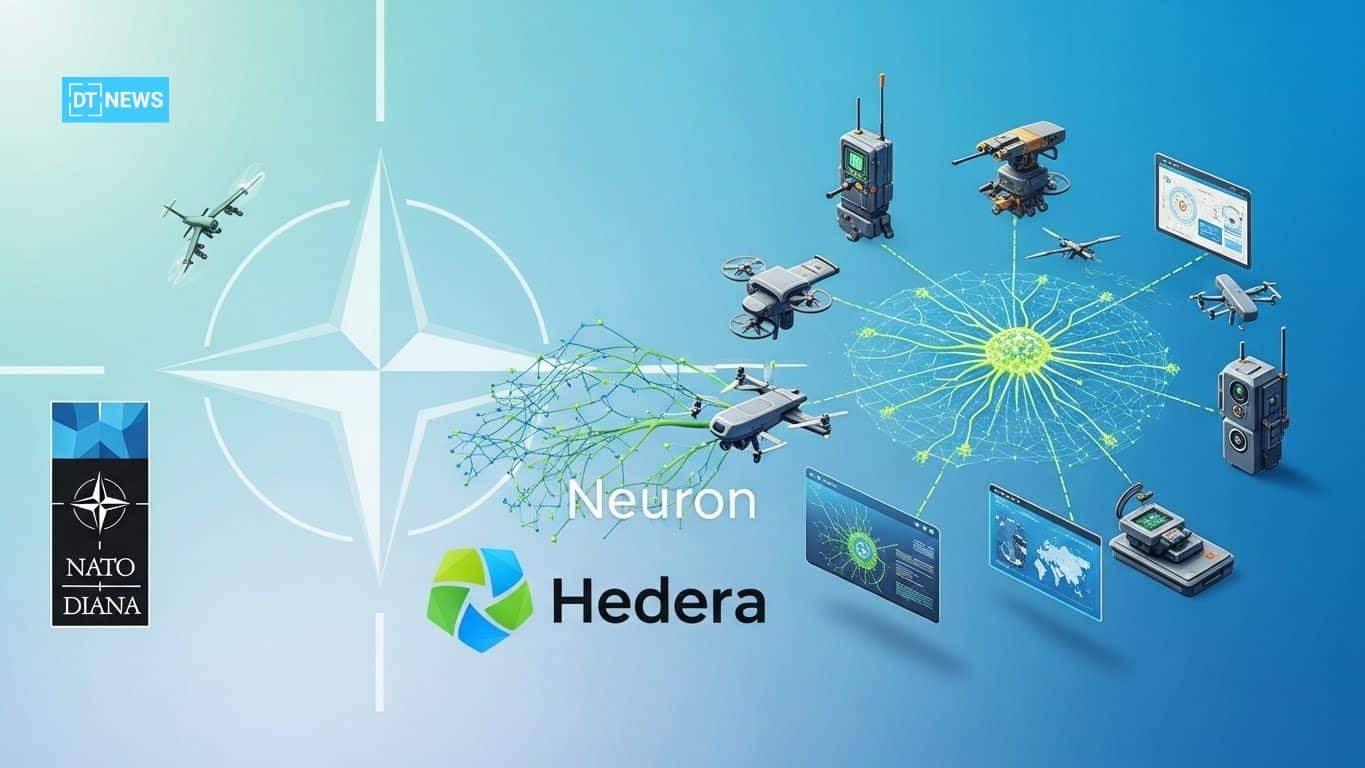
While the specific details of how Neuron will work are not yet formally released by NATO or Hedera, industry commentary and signals from their ecosystem suggest that Hedera time-stamping combined with Neuron sensor data indexing could be used to enable advanced autonomous systems and communication networks.
Tech observers say that for traditional defense systems, three factors are needed: secure deterministic finality, high throughput and low latency, all of which Hedera’s consensus protocol is aiming to offer.
What NATO’s DIANA Selection Means for Hedera and Decentralized Tech
NATO’s DIANA initiative is specifically focused on the identification and development of these technologies in an operational context, directly linking defense users with innovators.
Support structures in DIANA such as funding, mentoring, and pathways for testing technology, are built to help technology developers accelerate their progress through a tested prototype and into the hands of users.
Successful companies in the 2026 Challenge Program will be taking part in organized events from January 2026.
Industry and Innovation Implications of Hedera NATO DIANA Signals,
Although official project roles have yet to be announced, industry opinion has the following implications:
Neuron’s distributed architecture, based on the Hedera network, supports NATO technology fields including autonomy, collective and decentralized machines, and robust networked systems.
Analysts say the ability of a security distributed ledger combined with decentralized coordination systems represents a new one for machine-to-machine trust and data integrity.
Also, Hedera’s governance mechanism, governed by an enterprise council of large firms, bolsters its claim as a public ledger that can run at scale for important and regulated industries.
If NATO can confirm Neuron’s entry and the functional details, it may be a validation of decentralized systems as a trust layer for critical infrastructure and autonomous networks.
Conclusion
The Hedera NATO DIANA collaboration constitutes an alliance between defense innovation and decentralized ledger technologies.
While NATO appoints its largest ever cohort of innovators for the 2026 DIANA Challenge Program, onlookers are interested to see what applications like Neuron, which utilize Hedera’s distributed ledger infrastructure, have in store.
Even though there has been no formal press release confirming all of the operational specifics, ecosystem signals and NATO’s published cohort announcement show a movement toward infusing distributed systems within dual-use defense innovation.
Glossary
Neuron: A decentralized infrastructure project developed based on Hedera that provides secure, real-time data coordination and a decentralized service network.
DIANA (Defense Innovation Accelerator for the North Atlantic): A NATO led effort aimed at speeding up dual-use innovation in both defense and commercial spaces with support at national levels (funding, test centers, accelerators).
aBFT (Asynchronous Byzantine Fault Tolerance): A consensus algorithm with strong security and deterministic completion, fit for mission-critical distributed systems.
Dual-use technology: Technology that has both a civilian and defense application.
Frequently Asked Questions About Hedera NATO DIANA
What is Hedera NATO DIANA?
It refers to signals that Neuron, a project built on Hedera, is associated with NATO’s DIANA innovation accelerator for defense and dual-use technologies.
Who runs DIANA?
DIANA is an initiative by NATO to fast track technology innovation in defense and security.
What technology does Hedera provide?
Hedera provides a public, distributed ledger that enables fast and secure transaction and high defensibility with aBFT, as well as deterministic ordering of transactions for reliable coordination between systems.
Why would NATO be interested?
In defense applications, there’s need for security, low latency and a trusted platform above all else, and these are the attributes that Hedera’s distributed ledger in combination with Neuron’s infrastructure hope to accommodate.
When does the DIANA program start?
The 2026 Challenge Program would start activities around January 2026.