
This article was first published on Deythere.
- Grayscale’s Growing Allocation Shows Confidence
- Market Price vs Institutional Positioning
- Institutional Tools and Ecosystem Developments
- Technical Signs And The Overall Trading Environment
- Upgrades and Future Catalysts in Cardano’s Ecosystem
- Conclusion
- Glossary
- Frequently Asked Questions About Cardano Institutional Demand
- Why is Cardano’s share in Grayscale’s Smart Contract Fund on the rise?
- What is the difference between institutional demand and retail interest?
- Does the price of Cardano tie with institutional moves?
- What are some products that have increased ADA access for institutions?
- References
Cardano institutional demand is quietly building even while prices stagnate and retail traders express concern. This transition can be most clearly seen in Grayscale Investments Smart Contract Fund where Cardano is now over 20 percent of the portfolio; making it the third largest holding behind Ethereum and Solana.
The increase in institutional exposure is occurring while ADA has been trading around $0.26 to 0.28 over the past several weeks.
Grayscale’s Growing Allocation Shows Confidence
Based on market data, institutions aren’t sitting on their hands and watching, they’re reallocating capital to Cardano even as prices slide. Grayscale’s most recent rebalance has seen ADA’s share in its Smart Contract Fund increased to more than 20.3% from 19.50 percent at the start of February.
This increase means ADA now constitutes more than one-fifth of the fund’s portfolio, placing it ahead of other smart contract chains like Hedera, Avalanche, and Sui.
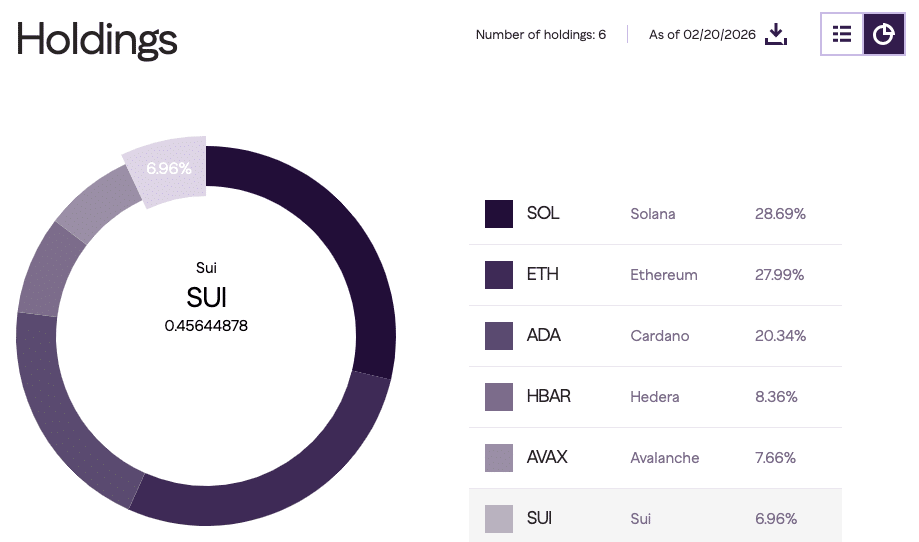
The repeated leaping in asset allocations these past weeks shows that institutional managers are not intimidated by ADA’s price fall, but rather can recognize inverse value when it develops on compressed prices.
Analysts discussing this change have attributed some of the allocation increase to Cardano’s growing focus on Bitcoin decentralized finance (DeFi) primitives, as it is actively building its non-custodial collateral and stablecoin credit features to bring BTC liquidity on-chain with no custody transfer.
Not that it has been confirmed by Grayscale itself, but these ecosystem developments have often been mentioned as catalysts for institutional accumulation in the market.
Market Price vs Institutional Positioning
The deafening silence, from the market at least, is in stark contrast to the degree of institutional support Cardano has received. The token has seen a noteworthy retracement over the past couple of months, with ADA going down more than 60% from its lows and trading around $0.26 to $0.28 range. Price weakness has checked support areas which has brought stronger retail selling into the market.
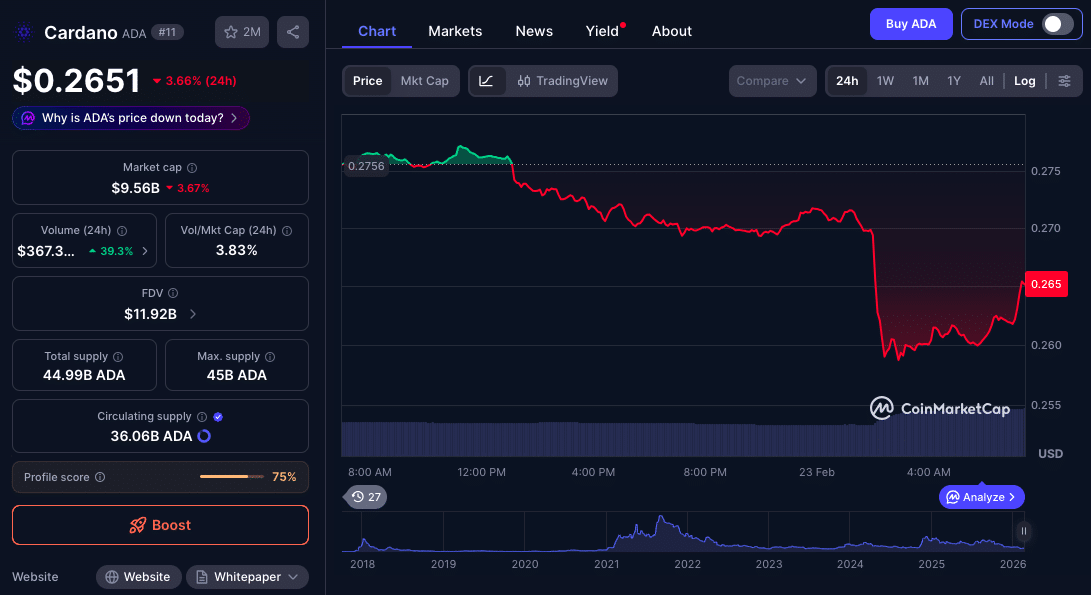
Yet, this same period has coincided with whale accumulation and increased allocation by Grayscale, and this could only mean that institutions are picking up cheap shares amid sell-offs.
Large Wallet Analysis Large wallet analysis reveals accumulation among holders of 10 and 100 million ADA, boosting the theme of institutional buying over distribution.
This disconnect of lower prices and higher allocations indicates that Cardano institutional demand is still strong.
Institutional Tools and Ecosystem Developments
One piece that also explains the Cardano-institutional-demand is how the network is plugging into greater financial infrastructure. Unlike previous waves of speculative price hype, 2026 for ADA has been layered on top of products like cryptocurrency lending and futures.
For example, ADA was just introduced as collateral for Coinbase’s lending product where users can borrow up to $100,000 USDC for loans backed by ADA.
Another development is the introduction of Cardano futures on the CME exchange, which debuted in February 2026 with both standard and micro contract sizes.
This is a step that injects ADA into the institutional derivatives system, with hedge and speculative strategies that weren’t once available to your typical asset manager.
These products directly serve Cardano institutional demand, as it makes ADA something that institutions can work into risk management, credit and yield plays.
Technical Signs And The Overall Trading Environment
From a technical point of view, the market around Cardano is consolidating. Metrics such as the MVRV ratio, which compares loss vs profit among holders have dropped sharply, suggesting that a substantial portion of current holders are in the red.
Past instances of negative MVRV have corresponded with extended consolidation periods leading up to slower accumulation cycles.
Derivatives open interest has also dropped, an indication that speculative traders are leaving the market. A market where both price and leverage are decreasing can suggest supply clearing and reduced selling pressure which is sometimes accompanied by institutional reallocation or possible base-building.
There is no assurance or suggestion that these price levels will be an indicator as to future price direction, but they offer the current way of how institutions could think about risk and entry particularly given ADA’s inclusion in regulated products and portfolio allocations.
Upgrades and Future Catalysts in Cardano’s Ecosystem
Price wise Cardano still has its challenges, but Cardano’s roadmap continues to deliver technical upgrades that could boost its long-term narrative.
One example is the upcoming launch of the Midnight privacy chain coming by March 2026, which introduces only selective privacy features suited for regulated use cases.
Built in partnership with Google-linked projects and messaging platform Telegram, Midnight is another effort to bridge regulated infrastructure with decentralized networks.
Other projects include progressive enhancements to governance, smart-contract functionality, and cross-chain interoperability via protocols like LayerZero that collectively increase Cardano’s utility beyond traditional transaction processing.
These ecosystem strengths reinforce the Cardano institutional demand as institutions invest in networks demonstrating real progress in infrastructure beyond just price action.
Conclusion
Cardano institutional demand is rising in an otherwise quiet price space this month, according to the latest reports. As the price of ADA is being range-bound, institutions such as Grayscale Investments are rebalancing their capital to allocate more into ADA, increasing its exposure in a leading smart contract fund to over 20%.
Cardano’s position as the third-largest holding behind Ethereum and Solana in Grayscale’s Smart Contract Fund shows continued confidence.
Combined with ADA’s integration into lending, futures markets and ecosystem upgrades such as Midnight integration, the asset is going from being “price-focused” to one being driven by institutional demand
Glossary
Smart Contract Fund: A fund which Grayscale manages that is diversified and holds a host of the largest smart contract blockchain networks based on index methodology.
MVRV Ratio: A ratio comparing market value to realized value to illustrate if holders are in profit or loss.
Open Interest: The total number of derivative contracts that have not been settled, a measure of speculation.
Midnight privacy chain: A selective privacy protocol on Cardano for use cases intended for regulated use cases to ensure network utility.
Frequently Asked Questions About Cardano Institutional Demand
Why is Cardano’s share in Grayscale’s Smart Contract Fund on the rise?
Cardano’s stake has risen past 20%, because Grayscale keeps reallocating, showing there is long-term institutional conviction even as the price for ADA deteriorates.
What is the difference between institutional demand and retail interest?
Institutional buyers are motivated by portfolio strategy, regulated products and long-term utility, whereas retail traders often follow price action and short-term trends.
Does the price of Cardano tie with institutional moves?
Not necessarily; price can be lagging or contradicting institutional accumulation, especially during market dips.
What are some products that have increased ADA access for institutions?
Institutional allocation tools such as Grayscale’s Smart Contract Fund and ADA futures on CME have surfaced.