


























The age-old Gold vs Bitcoin argument has popped up once more, after a vocal supporter of the yellow metal called out venture capitalist Tim Draper over his positive outlook on the future of Bitcoin as a global method of settlement. The exchange quickly circulated on social media and financial forums; bringing renewed focus to the issue.
- Why Tim Draper Still Believes Bitcoin Will Become the Default Global Payment System
- Peter Schiff Stands by Gold, and Says Bitcoin Is Too Volatile
- Crypto Community Responds to Schiff Claims
- Market Data Adds New Context to the Gold vs Bitcoin Argument
- Conclusion
- Glossary
- Frequently Asked Questions About Gold vs Bitcoin
However, many companies still remain cautious with regards to using Bitcoin as a viable option for everyday transactions due to volatility concerns. Draper was adamant that this would change. A longtime critic of cryptocurrencies; Schiff replied by defending gold’s generation-long history as a store of value and whether Bitcoin can really act as reliable money.
Why Tim Draper Still Believes Bitcoin Will Become the Default Global Payment System
Venture capitalist Tim Draper has been one of Bitcoin’s earliest and loudest supporters for quite some time now. Most recently, Draper said he thinks Bitcoin can actually become the world economy’s predominant money.
In an interview with James Heckman, Draper explained that businesses may be reluctant to embrace Bitcoin at first because of its volatile price. But, he stressed that adoption could start slow, for example by allowing retailers to accept Bitcoin payments in addition to existing payment systems.
Draper explained how a transition like this could start at the merchant level. As he put it:
“Like if I’m a retailer, first thing I do is I put out a sign and I say we accept Bitcoin.”
Reports claim his faith in Bitcoin is also based on a high-profile bet he took back in 2014, when he purchased about 30,000 Bitcoins seized from the Silk Road marketplace at a government auction. The purchase went on to be one of the earliest bets on a cryptocurrency that paid off most handsomely.
In addition to adoption of the asset by merchants, Draper has also argued that certain forces such as inflation and loss of confidence in fiat currencies such as U.S. dollar could ultimately push businesses to make Bitcoin a part of their balance sheets.
“People will get tired of watching a dollar turn into 90 cents to 80 cents to 70 cents and eventually goes straight to zero super fast.”
These remarks brought the Gold vs Bitcoin debate back into light, especially for those who contend that digital assets remain too volatile to overtake traditional stores of value.
Peter Schiff Stands by Gold, and Says Bitcoin Is Too Volatile
Peter Schiff, the long-time precious metals bull, responded to Draper’s comments saying that he still believes gold is the best monetary asset.
Schiff has often contended that Bitcoin’s volatility makes it unable to fulfill its role as a reliable store of value. In other market commentary, he cited price swings the cryptocurrency had been undergoing as evidence that it acts less like a stable form of money and more like a speculative asset.
Recent market behavior gave Schiff a chance to make that argument again. At one point this year, Bitcoin slipped dipped under the $65,000 mark, erasing previous weekly gains. Gold also gained sharply over the same time frame, up more than $50 after a jump of around $110 that pushed prices above the $5,150 mark.
For Schiff, this proves longtime belief that the metal has stronger wear during the stormiest of markets. He has long contended that physical goods like gold hold intrinsic value because they have industrial use and centuries’ worth of historical trust.
This position puts Schiff on the Gold vs Bitcoin battlefield, and his criticisms frequently spill onto high noise volumes among cryptocurrency advocates.
Crypto Community Responds to Schiff Claims
Unsurprisingly, Schiff’s comments were soon met with backlash from members of the crypto space. Online supporters responded to the post, arguing against his points and defending Bitcoin’s decentralized architecture.
One of those who responded was on-chain analyst Willy Woo, who asked if tokenized gold systems are even possible. Woo pointed to the example of Executive Order 6102, a 1933 U.S. government action that mandated citizens hand over gold held in private possession.
According to Woo, centralized custody of gold whether physical or tokenized could expose investors to similar policy risks in the future.
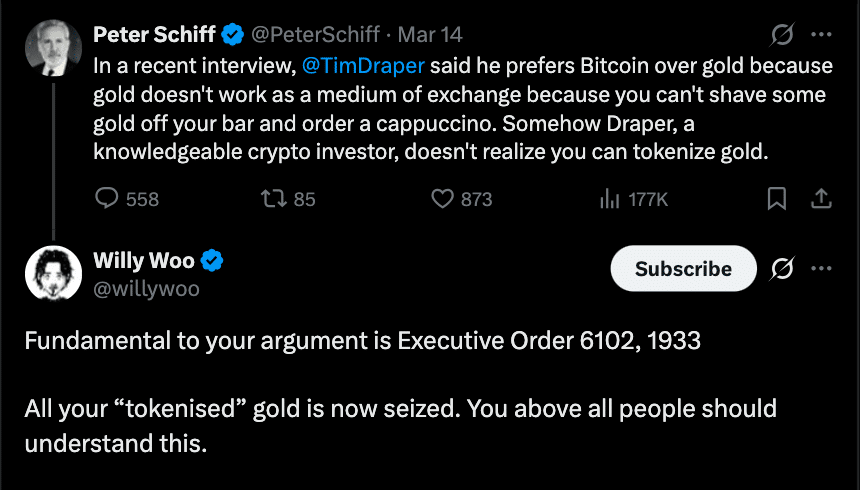
Other commentators wrote this off as an attempt to digitize gold that has been tried many times before, but never on the scale of Bitcoin. Bitcoin supporters argue that the cryptocurrency’s limited supply, open blockchain and decentralized nature make it immune to custodians or governments.
These opposing opinions expose why the Gold vs Bitcoin clash continues to be one of the most tenacious topics at any time in financial markets. Each asset embodies a distinct philosophy about how money should operate in the modern economy.
Market Data Adds New Context to the Gold vs Bitcoin Argument
Aside from ideological differences, market data as of now remains a key component in restructuring investor perceptions with regards to Gold vs Bitcoin.
Latest trading data shows Bitcoin trading around $74K; an increase of about 3.7 percent on the day. Spot gold on the other hand; dipped a bit lower during this time to about $5,018.
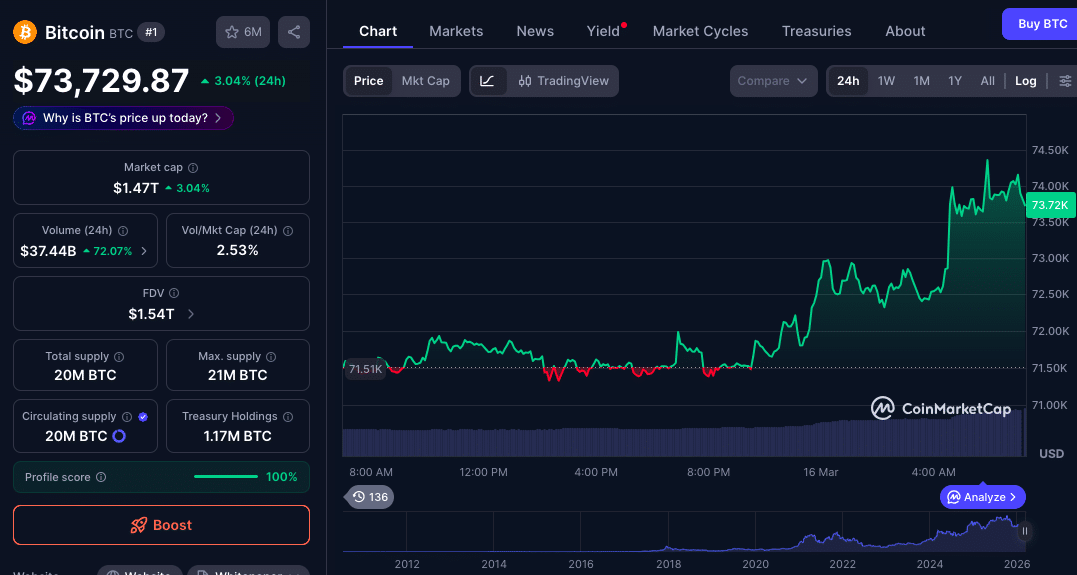
The price movements affected the gold-to-Bitcoin ratio, which investors use to gauge the relative performance of both assets. A falling ratio means that Bitcoin is leading gold in the short term.
Despite the recent momentum behind Bitcoin, gold continues to dominate on the bigger asset hierarchy. Bitcoin ranks as one of the smallest global assets compared to gold, which is still the world’s largest market capitalization asset.
Conclusion
Peter Schiff and Tim Draper are back in the ring, with another round of arguing Gold vs Bitcoin. According to Draper, the adoption of Bitcoin will increase slowly as enterprises start testing digital payments. Schiff, for his part, believes gold’s proven history and physical backing make it the better store of value.
What to make of market movements, investor behavior and evolving technology is likely to keep the debate alive for years. Bitcoin’s advocates view it as a borderless financial system built for the digital age; gold proponents still insist on the stability and history of precious metals.
Overall; the allure of Gold vs Bitcoin discussion is here to stay as each asset has attracted its share of loyal proponents and citations in financial discussions.
Glossary
Bitcoin: A digital currency with no central bank or single administrator ;that can be sent from user to user on the peer-to-peer Bitcoin network without an intermediary.
Gold: A commodity that has historically been used as a store of value and hedge against inflation.
Gold-to-Bitcoin Ratio: A market metric that compares the value of gold and Bitcoin; to gauge their relative performances.
Tokenized Gold: Digital tokens created on a blockchain; that denote rights to real gold held in secure vaults.
Store of Value: Something hoped to maintain purchasing power in the long run.
Frequently Asked Questions About Gold vs Bitcoin
Where is the Gold vs Bitcoin debate coming from?
The debate was reintroduced following Peter Schiff ridicule of Tim Draper’s bullish prediction for Bitcoin.
What does Tim Draper think about Bitcoin adoption?
Retailers may eventually start accepting Bitcoin; paving the way for its broader role in commerce, according to Draper.
Why does Peter Schiff prefer gold to Bitcoin?
He contends that gold’s long history and intrinsic value make it a more stable store of wealth; than Bitcoin’s volatility.
How do Investors Compare Gold And Bitcoin Performance
The gold-to-Bitcoin ratio is often used by investors to determine which asset has outperformed which over a given time frame.
What are the market sizes of Bitcoin versus gold?
Gold is still the largest asset in world history by market capitalization, and Bitcoin is not even in contention despite its growth
References