

This article was first published on Deythere.
Gemini has pushed a new product into the spotlight with the launch of Gemini Predictions, a market for event-based contracts that is now available across all 50 U.S. states. The rollout is live on Gemini’s iOS app and on the web, with the company also promoting a limited-time window of zero trading fees to pull early liquidity onto the platform.
The timing is not random. The exchange is leaning into a moment when crypto prediction markets are no longer treated as a niche corner of the internet, but as a category that regulators, exchanges, and mainstream traders are increasingly willing to engage with. Gemini framed the launch in plain language on X, writing, “Introducing Gemini Predictions, now live across all 50 US states,” and adding that users can trade outcomes with “near instant execution and full transparency.”
Why crypto prediction markets are getting a US-friendly makeover
Behind the product launch sits a regulatory milestone that Gemini has been chasing for years. Gemini’s affiliate, Gemini Titan, received a Designated Contract Market license from the U.S. Commodity Futures Trading Commission, and the regulator’s public listings show Gemini Titan as designated on December 10, 2025.
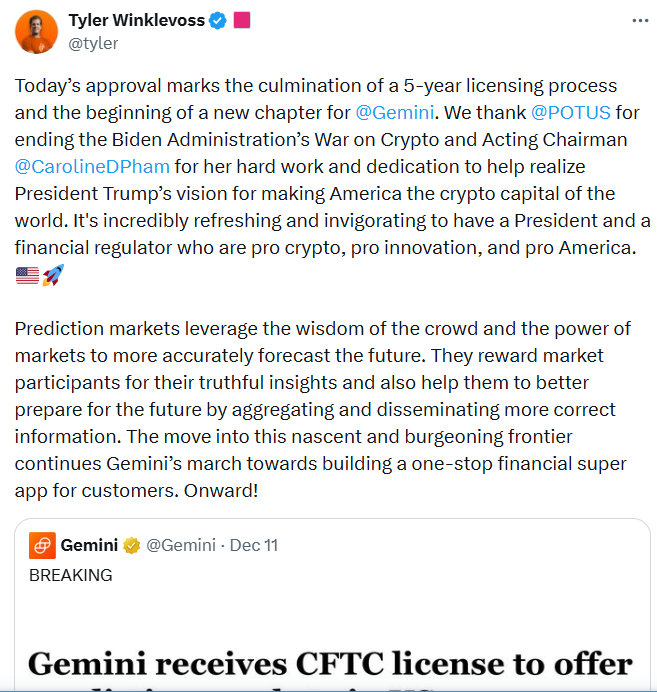
Tyler Winklevoss, Gemini’s CEO, linked the approval directly to the long grind of compliance, writing on X:
“Today’s approval marks the culmination of a 5-year licensing process and the beginning of a new chapter for @Gemini.”
Cameron Winklevoss, Gemini’s president, went bigger in his own post, saying, “Prediction markets have the potential to be as big or bigger than traditional capital markets.” Those public statements matter because they show the firm is not testing a feature. It is attempting to plant a flag while crypto prediction markets are still taking shape in the U.S.

What Gemini Predictions is, and what it is not
Gemini describes the contracts as simple “yes or no” questions on future events. That simplicity is the point. A user does not need to understand options Greeks to participate, but the pricing still behaves like a market signal. A contract trading near 0.60 implies the crowd is leaning toward roughly a 60% chance of that outcome, then it adjusts as new information arrives and as large orders hit the book.
For traders who already live inside crypto charts, this is where the overlap gets interesting. crypto prediction markets can act like a real-time sentiment gauge that reacts faster than headlines, sometimes even faster than social feeds. They can also become a way to express a view without directly buying or shorting a token, especially around events that can whip volatility in either direction.
The indicators that will decide whether it sticks
In the first weeks, success will look boring and measurable: tight spreads, consistent liquidity, and clear contract terms that do not confuse users at settlement. If open interest builds steadily, it signals the product is becoming a habit instead of a curiosity. If volume spikes only around major events and then disappears, it suggests the platform has not yet earned routine attention.
There is also a wider market context. Reuters has reported that prediction markets attract criticism because they resemble gambling, while supporters argue they can aggregate expectations more accurately than traditional forecasting tools. That tension is not going away, so Gemini’s best defense will be operational credibility, clean compliance, and a product experience that feels more like finance than hype.
What comes next for Gemini’s derivatives roadmap
Gemini has also pointed to bigger ambitions beyond event contracts, including the possibility of adding crypto futures, options, and perpetual contracts for U.S. users. If that expansion happens, crypto prediction markets may end up as the on-ramp, the feature that teaches newer users how to think in probabilities before they ever touch more complex derivatives.
Conclusion
Gemini is betting that nationwide access, a fee-free start, and a regulated wrapper can pull event trading into the mainstream. If liquidity holds and settlements remain predictable, crypto prediction markets could evolve into a daily reference point for how traders price uncertainty, not just a once-in-a-while novelty.
Frequently Asked Questions
What is Gemini Predictions?
It is Gemini’s event-contract product that lets users trade on “yes or no” outcomes tied to real-world events.
Is it available across the entire U.S.?
Gemini says it is live in all 50 states on iOS and the web.
Why does regulation matter here?
The product follows Gemini Titan receiving a CFTC Designated Contract Market license, which supports a more formal U.S. framework for crypto prediction markets.
Does it mean Gemini will list more derivatives?
Gemini has signaled it is considering additional U.S. derivatives such as futures, options, and perpetual contracts.
Glossary of Key Terms
Event contract: A contract that settles based on whether a clearly defined outcome happens, usually framed as a “yes or no” result.
Designated Contract Market: A CFTC-regulated venue authorized to list certain derivatives products, subject to U.S. oversight.
Implied probability: The market’s best estimate of the chance of an outcome, inferred from contract pricing and trading activity.
Liquidity: How easily a trader can enter or exit a position without moving the price significantly, often reflected in volume and spread.