


























This article was first published on Deythere.
- Moving Demand: ETF Growth and Institutional Flows
- Corporate Treasury Holdings: How BTC Appears on the Equity Markets
- Miner Economics and Security Budgets
- Scaling Solutions: Lightning and Layer-2 Living Systems
- Regulation and Access: How Rules Affect Market Participation
- Conclusion
- Glossary
- Frequently Asked Questions About Bitcoin in 2026
- How have Bitcoin narratives changed in 2026?
- Why are ETF flows important?
- How much do corporate Bitcoin holdings matter?
- What impact will regulation have on the future of Bitcoin?
- References
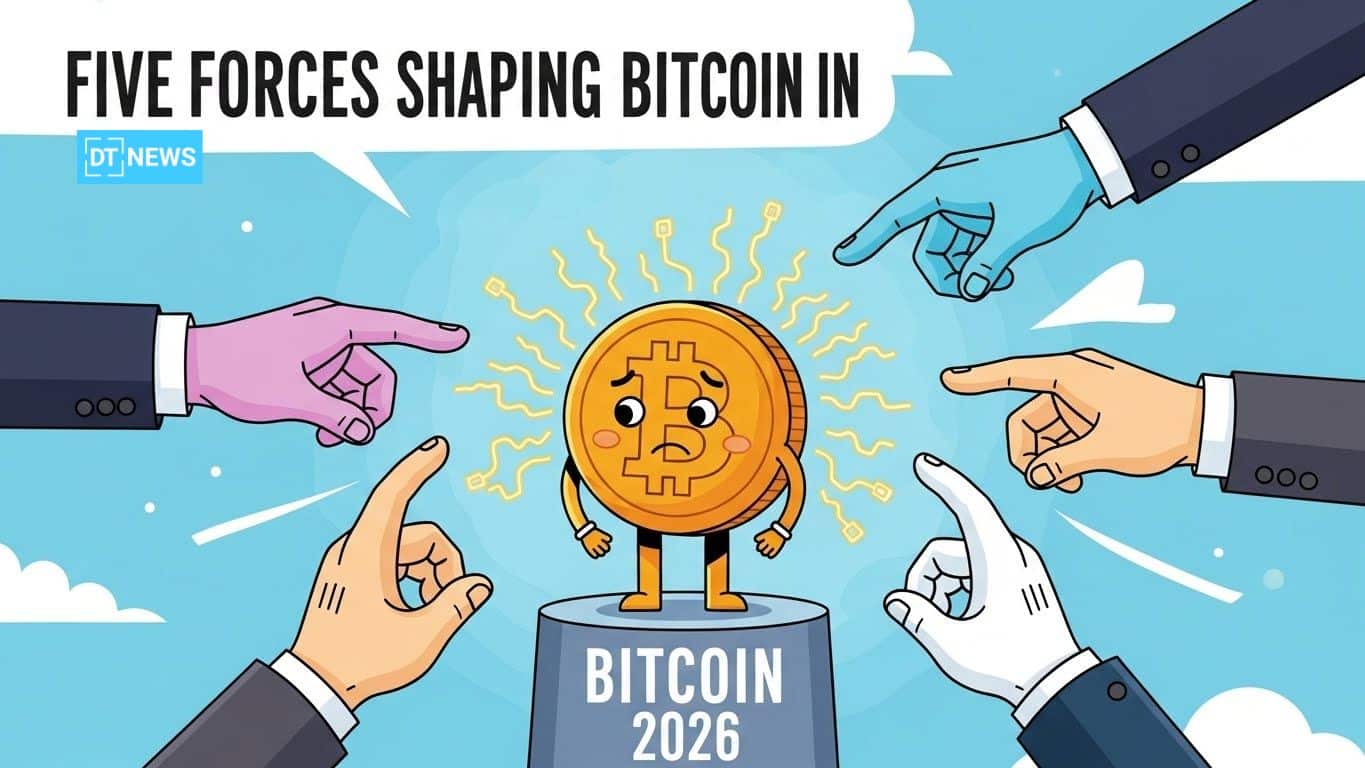
Bitcoin is no longer just a function of its price moves in 2026 as analysts are now paying more attention to the deeper indicators about structure, where demand, security, and access are changing.
These form a better case for Bitcoin in 2026, forces that can quietly affect Bitcoin’s position in global finance even when the price chart looks placid.
Institutional flows to exchange traded funds, the way corporate treasuries are holding BTC, also on miner revenue dynamics and scaling techs like lightning and layer-2 protocols and regulatory frameworks are all contributing factors to this new Bitcoin outlook..
Moving Demand: ETF Growth and Institutional Flows
Institutional capital entering Bitcoin through regulated exchange-traded funds (ETFs) has become one of the clearest structural markers of demand. Spot Bitcoin ETF flows represent asset allocation among large wealth platforms and institutional desks, not just short term trading.
As early as 2026, U.S. spot Bitcoin ETFs logged a one-day net inflow of $753.7 million, a noteworthy jump even in the midst of wider market movements
The Bitcoin ETF ecosystem also hit meaningful scale. Total spot ETF net assets climbed to roughly $123+ billion following recent inflows, data showed, with BlackRock’s iShares Bitcoin Trust (IBIT) and other funds driving the queue.
These are not just inflows of momentum data, but they represent committed allocations from traditional investors who include Bitcoin as part of diversified portfolios instead of speculative bets.
This institutional interest is a central piece of Bitcoin in 2026 because it presents Bitcoin as a regulated asset class incorporated into the common fabric of financial services.
The expansion of institutional flows is a structural demand signal that many market watchers have now started paying more attention to than price itself.
Corporate Treasury Holdings: How BTC Appears on the Equity Markets
Another aspect of Bitcoin in 2026 is how public companies hold Bitcoin. Instead of buying BTC outright, a few firms create equity with claims they will hold Bitcoin for investors.
These so-called Bitcoin treasury stocks are a hybrid, operating company/investment vehicle. Reuters reporting in 2026 noted that index provider MSCI had put off potential changes to exclude these companies from top indexes, amid concerns around their categorization .
This point to two ways in which corporate treasury holdings affect the scope of Bitcoin. For one, they point to confidence from those who treat BTC as a strategic reserve. Second, because these stocks are being added or nearly added to major indexes, they can cause other related equities to move in big ways, and add a market layer outside of the spot Bitcoin market itself.
Miner Economics and Security Budgets
The security model of Bitcoin, based on proof-of-work, is reliant on miner participation. The block subsidy was halved following the 2024 halving of Bitcoin. Miner revenue from transaction fees, therefore, became more closely examined.
Recently, it has been reported that transaction fees in some parts of 2025 amounted to less than 1 percent of total miner rewards, and numerous blocks were mined with negligible fees.
These developments have raised long-standing questions about Bitcoin’s security budget, particularly how miners would be compensated once subsidies get smaller and fees don’t rise.
One indicator of this pressure was that the network’s hashrate, which is the sum total of all computing power securing Bitcoin, exhibited slight declines in late 2025 as reduced reward revenue began to set in.
Miner economics and security funding are an important part of Bitcoin in 2026, as it speaks to the degree to which the network will continue to be resilient as economic incentives change and block rewards decrease.
Scaling Solutions: Lightning and Layer-2 Living Systems
The Lightning Network, a second-layer protocol intended to make it possible to transact quickly and cheaply, set new capacity highs in late 2025. Analysts stress that the distribution of liquidity among many participants, not concentration among only a few participants, is important for the network’s decentralized utility.
In addition to Lightning, there have been an increasing number of L2 solutions building on top of Bitcoin. Industry research points out that the number of BTC-focused L2 projects exploded over the past couple of years and didn’t just attract attention towards payments, but also as a bridge to connect capital and liquidity into an overall ecosystem.
There is also increased talk about potential protocol upgrades that may increase the quality of scaling primitives at the base layer. Proposals like OP_CAT and OP_CTV have resurfaced as potential building blocks for trustless bridges connecting Bitcoin to other layers or networks.
Furthermore, the advances in scaling infrastructure represent a big part of Bitcoin in 2026 since they demonstrate improvements in usability, network utilization and potential for Bitcoin to act as both a settlement layer and platform for wide-ranging financial applications.
Regulation and Access: How Rules Affect Market Participation
The regulatory and legal environment determines who is able to own Bitcoin, where, and how. The creation of Strategic Bitcoin Reserves by executive action in the US lends credence to the fact that the federal government at least views Bitcoin as a strategic asset.
The policy further mandates that a U.S. Digital Asset Reserve be established to hold digital assets as a long-term strategic asset.
Meanwhile, the European Union’s Markets in Crypto-Assets (MiCA) regulation still defines very clear paths to authorization for crypto-asset service providers.
This regulation introduces an organized compliance framework for custody, trading and consumer protection throughout European Union states.
Regulatory developments for Bitcoin in 2026 decide which banks, asset managers and retail platforms can provide Bitcoin products in the market.
The way in which policymakers make decisions has an impact on the structure of the market about how risk is priced, how Bitcoin achieves adoption, and ultimately shapes how and where capital will be injected into the Bitcoin economy.
Conclusion
The story of Bitcoin in 2026 has changed and is now increasingly being defined by forces beyond the price chart.
These forces include institutional demand flows through ETFs, corporate treasury BTC holdings, mining economics and network security funding, technical improvements in scaling via Lightning and L2 networks and shifts in the regulatory environment which provides a framework for access and legitimacy.
All together, these forces tell a tale of a maturing asset class where structural dynamics, capital formation, and legal frameworks count for as much, if not more than day-to-day price moves.
Glossary
Bitcoin ETF: A regulated investment fund that holds Bitcoin, providing investors access to the cryptocurrency without having to own it outright.
Corporate Treasury BTC: Bitcoin held on a company balance sheet as a strategic asset.
Hashrate: The combined strength of all Computers Securing the Bitcoin Network.
Lightning Network: A layer-2 protocol for making Bitcoin transactions faster and less expensive.
MiCA: Markets in Crypto-Assets, EUs regulation of crypto service providers.
Strategic Bitcoin Reserve: The US government proposed a framework for the accumulation of BTC as a long-term reserve asset at the national level.
Frequently Asked Questions About Bitcoin in 2026
How have Bitcoin narratives changed in 2026?
The main themes analysts are now watching to get a grip on Bitcoin’s structural market force, extend beyond price. They now take into consideration institutional flows and miner economics, scaling technology and regulation.
Why are ETF flows important?
ETFs provide visibility into long-term capital allocations by institutions and wealth managers, unlike price moves driven by short-term traders.
How much do corporate Bitcoin holdings matter?
Companies keeping BTC on their balance sheet represents a proxy exposure to equity markets and influence how Bitcoin is perceived in financial indexes.
What impact will regulation have on the future of Bitcoin?
Regulatory clarity in major jurisdictions will impact the participation of mainstream investors, banks and platforms providing Bitcoin services, which in turn affects overall participation in the market.