
Ethereum vs S&P 500 performance has entered market focus as geopolitical tensions influence asset behavior, with Fundstrat’s head of research Tom Lee stating that Ethereum has gained 7% since the Iran war began and outperformed the S&P 500 by 1,130 basis points. The conflict, which began in late February 2026, has created a complex environment where traditional and digital assets are reacting differently.
- How does Ethereum vs S&P 500 performance compare in current conditions?
- Why has Ethereum shown resilience during the Iran conflict?
- How significant is the 1,130 basis point outperformance?
- What is happening in broader markets alongside this trend?
- What could come next for Ethereum and equities?
- Conclusion
- Glossary
- Frequently Asked Questions About Ethereum vs S&P 500 Performance
Fundstrat’s observation also places Ethereum ahead of assets like gold and Bitcoin during this period, though its absolute gains remain limited. Notably, Ethereum is still trading well below prior highs, reflecting a broader context where volatility and drawdowns continue to shape investor sentiment.
How does Ethereum vs S&P 500 performance compare in current conditions?
Ethereum vs S&P 500 performance reflects a divergence between crypto and traditional equities during a period of geopolitical stress. Lee stated that Ethereum’s 7% rise contrasts with pressure on the S&P 500, a benchmark that has struggled amid uncertainty.
The comparison was shared in a Fundstrat note that circulated widely across crypto-focused platforms. This divergence highlights relative strength rather than absolute dominance. Analysts note that such gaps can narrow if macro conditions improve, particularly if tensions ease or commodity markets stabilize.
Why has Ethereum shown resilience during the Iran conflict?
Ethereum’s resilience during the conflict points to a nuanced shift in investor positioning, though not a complete departure from risk dynamics. Tom Lee linked this trend to the idea that crypto may function as a wartime store of value. He has also previously outlined a long-term outlook that places Ethereum at significantly higher valuations.
At the same time, Ethereum continues to behave like a high-risk asset. Sharp drawdowns remain possible, and past cycles have shown that declines exceeding 30% are not unusual, reinforcing that the Ethereum vs S&P 500 performance trend exists within a volatile framework.
How significant is the 1,130 basis point outperformance?
The reported 1,130 basis point lead represents a clear but relative performance gap. Such a margin suggests capital may be rotating toward digital assets in the short term.
However, the comparison is influenced by simultaneous weakness in equities, which can exaggerate relative gains. Market participants caution that the Ethereum vs S&P 500 performance spread can reverse quickly if sentiment shifts, as crypto markets have historically shown rapid corrections during risk-off phases.
What is happening in broader markets alongside this trend?
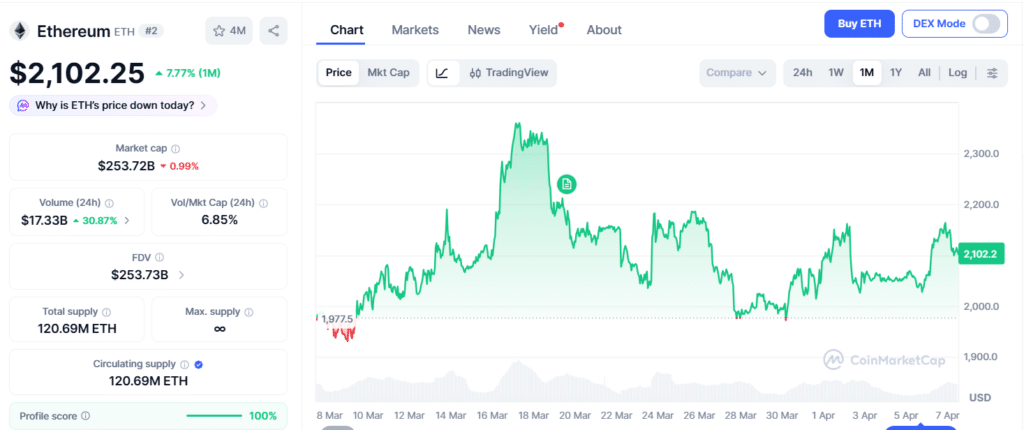
Global financial markets remain under pressure from multiple macroeconomic factors linked to the ongoing geopolitical conflict. Oil‑price volatility and persistent inflation concerns continue to weigh on equities. Against this backdrop, Ethereum is trading near $2,101.45, testing the $2,000 support level. Which reflects cautious positioning among market participants
While the Ethereum vs S&P 500 performance narrative highlights resilience, longer-term comparisons still show that crypto has lagged equities over extended periods, adding balance to the current short-term strength.
What could come next for Ethereum and equities?
The next phase will depend on how macro conditions evolve. If Ethereum maintains its relative strength, the Ethereum vs S&P 500 performance trend could reinforce arguments around crypto’s role in diversified portfolios. Continued divergence would likely attract more institutional attention.

At the same time downside risks remain. Policy decisions, inflation data, and developments in the Iran conflict could quickly shift sentiment. Which is putting pressure on Ethereum’s current levels.
Conclusion
Ethereum vs S&P 500 performance highlights a clear divergence in how digital and traditional assets are reacting to geopolitical stress. Ethereum’s 7% gain and 1,130 basis point lead signal relative strength, but this advantage remains context-driven rather than structural.
The comparison underscores a moment of shifting market dynamics, though it is still shaped by volatility and external risks. For now Ethereum is ahead but the sustainability of this trend will depend on how both crypto and equity markets respond to ongoing uncertainty.
Glossary
S&P 500: An index that shows overall performance of 500 top U.S. companies
Basis Points: A way to measure small percentage changes.
Safe-Haven Assets: Assets like gold that investors trust during uncertain times
Crypto Resilience: The strength of cryptocurrencies during market stress
Ethereum: A widely used cryptocurrency that runs smart contracts.
Frequently Asked Questions About Ethereum vs S&P 500 Performance
How much has Ethereum risen during the Iran conflict?
Ethereum has risen by around 7% since the Iran conflict began. Which shows steady strength during this period.
How much did Ethereum outperform the S&P 500?
Ethereum outperformed S&P 500 by about 1,130 basis points during this time.
Can this outperformance continue?
This outperformance can continue if market conditions remain stable, but it may change quickly if sentiment shifts.
Who shared this Ethereum performance insight?
This performance insight was shared by Tom Lee from Fundstrat.
Is Ethereum still below its previous highs?
Yes Ethereum is still trading below its earlier peak prices.