

This article was first published on Deythere.
- How is the Ethereum funding rate shaping the current market narrative?
- Why is Ether’s price still under pressure despite recent market developments?
- Are institutional flows and corporate developments influencing sentiment?
- What does on-chain activity reveal about network demand?
- What do derivatives and options markets say about investor expectations?
- How could upcoming upgrades change Ethereum’s outlook?
- Conclusion
- Glossary
- Frequently Asked Questions About Ethereum Funding Rate
Ethereum’s funding rate has moved into negative territory as derivatives market positioning, slower on-chain activity, and institutional fund outflows continue to weigh on Ether’s short-term outlook. This shift is happening while ETH is currently trading around $2,017.64, after earlier hovering near $2,023, and the asset has struggled to stay above the $2,100 level over the past month.
Although ETH managed to climb 7% between Monday and Tuesday, current market indicators show that traders remain cautious about opening large leveraged bullish positions. The current movement in the Ethereum funding rate reflects a careful market mood, where participants are balancing weaker network demand with the ongoing technical improvements being developed within the Ethereum ecosystem.
How is the Ethereum funding rate shaping the current market narrative?
The Ethereum funding rate has moved into negative territory in perpetual futures markets, showing that more traders are opening short positions than bullish ones. In crypto derivatives, funding rates usually stay within an annual neutral range of 6% to 12%. However, the Ethereum funding rate has remained below that level for nearly a month, indicating weaker confidence among derivatives traders.
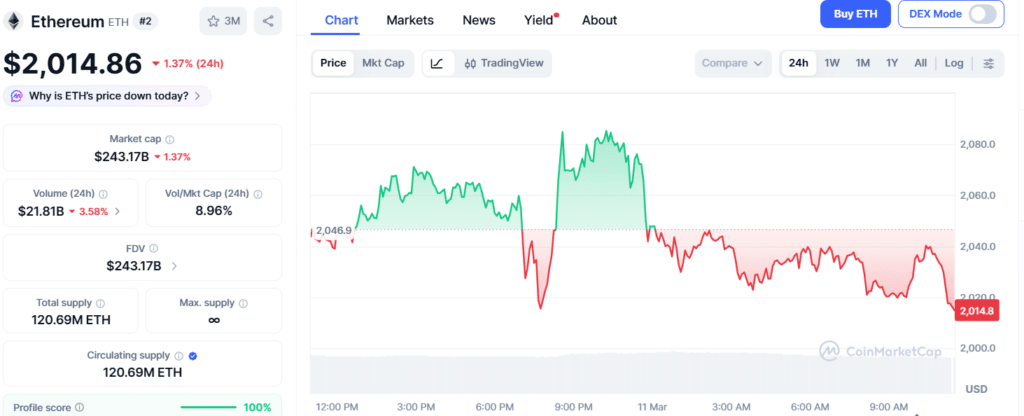
This continued weakness suggests that many market participants are still cautious about taking strong long positions. Traders appear to be waiting for clearer signals before increasing their exposure to ETH. The hesitation is visible even though Ether recorded a brief recovery earlier in the week. While the price moved back toward the $2,000 range, the rebound was not strong enough to convince derivatives traders that ETH could sustain a move above $2,100.
Market observers often describe a negative funding environment as a defensive stage in trading. In such situations, participants may hedge their risk instead of fully exiting the market. Even so, the Ethereum funding rate continues to indicate that traders currently have limited confidence in a strong rally in the near term.
Why is Ether’s price still under pressure despite recent market developments?
Ether’s overall price trend has remained under pressure for several months. During the past six months, the asset has fallen by about 54%, which has weakened confidence among many traders and investors in the market. ETH is currently trading around $2,017.64, down about 1.25% over the past 24 hours, reflecting the cautious mood across the market.
Short-term indicators also show mixed signals, with the 14-day Relative Strength Index (RSI) at 47.6, placing the asset in a neutral zone and suggesting that momentum is neither strongly bullish nor bearish at the moment. The broader crypto market environment has also played a role. Since October 2025, ETH has lagged behind the wider cryptocurrency market.
This happened after the total digital asset market capitalization climbed close to the $4 trillion all-time high, after which the sector entered a period of correction. That market slowdown happened around the same time staking features were introduced for Ethereum exchange-traded funds in the United States.
The timing reduced the immediate impact of what many participants had expected to be a strong catalyst for demand. Because of these combined factors, the Ethereum funding rate reflects a market that is still adjusting to recent structural changes rather than clearly moving into a strong recovery phase.
Are institutional flows and corporate developments influencing sentiment?
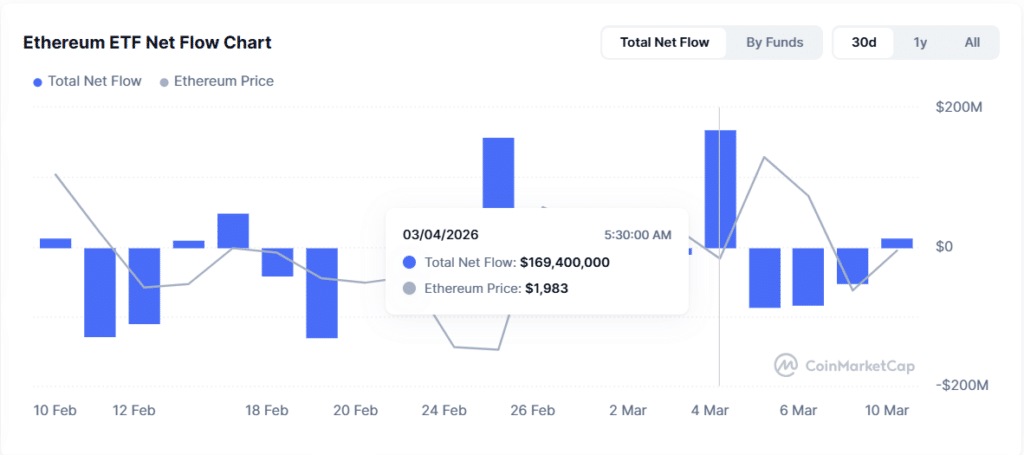
Institutional demand indicators have recently weakened. Ether exchange-traded funds recorded $225 million in net outflows between Thursday and Monday, reversing $169 million in inflows recorded earlier in the week on Wednesday. These flows are often used as a measure of professional investor sentiment in the market. Ethereum’s 2.8% native staking reward currently remains lower than some stablecoin yields.
For example, returns on Sky Lending, previously known as MakerDAO, are around 3.75%, which creates additional competition for capital. This difference in yield can influence where investors choose to allocate funds. Investor sentiment has also been affected by developments within the Ethereum ecosystem. In 2025, the Ethereum treasury firm Sharplink, chaired by Ethereum co-founder Joseph Lubin, reported a $735 million net loss.
The company released these financial results on Monday, adding another layer of caution among market participants. ETF flow data from March also showed how capital can move between different issuers as investors compare fees, liquidity, and fund performance. These reallocations can influence market positioning and may occur alongside movements in the Ethereum funding rate.
What does on-chain activity reveal about network demand?
On-chain indicators show that network activity has slowed compared with earlier in the year. Over the past month, weekly base-layer fees on the Ethereum network averaged about $2.3 million, which is significantly lower than the $8 million peak recorded in early February. However, transaction activity has remained relatively stable.
The seven-day transaction count continues to hover near 14 million, suggesting that users are still active on the network, though the level of demand is not strong enough to support a sharp rise in price momentum. One factor behind this trend is the industry’s increasing focus on layer-2 rollups, which help improve scalability by processing transactions outside Ethereum’s main base layer.
While these solutions expand the network’s overall capacity and efficiency, they have not yet led to stronger demand for native Ether itself. Because of this combination of stable activity but weaker revenue generation on the base layer, the Ethereum funding rate has remained subdued even as transaction levels hold steady.
What do derivatives and options markets say about investor expectations?
While futures data suggests caution, options markets present a more balanced outlook. The 30-day ETH options delta skew remained close to the neutral band of –6% to +6%. Put options traded at about a 7% premium over call options, reflecting defensive positioning but not extreme pessimism.
Analysts view this as a sign that some investors still expect a recovery scenario. Ethereum’s position in the decentralized finance sector is another stabilizing element. The network continues to control around $56 billion in total value locked (TVL) across its DeFi ecosystem.
Currently, that figure is near $55.511 billion, showing a slight 0.18% decline over the past 24 hours, but the scale still places Ethereum comfortably ahead of competing blockchain networks. Even with the negative Ethereum funding rate, this dominance in DeFi infrastructure continues to support longer-term confidence in Ethereum’s ecosystem and its role within decentralized finance markets.
How could upcoming upgrades change Ethereum’s outlook?
Technical progress continues to shape Ethereum’s long-term outlook. Ethereum co-founder Vitalik Buterin recently said that account abstraction, often described as smart accounts, could arrive within about a year after spending more than a decade in development. The upgrade would allow transactions to reference data from other transactions and could introduce stronger security features, including wallets designed to be resistant to future quantum computing risks.

Developers are also preparing the Hegota fork, an update expected to expand how users interact with the network. One key change would allow transaction fees to be paid using tokens other than ETH through specialized decentralized exchanges. This could make the network more flexible for users who already hold other digital assets.
The proposal also includes the introduction of a general-purpose public mempool, alongside the removal of public broadcasters currently used in privacy platforms such as Railgun and Tornado Cash. These structural changes are intended to refine how transactions move through the network.
Buterin has further indicated that Ethereum may gradually reduce slot time and finality time in the future. Such adjustments would help transactions settle faster and improve overall network responsiveness. Over time, these technical upgrades could influence investor expectations, even though the Ethereum funding rate currently reflects a cautious stance in derivatives markets.
Conclusion
Ethereum funding rate trends currently reflect a market dealing with mixed signals. On one side, derivatives indicators remain soft, ETF outflows have been recorded, and base-layer revenue on the network has slowed. On the other side, development work on the protocol continues, and Ethereum still holds a strong position in decentralized finance.
The Ethereum funding rate staying below its usual neutral range suggests that traders are not yet convinced about a clear move above the $2,200 level. Market participants appear cautious, waiting for stronger signs of demand before committing to larger bullish positions.
Yet the data also shows no clear evidence of deteriorating fundamentals or overwhelming bearish dominance. As Ethereum developers continue to roll out improvements and institutional flows stabilize, the Ethereum funding rate will remain a closely watched indicator for whether confidence in the asset begins to return.
Disclaimer: This article is for informational purposes only and does not constitute financial or investment advice. Cryptocurrency markets are volatile, and readers should conduct their own research before making any investment decisions.
Glossary
Ethereum funding rate: Metric showing whether ETH futures traders favor longs or shorts.
Perpetual futures: Futures contracts with no expiry used for crypto trading.
Total value locked (TVL): Total value of assets locked in DeFi protocols.
Options delta skew: Indicator comparing demand for put and call options.
Layer-2 rollups: Off-chain scaling networks that make transactions faster and cheaper.
Frequently Asked Questions About Ethereum Funding Rate
What does a negative Ethereum funding rate mean?
A negative Ethereum funding rate means more traders are betting that the ETH price may fall.
What price is Ethereum trading at now?
Ethereum is currently trading around $2,017 after failing to stay above the $2,100 level.
Has Ethereum’s price dropped in recent months?
Yes, Ethereum’s price has fallen about 54% over the past six months.
What does on-chain activity show about Ethereum?
On-chain data shows that network usage is stable but not strong enough to support a big price rise.
Why are traders cautious about ETH right now?
Traders are cautious because the market has weak demand and recent price declines.