

This article was first published on Deythere.
Ethereum capital inflows are drawing renewed attention across the crypto industry as the network records more than $2.1 billion in new liquidity in 2026. The figure reflects rising investor confidence in the blockchain’s role as a foundation for decentralized finance, digital assets, and Web3 innovation.
According to the source, data from an on-chain analytics dashboard shows Ethereum capital inflows surpassing every other blockchain network this year. The metric tracks the difference between funds entering and leaving blockchain ecosystems. Strong inflows usually signal rising activity across decentralized applications, trading platforms, and on-chain financial services.
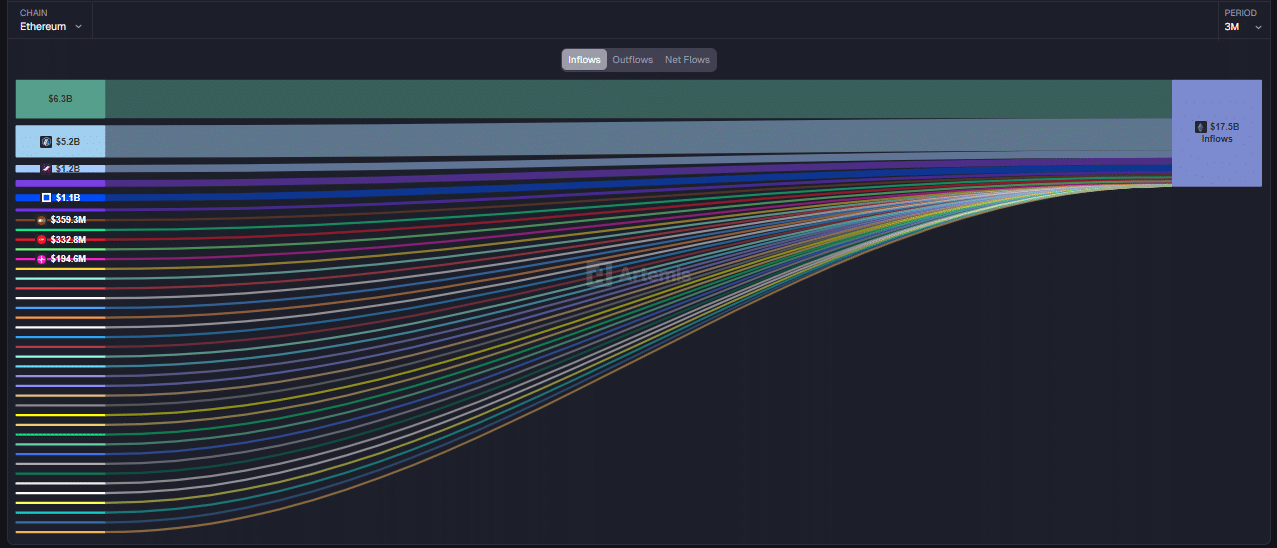
Ethereum Capital Inflows Signal Strong Market Confidence
The steady rise in Ethereum capital inflows has become one of the clearest indicators of blockchain adoption in 2026. Net capital flows measure the balance between liquidity entering a network and funds exiting it through cross-chain transfers.
When inflows remain positive, analysts view the signal as a sign of ecosystem strength. In this case, Ethereum capital inflows exceeding $2.1 billion place the network ahead of competing ecosystems such as Solana, BNB Chain, and Avalanche.
Market analysts often stress that liquidity movements reveal deeper trends than price swings. One industry study notes that “capital flows across blockchains often highlight real adoption and long-term user commitment.” Insights shared through this market research report show that liquidity growth frequently precedes ecosystem expansion.
Because of this, Ethereum capital inflows have become a closely watched metric among financial analysts and blockchain developers.
DeFi Expansion Keeps Ethereum at the Center of Innovation
The growth of Ethereum capital inflows is closely tied to the rapid expansion of decentralized finance. Ethereum remains the dominant platform for DeFi protocols, stablecoins, and tokenized assets, supporting thousands of decentralized applications across its network.
These applications enable users to trade, borrow, and provide liquidity without traditional intermediaries. As activity increases, more capital flows into the ecosystem. Rising Ethereum capital inflows also inflates tokenized assets and stablecoin settlement networks. This builds ever stronger liquidity pools, promotes trading volumes, and widens markets for decentralized borrowing.
Institutional Investors Fuel Ethereum’s Liquidity Growth
Institutional investors are playing a major role in the rise of Ethereum capital inflows. Large funds are now directing capital toward blockchain infrastructure, staking services, and decentralized financial products. Rather than simply holding digital assets, many institutions are actively participating in blockchain ecosystems.

Institutional funding is also supporting staking infrastructure that helps secure Ethereum’s network, while financial firms explore tokenized securities and real-world assets built on the platform. As Ethereum capital inflows grows, liquidity across decentralized exchanges and lending markets gets better. This increases trading efficiency.
It also encourages seed money for developers to come out of the woodwork and put forth new applications. Projects like these cyclically feed back and create more than just a boost for Ethereum’s standing in wider cryptocurrency markets.
Conclusion
The sudden increase in the epoch of Ethereum capital inflows is a clear shift in the world of cryptocurrencies. Liquidity is flooding more and more to networks that offer infrastructure, have active developers and enjoy real user demand.
With more than $2.1 billion pouring into the Ethereum ecosystem since 2026, Ether still takes its natural position in decentralized finance and digital innovation. The seemingly uninterrupted expansion of Ethereum Money Guy shows that the network is still seen by investors as one trusted bases blockchain technology ever built.
If institutional adoption and DeFi expansion continue, then these inflows would be a key gauge of Ethereum’s long-term strength.
This article is for informational purposes only and does not constitute financial advice. Readers should conduct their own research before making investment decisions.
Glossary of Key Terms
Net Capital Flows: The difference between funds entering and leaving a blockchain ecosystem over a specific period.
Stablecoins: Cryptocurrencies designed to maintain a stable value, usually pegged to fiat currencies such as the U.S. dollar.
Tokenized Assets: Digital representations of real-world assets issued on a blockchain.
Staking: The process of locking cryptocurrency to help secure a blockchain network and earn rewards.
FAQs About Ethereum Capital Inflows
Why are Ethereum capital inflows important?
They show how much liquidity enters the ecosystem. High inflows often signal growing investor confidence and increased blockchain activity.
What does net capital flow mean in crypto?
Net capital flow measures the difference between money entering and leaving a blockchain network.
Why does Ethereum lead other blockchains in capital flows?
Ethereum hosts the largest DeFi ecosystem and supports many stablecoins and tokenized assets.
Can capital inflows impact blockchain growth?
Yes. Strong capital inflows increase liquidity, attract developers, and support long-term ecosystem expansion.