

This article was first published on Deythere.
- Ethereum 2026 roadmap: Getting Nodes Back on Everyday Computers
- Why the Ethereum 2026 roadmap Targets “Trust Me” Wallet Data
- Privacy Becomes a Default Expectation, Not a Luxury Feature
- Safer Wallet Recovery Without Seed-Phrase Panic
- The “Walkaway Test” and Apps That Keep Working
- Conclusion
- Frequently Asked Questions
- Glossary of Key Terms
Ethereum is heading into 2026 with the kind of market mood traders know too well: choppy price action, nervous sentiment, and short-term narratives fighting for oxygen. At one point during the latest pullback, ETH hovered near $2,942, sliding roughly 5% over 24 hours, a reminder that even the largest networks still move with risk-on and risk-off waves.
Yet the more interesting story is not the red candles. It is the signal coming from Ethereum co-founder Vitalik Buterin, who has been framing 2026 as a year to restore what got blurred during the last growth phase: self-sovereignty, verifiable security, and privacy that feels normal instead of optional. In other words, the Ethereum 2026 roadmap is being positioned as infrastructure-first, even if that approach does not instantly boost headlines.
Ethereum 2026 roadmap: Getting Nodes Back on Everyday Computers
One of the clearest priorities is making it easier for regular people to verify Ethereum locally again, without needing a specialist setup. Over time, running a full node became heavier, largely because chain state kept growing and the “simple laptop” dream started to feel unrealistic for many users.
That problem sits at the heart of the Ethereum 2026 roadmap, with two technical directions mentioned repeatedly: ZK-EVM improvements and Block-level Access Lists, often shortened as BAL.
BAL is designed to make execution more predictable by describing what parts of Ethereum state a block will touch, which helps clients reduce waste and plan work more efficiently. If Ethereum wants more decentralization in practice, not just in theory, shrinking the effort required to verify matters a lot, because the network is only as independent as the people who can actually run it.
Why the Ethereum 2026 roadmap Targets “Trust Me” Wallet Data
Most users interact with Ethereum through wallets that rely on remote RPC providers, essentially asking a third-party server what their balance is and whether a transaction is confirmed. It is convenient, but it quietly introduces trust.
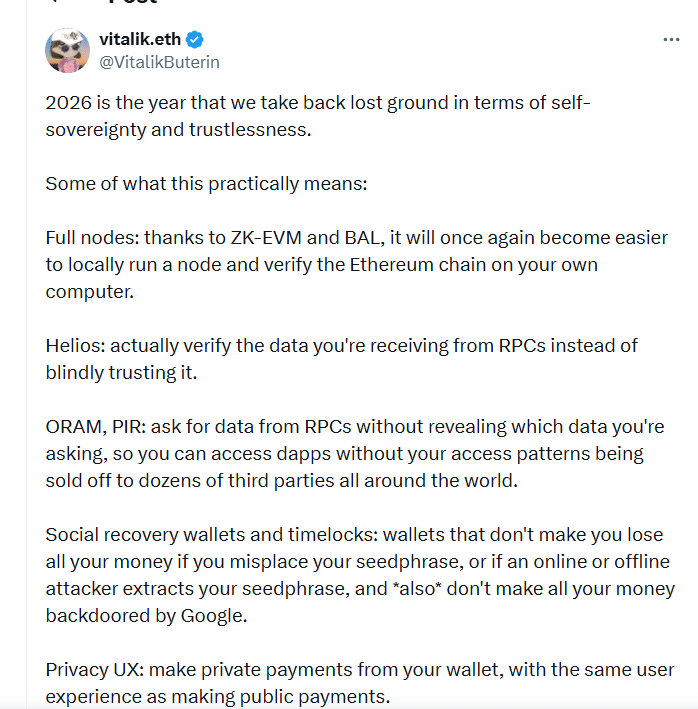
The fix being highlighted is Helios, a lightweight client approach that can turn an untrusted RPC feed into something verifiable on the user side. This is not about making wallets complicated. It is about making them harder to fool. The idea matches what official Ethereum developer documentation describes: light clients can verify data instead of simply trusting what an RPC provider claims.
In practical terms, Helios fits the Ethereum 2026 roadmap because it pushes Ethereum closer to a world where users can keep the same smooth experience, while gaining the safety of independent verification, similar to how a password manager protects accounts without forcing people to memorize everything.
Privacy Becomes a Default Expectation, Not a Luxury Feature
Ethereum has always had a transparency tradeoff. Anyone can audit the chain, but everyday activity becomes traceable in ways most people would never accept in traditional finance. The 2026 plan leans into privacy-preserving query tools such as ORAM and PIR, aimed at reducing data leakage when users or apps request information from the network.
This matters because privacy is not only about hiding. It is about preventing unnecessary exposure, the same way a person does not publish their bank statement just to prove they can pay rent. Inside the Ethereum 2026 roadmap, privacy is being treated as a usability requirement, not a niche preference.
Safer Wallet Recovery Without Seed-Phrase Panic
Another theme is improving wallet security so that one mistake does not mean permanent loss. Social recovery designs, account-style wallets, and more flexible security models aim to reduce the “single point of failure” problem that seed phrases create.

That fits the Ethereum 2026 roadmap because mainstream adoption needs safety nets that feel familiar, like account recovery in modern apps, but without reintroducing centralized control.
The “Walkaway Test” and Apps That Keep Working
Beyond wallets and nodes, Buterin has also pushed the concept of the “walkaway test,” meaning applications should still function even if the original team disappears. That is a direct response to the quiet centralization many so-called decentralized apps still rely on, such as hosted front-ends and single-provider infrastructure.
In the Ethereum 2026 roadmap, this mindset promotes apps that can survive real-world chaos, where uptime and user access are not tied to one company’s servers or one developer group’s attention span.
Conclusion
Ethereum has spent years scaling, expanding, and absorbing new financial behavior, sometimes at the cost of simplicity and trustlessness for regular users. The current message from leadership is clear: 2026 is meant to be a reset toward verification, privacy, and user control, even if price action stays messy in the short run. If the Ethereum 2026 roadmap delivers on lighter nodes, verifiable wallets, and durable applications, Ethereum will not just ride another cycle, it will mature into infrastructure people can depend on.
Frequently Asked Questions
What is the main goal of the Ethereum 2026 roadmap?
It aims to restore decentralization by making verification easier, improving wallet security, and strengthening privacy.
Why does Ethereum want lighter node requirements?
Because more people running nodes reduces reliance on centralized infrastructure and increases network resilience.
What problem does Helios solve for users?
It helps wallets verify blockchain data instead of trusting remote RPC servers for balances and transaction status.
Will privacy upgrades hide transactions completely?
The focus is on reducing unnecessary data exposure during queries and app interactions, not creating total invisibility.
What is the “walkaway test” in simple terms?
It is the idea that an app should still work even if its creators stop maintaining it.
Glossary of Key Terms
BAL (Block-level Access Lists): A proposed method to describe what state a block will access, improving efficiency and helping future scalability.
ZK-EVM: Zero-knowledge systems designed to help verify execution more efficiently, supporting easier local verification.
Light Client: A lightweight way to verify blockchain data without running a full node, often used in wallets.
RPC Provider: A remote service wallets use to read blockchain data and send transactions.
Helios: A light client project that enables trust-minimized verification of Ethereum data through a local interface.
Walkaway Test: A standard for ensuring decentralized apps remain usable even if the original team disappears.
References