

This article was first published on Deythere.
- What does the crypto market sell-off reveal about the week’s underlying dynamics?
- How did geopolitical risk transmit so quickly into crypto prices?
- Why did security failures regain attention during the downturn?
- How did regulation and stablecoins shape sentiment?
- What did exchange developments signal during the crypto market sell-off?
- Are institutions retreating or quietly repositioning?
- How is traditional finance continuing to converge with crypto?
- Why did legal, integrity, and enforcement issues resurface?
- What smaller signals did the market absorb during the week?
- Conclusion
- Glossary
- Frequently Asked Questions About Crypto Market Sell-Off
Crypto market sell-off marked a challenging stretch for digital assets as global tensions, tighter oversight, and technical pressures hit the market at the same time without stopping activity altogether. Rising conflict between Iran and Israel led to sudden price swings, widespread liquidations, and fresh questions about how crypto behaves during periods of international stress.
Alongside this, security breaches, compliance checks, and ongoing legal issues returned to the spotlight, weighing on already fragile confidence. Still, despite the sharp moves, the crypto system kept running, with institutions adjusting positions, developers continuing their work, and regulators pushing forward with policy plans.
What does the crypto market sell-off reveal about the week’s underlying dynamics?
The crypto market sell-off pointed to mounting stress rather than a complete market collapse. Prices shifted sharply following the rise in geopolitical tensions, but activity across the broader crypto ecosystem continued and did not come to a standstill. Bitcoin slipped from the mid-$65,000 range toward the low $60,000s, while Ethereum declined from around $3,500 to below $3,200 during the same period.
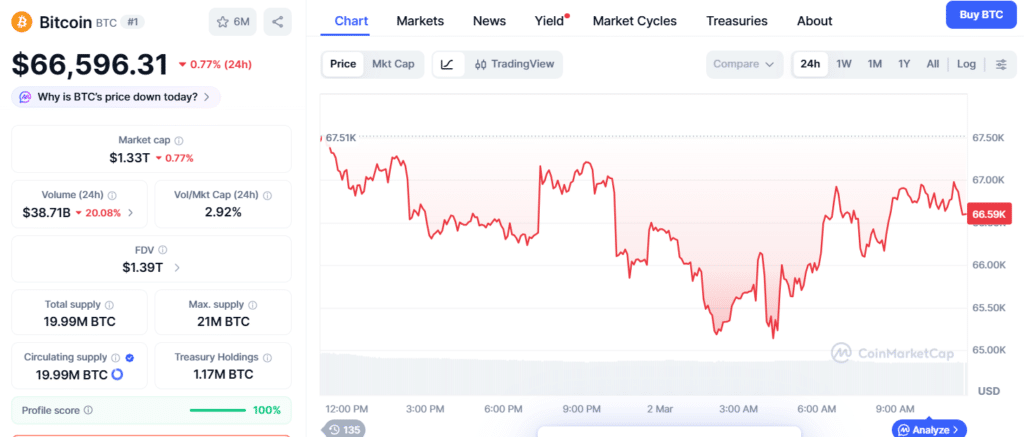
Solana and XRP also weakened, moving in step with wider risk assets as caution spread across markets. Liquidations climbed beyond $500 million as leveraged positions were forced to close after key support levels failed. Bitcoin is currently trading around $66,893.99, down 0.72% over the past 24 hours.
Ethereum is hovering near $1,976.67, posting a 1.76% decline during the same period. Even with the pressure, retail investors largely avoided panic selling, and traders described the moves as tense but controlled, reinforcing the view that the market was adjusting under sustained pressure rather than unraveling in a disorderly manner.
How did geopolitical risk transmit so quickly into crypto prices?
Geopolitics delivered the sharpest shock of the week. Confirmation of rising tensions between Iran and Israel pushed investors into a risk-off stance, and crypto was among the first markets to react because of its round-the-clock liquidity.
Traders moved quickly to cut exposure, setting off a wave of liquidations across derivatives markets. Analysts observed that Bitcoin once again tracked broader risk sentiment, instead of acting as a hedge during periods of heightened uncertainty.
Why did security failures regain attention during the downturn?
Security issues moved back into focus as market pressure increased during the crypto market sell-off. Ethereum co-founder Vitalik Buterin said crypto security can never be fully flawless, citing system complexity, misaligned incentives, and simple human mistakes. That message quickly proved relevant.
IoTeX confirmed a $4.3 million exploit on its ioTube bridge after a validator key was compromised, allowing attackers to create and transfer assets. FOOMCASH later reported losses of $2.26 million from a copycat attack that used zkSNARK-based methods.
Claims that Ploutos Money carried out an exit scam involving 188 ETH further unsettled investors. At the same time, Buterin shared plans for Ethereum’s upcoming upgrade, aimed at improving block structure and gas efficiency, showing that core development is continuing even as markets remain under stress.
How did regulation and stablecoins shape sentiment?
Stablecoins came under heavier scrutiny across multiple regions as regulatory pressure increased. In South Korea, the Bank of Korea urged lawmakers to limit stablecoin issuance to banks, pointing to risks highlighted by Bithumb-related issues that reportedly affected $40 billion.
In the United States, the Office of the Comptroller of the Currency put forward new guardrails for stablecoin issuers, with a focus on reserves, governance, and oversight. Tether said it has frozen $4.2 billion worth of USDT tied to illicit activity since 2023 and confirmed plans to wind down its offshore yuan-backed CNH₮ stablecoin due to limited adoption. World Liberty Financial also came into focus after reports of an attack on its USD1 stablecoin briefly sparked depegging concerns.
What did exchange developments signal during the crypto market sell-off?
The crypto market sell-off played out as exchanges took very different paths. Binance said its exposure to sanctions-related risk has dropped by 97% after internal compliance upgrades, with CEO Richard Teng pushing back against claims that Binance-linked transactions were tied to Iranian entities.

At the same time, Gemini cut about 25% of its workforce and exited the UK, EU, and Australia, pointing to ongoing market weakness. The split response highlighted how some platforms are scaling back, while others are focusing on strengthening compliance and continuing operations.
Are institutions retreating or quietly repositioning?
Institutional activity suggested adjustment rather than withdrawal from the market. Strategy completed its 100th Bitcoin purchase, a milestone Michael Saylor referred to as “The Orange Century,” supporting its long-term accumulation approach.
Jane Street raised its stake in Strategy by 473% to $144 million, despite dealing with a $566 million penalty in India and renewed attention tied to the $40 billion Terraform Labs collapse. Market watchers interpreted the move as a sign that long-term investors are reshaping their exposure instead of stepping away from the sector.
How is traditional finance continuing to converge with crypto?
Even with ongoing market swings, links between traditional finance and blockchain continued to strengthen. The SEC approved blockchain-based intraday trading for a money market fund managed by WisdomTree, moving regulated finance a step closer to tokenized cash products.
Coinbase widened its offerings by adding stock and ETF trading, while Brazil’s Banco Braza launched its real-backed BBRL stablecoin on Polygon. In Europe, OKX secured a Malta license that allows it to offer crypto payment services across the EU. Animoca Brands also received a VASP license from Dubai’s VARA, reinforcing its presence in the Middle East.
Why did legal, integrity, and enforcement issues resurface?
Legal and governance issues moved back into focus during the week. Sam Bankman-Fried said the collapse of FTX was caused by a liquidity shortage rather than insolvency, pushing back against claims of an $8 billion gap and pointing to bankruptcy payouts that are expected to return more than 100% of November 2022 claim values.
Meanwhile, disclosures linked to ZachXBT sparked fresh concerns about insider trading after wallets connected to insiders were reported to have earned over $1 million. U.S. authorities also seized $580 million in crypto tied to Southeast Asian scam networks, highlighting a stronger enforcement push as market conditions remain under pressure.
What smaller signals did the market absorb during the week?
Outside the major developments, several updates showed that activity across the crypto space continued. Telegram’s TON Wallet introduced yield products for Bitcoin, Ethereum, and USDT, with returns reaching up to 18%. South Korea also moved toward regulating crypto influencers, including penalties for failing to disclose holdings.

CME said it plans to shift crypto futures trading on its Globex platform to a 24/7 schedule. Discussion also returned around TRUMP and MELANIA meme coins after estimates indicated investors suffered combined losses of about $4.3 billion.
Conclusion
Crypto market sell-off summed up a week marked by pressure rather than collapse. Prices declined, liquidations increased, and familiar risks reappeared, yet retail investors remained largely composed while institutions adjusted their positions.
Market infrastructure continued to function, showing that activity did not grind to a halt despite the stress. The period felt less like capitulation and more like sustained pressure, keeping attention on whether key support levels can hold and how participants respond if volatility continues.
Disclaimer: This article is for informational purposes only and does not constitute financial or investment advice.
Glossary
Crypto Market Sell-Off: A fast drop in crypto prices caused by heavy selling.
Liquidations: Forced closing of trades when losses hit set limits.
Risk-Off Sentiment: When investors avoid risky assets during uncertainty.
Capitulation: Panic selling after extreme fear in the market.
Bridge Exploit: A hack that targets cross-chain crypto systems.
Frequently Asked Questions About Crypto Market Sell-Off
Why did the crypto market fall this week?
The Crypto market sell-off happened because of rising tension between Iran and Israel, which made investors feel worried and reduce risk.
How much was liquidated during this sell-off?
More than $500 million in crypto trades were liquidated during the crypto market sell-off.
How did Ethereum perform during the crypto market sell-off?
Ethereum’s price dropped along with Bitcoin as investors reduced risky positions.
Why did security concerns increase during the drop?
Security concerns increased because some platforms reported hacks and attacks during the market stress.
Is the crypto market still working normally?
Yes, the crypto market is still running normally even though prices have been unstable.
Sources